
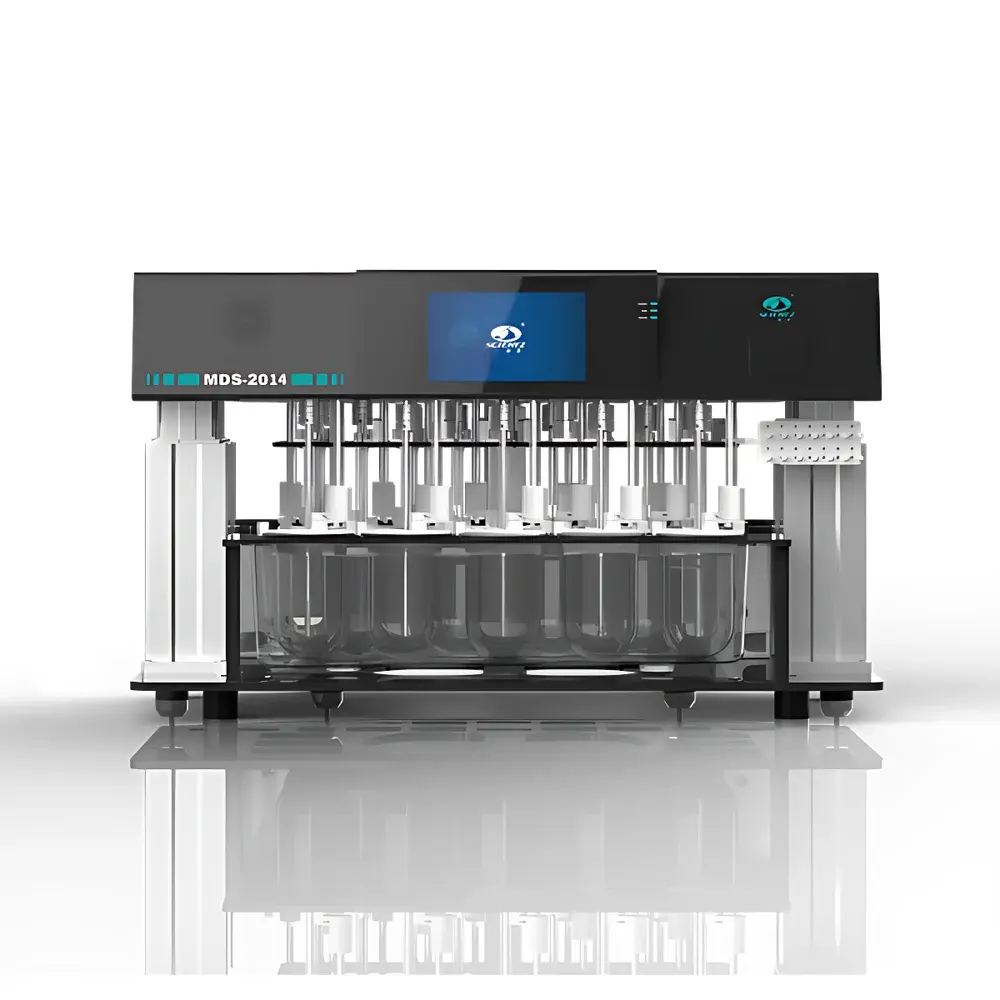
Ningbo Scientz MDS-2014DS Automated On-line Dissolution Tester
| Brand | Scientz |
|---|---|
| Origin | Zhejiang, China |
| Manufacturer Type | Direct Manufacturer |
| Instrument Type | On-line Dissolution Tester |
| Number of Vessels | 8 |
| Temperature Control Range | Ambient to 45 °C |
| Temperature Resolution | 0.01 °C |
| Temperature Accuracy | ±0.2 °C |
| Rotational Speed Range | 25–250 rpm |
| Paddle Wobble Amplitude | ≤0.5 mm |
| Basket Wobble Amplitude | ≤0.5 mm |
| Water Bath Volume | 32 L |
| Vessel Options | 250 mL and 1000 mL (amber glass option available) |
| Independent Temperature Monitoring | 14 built-in PT100 probes |
| User Interface | 10-inch color capacitive touchscreen |
| Method Storage Capacity | 144 protocols |
| Audit Trail Compliance | 3-tier user permission system with electronic signature support |
| Data Output | Built-in thermal printer + USB export (proprietary .scd format) |
| Automation Features | Auto-dosing module (simultaneous or sequential 8-vessel dosing), auto-level monitoring, voice status alerts, unattended pre-heating scheduling |
Overview
The Ningbo Scientz MDS-2014DS is an on-line, fully automated dissolution testing system engineered for compliance with international pharmacopeial standards—including USP General Chapter <711>, EP 2.9.3, and JP 17—while supporting Good Manufacturing Practice (GMP) and Good Laboratory Practice (GLP) operational requirements. It employs the paddle and basket methods (USP Apparatus 2 and 1) to quantitatively assess the rate and extent of drug substance release from solid oral dosage forms—including immediate- and extended-release tablets, capsules, transdermal patches, microspheres, and implantable matrices—into a simulated physiological medium under controlled hydrodynamic and thermal conditions. The system integrates real-time temperature monitoring, precision mechanical alignment, and closed-loop PID + fuzzy logic temperature control to ensure reproducible dissolution profiles across regulatory submissions, formulation development, and quality control workflows.
Key Features
- 8-Vessel On-line Architecture: Supports parallel dissolution testing with independent vessel positioning, dual-speed capability (7×2 configuration), and synchronized or staggered sampling cycles per ICH Q5C and USP guidance.
- High-Fidelity Mechanical Stability: Multi-point 316L stainless steel guide rods maintain head assembly rigidity; segmented shaft design enables rapid interchange between paddles, baskets, and small-volume adapters without recalibration of immersion depth.
- Vessel Integrity & Alignment System: Embedded circumferential clamping rings secure vessels in precise vertical alignment; diagonal fixing brackets and rim-mounted alignment indicators minimize inter-vessel positional variance—critical for hydrodynamic consistency per USP <711> Section 5.
- Evaporation Mitigation: V-shaped silicone-sealed cover plates conform precisely to vessel geometry, reducing solvent loss to <1.5% over 6-hour tests (validated per USP <724>). Amber glass 1000 mL vessels and integrated photosensitive lighting enable light-sensitive compound testing under ICH Q1B photostability-aligned conditions.
- Intelligent Thermal Management: 32 L monolithic injection-molded water bath with zero-dead-space corner design and quick-disconnect fittings enables full drainage and residue-free cleaning—supporting microbial control per FDA Aseptic Processing Guidance and EU Annex 1.
- Regulatory-Ready Software Interface: 10-inch capacitive touchscreen with bilingual (English/Chinese) UI, 144-method storage, USB-based method import/export, and audit-trail-enabled 3-tier access control (Administrator / Supervisor / Operator) compliant with 21 CFR Part 11 Subpart B requirements.
Sample Compatibility & Compliance
The MDS-2014DS accommodates diverse dosage forms per USP <724> and Ph. Eur. 2.9.3, including coated/uncoated tablets, hard/soft gelatin capsules, osmotic pumps, buccal films, and semi-solids such as ointments and gels. Its modular vessel system supports both standard 250 mL and 1000 mL configurations—with amber vessels qualified for photolabile APIs—and optional sinker fixtures for floating dosage forms. All mechanical components meet ISO 9001-certified manufacturing standards; vessel geometry, wobble tolerances (≤0.5 mm), and rotational speed accuracy (±0.5 rpm) are verified during factory IQ/OQ and documented per ASTM E2503-22 and USP <1092>. Full mechanical validation packages—including Performance Qualification (PQ) templates, Installation Qualification (IQ) checklists, and Operational Qualification (OQ) test protocols—are provided to support GxP-regulated environments.
Software & Data Management
Embedded firmware supports GLP-compliant data integrity through time-stamped, immutable event logging—including method execution history, parameter changes, temperature excursions, and user login/logout sequences. All logs are stored locally and exportable via USB in encrypted .scd format, readable only through Scientz’s validated data review software (v3.2+), which includes digital signature verification, electronic notebook integration, and CSV/PDF report generation. The system meets FDA 21 CFR Part 11 requirements for electronic records and signatures when deployed with enabled audit trail and role-based authentication. Optional AIQ (Analytical Instrument Qualification) documentation packages include risk assessments, URS alignment reports, and traceable calibration certificates for all critical sensors (PT100 probes, rpm encoders, thermal actuators).
Applications
- Comparative dissolution profiling for generic product development (BCS Class I–IV)
- Stability-indicating method development per ICH Q5C
- In vitro–in vivo correlation (IVIVC) model building
- Excipient screening and formulation robustness assessment
- Batch release testing in QC laboratories operating under GMP Annex 18
- Dissolution testing of complex generics (e.g., multiparticulates, implants, transdermals)
FAQ
Does the MDS-2014DS comply with 21 CFR Part 11?
Yes—the system implements electronic signature enforcement, audit-trail logging, and role-based access controls aligned with Subpart B requirements when configured with enabled security settings and validated software version 3.2 or later.
Can it perform synchronized multi-speed testing?
Yes—its 7×2 independent drive architecture allows two distinct speed profiles to run concurrently across eight vessels, enabling comparative studies such as paddle vs. basket or pH-shift experiments.
Is mechanical validation support included?
Scientz provides complete IQ/OQ documentation kits, PQ templates, and on-site mechanical verification services performed by certified field application engineers trained to ASTM E2503-22 and USP <1092> standards.
What temperature monitoring resolution is achieved during operation?
Each of the 14 embedded PT100 probes delivers real-time temperature readouts at 0.01 °C resolution, with active probe retraction during dissolution to eliminate hydrodynamic interference.
How is solvent evaporation controlled during long-duration tests?
The V-seal cover plate reduces evaporation to <1.5% over 6 hours; combined with ambient humidity compensation algorithms and closed-loop PID + fuzzy logic heating, it maintains media volume within ±2% tolerance throughout 24-hour dissolution runs.






