
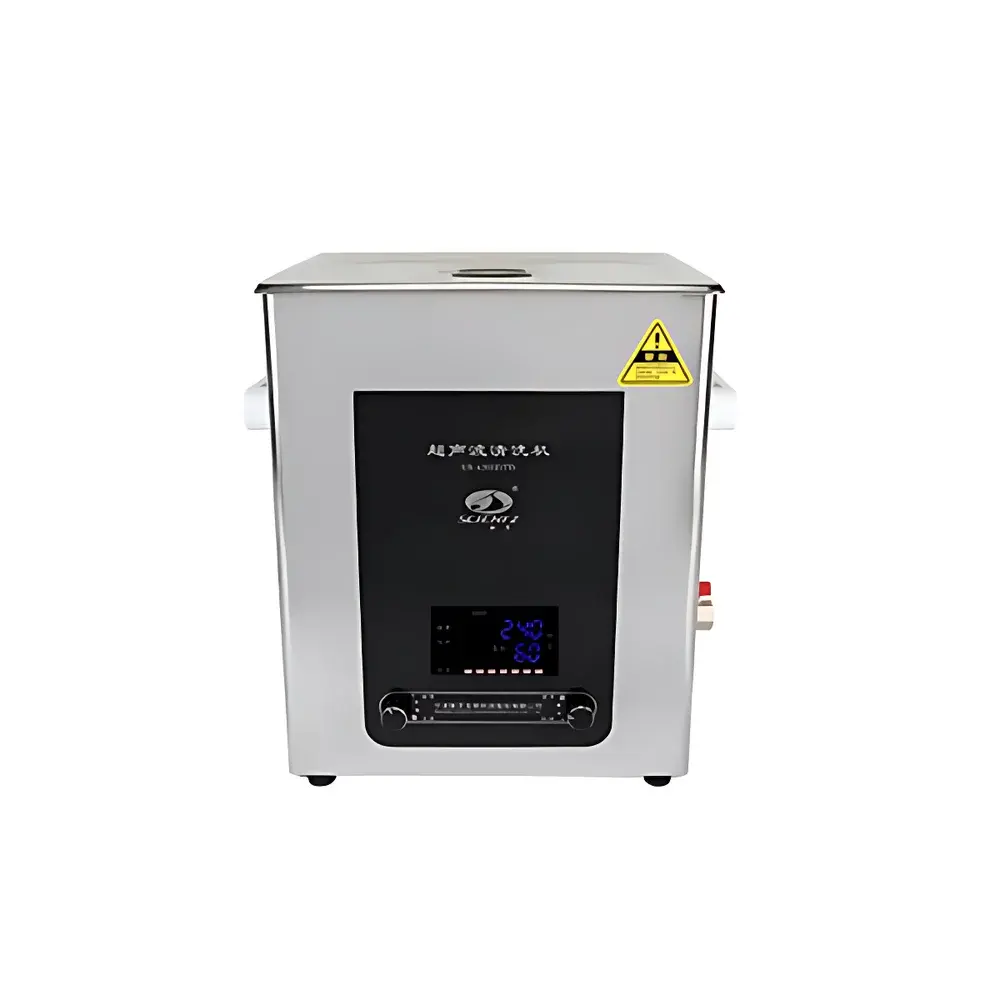
Ningbo Scientz SB-4200DTD Digital Ultrasonic Cleaner
| Brand | Ningbo Scientz |
|---|---|
| Origin | Zhejiang, China |
| Manufacturer Type | Direct Manufacturer |
| Instrument Type | General-Purpose Ultrasonic Cleaner |
| Tank Capacity | 14.4 L |
| Ultrasonic Frequency | 40 kHz |
| Ultrasonic Power Output | 400 W |
| Adjustable Power | Yes (40–100% in 10% increments) |
| Adjustable Heating | Yes (Room Temperature to 80 °C) |
| Adjustable Timer | Yes (1–999 min) |
| Sound-Dampening Lid | Included |
| Drain & Fill Fitting | Integrated |
Overview
The Ningbo Scientz SB-4200DTD Digital Ultrasonic Cleaner is an engineered solution for laboratory-scale precision cleaning based on the physical principle of acoustic cavitation. At its core, the device employs piezoelectric transducers bonded to the stainless-steel tank base to convert high-frequency electrical energy (40 kHz) into mechanical vibrations transmitted uniformly through deionized water or compatible aqueous cleaning solutions. This induces controlled nucleation and implosive collapse of microcavities—generating localized transient pressures exceeding 1000 atm and liquid jet velocities up to 400 m/s. These hydrodynamic forces effectively disrupt weak intermolecular adhesion (e.g., van der Waals, hydrogen bonding) between contaminants—including particulate debris, organic residues, biofilms, and thin oil films—and substrate surfaces without mechanical abrasion or thermal degradation. Designed for reproducible, non-contact cleaning of delicate components, the SB-4200DTD meets fundamental requirements for routine maintenance in analytical, pharmaceutical, and materials science laboratories where surface integrity and contamination control are critical.
Key Features
- Digital Precision Control: Microprocessor-driven interface with real-time digital display showing elapsed/remaining time and actual bath temperature (±1 °C accuracy), enabling strict adherence to validated cleaning protocols.
- Adjustable Ultrasonic Power: Linear 40–100% power modulation in 10% steps allows optimization for sensitive substrates (e.g., optical lenses, MEMS devices) versus robust industrial parts (e.g., metal injection molds).
- Programmable Heating System: PID-controlled heating element maintains stable bath temperatures from ambient to 80 °C, enhancing solubilization kinetics for waxy or polymer-based soils while supporting degassing applications.
- Integrated Safety Architecture: Automatic shutdown on lid open, overtemperature cutoff (>85 °C), and overload protection ensure compliance with IEC 61010-1 safety standards for laboratory equipment.
- Acoustic Isolation Design: Hinged stainless-steel sound-dampening lid reduces airborne noise to ≤55 dB(A) at 1 m distance—critical for shared lab environments and long-duration cycles.
- Service-Oriented Fluid Management: Front-mounted drain valve and fill port support rapid solution exchange and residue-free tank rinsing; tank interior features electropolished 316L stainless steel for corrosion resistance and low particle shedding.
Sample Compatibility & Compliance
The SB-4200DTD accommodates a broad range of sample geometries and material classes: glassware (volumetric flasks, cuvettes, chromatography vials), polymer-based consumables (centrifuge tubes, pipette tips), metallic components (surgical instruments, watch gears), and fragile optics (quartz cuvettes, microscope slides). It supports cleaning validation workflows aligned with ISO 13485 (medical device manufacturing), USP (cleaning of laboratory apparatus), and ASTM D2603 (ultrasonic cleaning performance testing). While not certified for sterilization per ISO 17665, it serves as a validated pre-sterilization step when paired with compatible biocidal agents. The unit complies with CE marking directives (EMC Directive 2014/30/EU, Low Voltage Directive 2014/35/EU) and RoHS 2011/65/EU material restrictions.
Software & Data Management
The SB-4200DTD operates as a standalone instrument without proprietary software dependencies. All operational parameters—including time, temperature setpoint, and power level—are stored in non-volatile memory and retained after power interruption (power-fail recovery). Though it lacks network connectivity or audit trail functionality, its deterministic digital controls support manual documentation per GLP/GMP Annex 11 principles: users may record batch-specific settings, cycle duration, and observed cleaning outcomes in laboratory notebooks or LIMS-integrated logbooks. For regulated environments requiring electronic records, integration with external data loggers (e.g., Omega OM-DAQPRO-5300) via analog voltage outputs (0–5 V for temperature, 0–10 V for power status) is technically feasible.
Applications
- Cleaning of volumetric glassware and plastic labware prior to trace elemental analysis (ICP-MS, AAS) to minimize background contamination.
- Removal of polishing compounds and residual oils from precision-engineered components in metrology labs.
- Preparation of surgical tools and dental handpieces under ISO 15883-compliant reprocessing guidelines (as part of multi-stage cleaning protocols).
- Deagglomeration and dispersion of nanomaterial suspensions (e.g., TiO₂, SiO₂ colloids) for DLS or TEM sample preparation.
- Accelerated solvent extraction of plant tissues or soil matrices in environmental chemistry workflows.
- Degassing of HPLC mobile phases and resin slurries to prevent pump cavitation and column void formation.
FAQ
What cleaning solutions are compatible with the SB-4200DTD?
Aqueous alkaline, neutral, or mildly acidic detergents approved for ultrasonic use (e.g., Alconox, Tergazyme) are recommended. Avoid halogenated solvents, strong oxidizers (e.g., undiluted nitric acid), or highly volatile organics unless explicitly validated for compatibility with 40 kHz transducers.
Can this unit be used for sterilization?
No. Ultrasonic cleaning removes bioburden but does not achieve sterility assurance levels (SAL ≤10⁻⁶). It functions as a critical pre-cleaning step before autoclaving, ethylene oxide, or vaporized hydrogen peroxide sterilization.
Is the tank volume truly 14.4 L usable capacity?
Yes—the nominal capacity reflects internal dimensions (300 × 240 × 200 mm) yielding 14.4 L of liquid volume at maximum fill line. Effective cleaning zone extends across ≥95% of this volume when operated within manufacturer-recommended load limits.
How often should the transducer array be serviced?
Under normal operation (≤8 hrs/day, distilled/deionized water), no scheduled transducer maintenance is required. Annual visual inspection for delamination or corrosion at the tank-transducer interface is advised.
Does the unit meet FDA 21 CFR Part 11 requirements?
No—this model lacks electronic signature capability, automated audit trails, or role-based access control. It is intended for research-use-only or non-GxP environments where manual recordkeeping suffices.



