
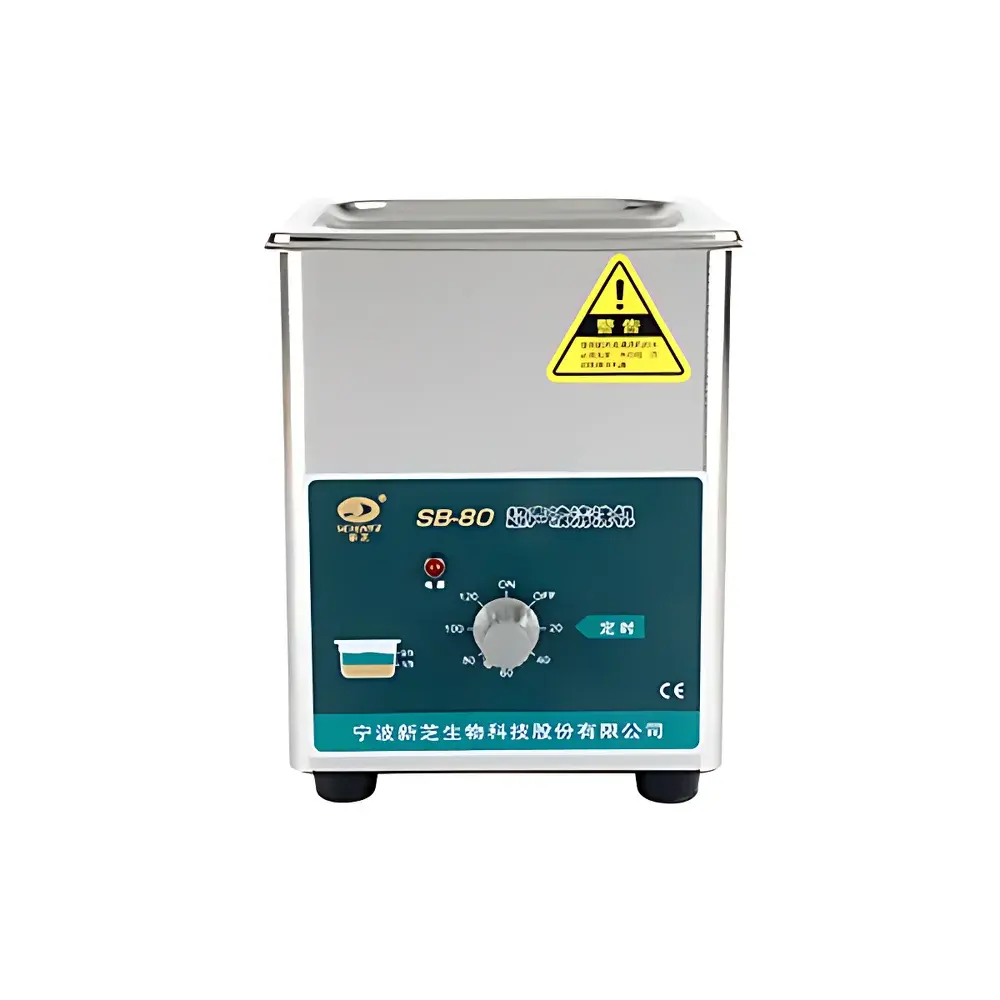
Ningbo Scientz SB-80 Benchtop Ultrasonic Cleaner
| Brand | Scientz |
|---|---|
| Origin | Zhejiang, China |
| Manufacturer Type | Direct Manufacturer |
| Product Category | Domestic (China-Made) |
| Model | SB-80 |
| Instrument Type | General-Purpose Ultrasonic Cleaner |
| Tank Capacity | 2 L |
| Ultrasonic Frequency | 40 kHz |
| Ultrasonic Power Output | 50 W |
| Timer Adjustment | Yes (1–999 min) |
| Sound-Dampening Lid | Included |
Overview
The Ningbo Scientz SB-80 is a compact, benchtop ultrasonic cleaner engineered for precision cleaning of delicate and complex laboratory components. It operates on the principle of acoustic cavitation: high-frequency mechanical vibrations (40 kHz) generated by piezoelectric transducers are transmitted through a liquid medium—typically aqueous or mild solvent-based cleaning solutions—inducing rapid formation and implosive collapse of microscopic vapor cavities. This transient cavitation generates localized shockwaves and microstreaming forces capable of dislodging particulate contaminants, organic residues, oils, and biofilms from surfaces, crevices, blind holes, and microstructures without mechanical abrasion or thermal degradation. Designed for routine use in analytical, pharmaceutical, biomedical, and materials science laboratories, the SB-80 delivers consistent cleaning performance with minimal operator intervention and no risk of surface scratching or dimensional alteration to sensitive substrates.
Key Features
- Benchtop Form Factor: Compact 2-liter tank volume enables integration into standard lab workspaces while supporting efficient cleaning of multiple small-to-medium items simultaneously—including pipette tips, vials, crucibles, microcentrifuge tubes, and optical components.
- Stable 40 kHz Operation: Optimized frequency balance between penetration depth and cavitation intensity—ideal for general-purpose removal of particulates, greases, and loosely adhered biological residues.
- Precise Digital Timer Control: Adjustable cleaning duration from 1 to 999 minutes with real-time countdown display; supports reproducible process validation and method standardization across shifts or users.
- Integrated Sound-Dampening Lid: Stainless-steel hinged lid reduces airborne noise emission during operation and minimizes solvent evaporation, enhancing workplace safety and environmental control.
- Durable Construction: Inner and outer tank walls, as well as the lid, fabricated from high-grade 304 stainless steel—resistant to corrosion, thermal stress, and repeated chemical exposure typical in lab cleaning protocols.
- Power Integrity & Safety: Built-in power protection circuitry ensures stable 50 W output delivery; automatic shutdown upon timer completion or abnormal load conditions prevents transducer overheating and extends system service life.
Sample Compatibility & Compliance
The SB-80 accommodates a broad range of sample types and materials commonly encountered in regulated and non-regulated laboratory environments. Compatible substrates include borosilicate glassware (e.g., volumetric flasks, cuvettes), fused silica optics, stainless-steel instruments, titanium surgical tools, aluminum fixtures, and polymer-based consumables (e.g., polypropylene centrifuge tubes). While not certified for sterile processing per ISO 13485 or FDA 21 CFR Part 820, its consistent cavitation profile supports cleaning steps aligned with ASTM D4297 (Standard Guide for Ultrasonic Cleaning of Laboratory Glassware) and USP (Cleaning and Sanitization of Laboratory Equipment). When used with validated cleaning agents and documented time/temperature parameters, it contributes to GLP-compliant cleaning workflows and audit-ready documentation.
Software & Data Management
The SB-80 operates via an embedded microcontroller interface with no external software dependency. All operational parameters—including elapsed time, remaining time, and power-on status—are displayed on a high-contrast LED screen. The unit retains user-defined timer settings after power interruption (non-volatile memory), enabling uninterrupted batch continuity and reducing procedural variability. Although it lacks USB or Ethernet connectivity, its deterministic behavior and digital repeatability make it suitable for inclusion in SOPs requiring traceable cleaning durations. For labs implementing electronic lab notebooks (ELNs) or LIMS integration, manual entry of cleaning parameters (e.g., “SB-80, 40 kHz, 50 W, 10 min, DI water + 0.5% detergent”) satisfies basic data integrity requirements under ALCOA+ principles.
Applications
- Cleaning of analytical glassware prior to HPLC, ICP-MS, or spectroscopic analysis to eliminate carryover and background interference.
- Preparation of cell culture vessels and microfluidic chips to ensure sterility and surface wettability.
- De-gassing of solvents and mobile phases to prevent bubble formation in chromatographic systems.
- Surface preparation of SEM/TEM sample stubs and AFM cantilevers to reduce artifact-inducing particulates.
- Removal of machining oils and metal fines from precision-engineered parts in R&D prototyping.
- Supporting sterilization prep for reusable dental handpieces and endoscopic accessories in clinical research settings.
FAQ
Is the SB-80 suitable for cleaning delicate optical lenses or quartz cuvettes?
Yes—its 40 kHz frequency and controlled 50 W output minimize surface erosion risk; however, use only low-surface-tension, non-ionic detergents and avoid prolonged exposure (>15 min) without solution refresh.
Can the unit be operated without the sound-dampening lid?
Operation without the lid is technically possible but not recommended: it increases ambient noise levels above 75 dB(A), accelerates solvent loss, and may compromise cleaning uniformity due to uncontrolled acoustic energy dissipation.
Does the SB-80 support heating or temperature control?
No—the base model SB-80 does not include a heater. Scientz offers optional variants (e.g., SB-80DT) with integrated thermostatic control for applications requiring elevated cleaning temperatures.
What maintenance is required for long-term reliability?
Routine tasks include periodic descaling of the tank using dilute acetic acid (5%) when mineral deposits accumulate, visual inspection of transducer bonding integrity, and replacement of degraded gaskets every 18–24 months under continuous use.
Is calibration or certification available for this instrument?
Scientz provides factory-installed verification of timer accuracy and power output consistency. Third-party calibration services for cavitation intensity (per ASTM E2810) can be arranged separately, though not included with standard purchase.



