
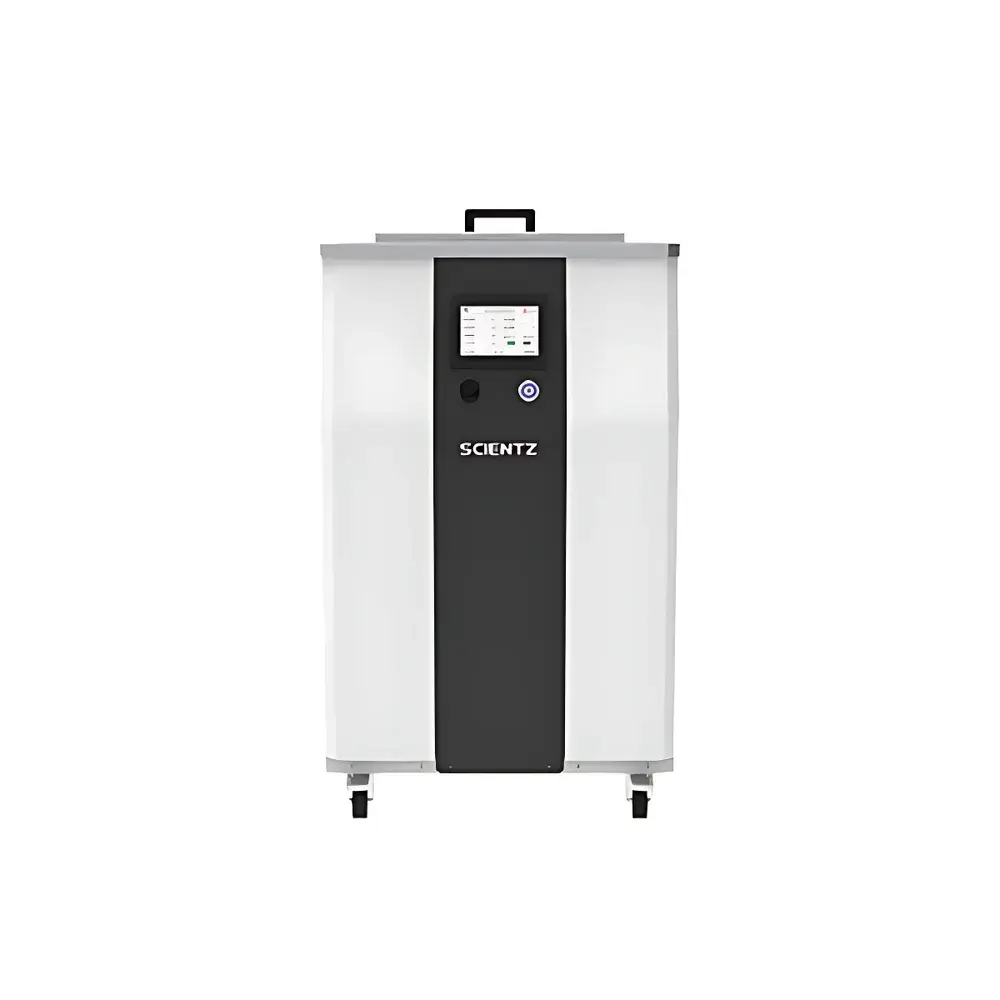
Ningbo Scientz SBL-54DT Benchtop Ultrasonic Cleaner with Heated & Cooled Temperature Control
| Brand | Ningbo Scientz |
|---|---|
| Origin | Zhejiang, China |
| Manufacturer Type | OEM/ODM Manufacturer |
| Instrument Type | General-Purpose Ultrasonic Cleaner |
| Tank Capacity | 54 L |
| Ultrasonic Frequency | 40 kHz |
| Ultrasonic Power Output | 1000 W |
| Power Adjustment | Yes (1–99% continuous) |
| Temperature Control Range | 5–80 °C (Heating & Active Cooling) |
| Timer Range | 1–9999 min |
| Lid with Sound-Dampening Design | Yes |
| Drain Option | Manual and Optional Automatic Drain Kit |
| Compliance | CE-marked per IEC 61000-6-3 (EMC), IEC 61000-6-2 (Immunity) |
Overview
The Ningbo Scientz SBL-54DT is a benchtop ultrasonic cleaner engineered for reproducible, high-efficiency cleaning of laboratory and industrial components where precision surface integrity and contamination control are critical. It operates on the principle of acoustic cavitation: high-frequency mechanical vibrations (40 kHz) generated by piezoelectric transducers bonded to the stainless-steel tank bottom propagate through the cleaning medium (typically aqueous or solvent-based solutions), inducing transient microbubble formation and collapse. This implosive cavitation generates localized pressures exceeding 1000 atm and microjet velocities >400 m/s—sufficient to dislodge submicron particulates, organic residues, biofilms, and hydrophobic contaminants from complex geometries including blind holes, capillary channels, and porous surfaces—without mechanical abrasion or thermal degradation.
Key Features
- Integrated dual-mode thermal management: resistive heating (up to 80 °C) and active thermoelectric cooling (down to 5 °C), enabling temperature-sensitive applications such as enzymatic decontamination or cold-process degassing.
- Full-range ultrasonic power modulation (1–99% in 1% increments), allowing optimization for delicate optics, fragile ceramics, or heavily soiled metal parts without over-cavitation damage.
- High-resolution capacitive touchscreen interface with real-time display of elapsed time, set temperature, actual bath temperature (±0.5 °C accuracy), and active power level.
- Intelligent power interruption recovery: all user-defined parameters—including timer, temperature setpoint, and power level—are retained in non-volatile memory after unexpected power loss.
- Sound-dampened hinged lid with safety interlock prevents ultrasonic energy leakage and reduces ambient noise to ≤55 dB(A) at 1 m distance—meeting ISO 7779 and ANSI S12.10 requirements for laboratory acoustic environment.
- 316L stainless-steel tank (54 L usable volume) with reinforced corners and seamless welds; compatible with common alkaline, acidic, and neutral detergents per ASTM D4169 and ISO 15883-1 protocols.
Sample Compatibility & Compliance
The SBL-54DT accommodates a wide range of sample types and materials: borosilicate glassware (vials, cuvettes, pipette tips), polymer consumables (centrifuge tubes, microplates), medical-grade stainless-steel instruments (surgical forceps, endoscope components), optical elements (lens assemblies, fiber-optic connectors), and precision machined parts (fuel injectors, bearing races). Its design adheres to key regulatory expectations for analytical and quality control laboratories: temperature and time parameters are digitally logged with timestamped audit trails (optional USB export), supporting compliance with FDA 21 CFR Part 11 (when paired with Scientz LabControl™ software), ISO/IEC 17025 clause 7.7 (equipment management), and EU GMP Annex 15 (validation of cleaning processes). All electrical subsystems conform to IEC 61010-1 for laboratory equipment safety.
Software & Data Management
While the SBL-54DT operates autonomously via its onboard controller, optional integration with Scientz LabControl™ v3.2 (Windows-based) enables remote parameter programming, batch protocol storage (up to 99 methods), real-time graphing of temperature vs. time profiles, and CSV-formatted data export for QC documentation. The software supports electronic signature capture and role-based access control—facilitating alignment with ALCOA+ data integrity principles (Attributable, Legible, Contemporaneous, Original, Accurate) required under WHO TRS 996 and PIC/S PI 007-6.
Applications
- Routine decontamination of volumetric glassware and plastic labware prior to trace-metal analysis (e.g., ICP-MS sample prep).
- Removal of residual photoresist, flux, or oxide layers from semiconductor wafers and MEMS devices.
- Pre-sterilization cleaning of reusable surgical instruments per AAMI ST79:2017 guidelines.
- Ultrasonic-assisted extraction of plant metabolites or nucleic acids from tissue homogenates.
- Degassing of HPLC mobile phases and cell culture media to eliminate dissolved oxygen-induced oxidation artifacts.
- Cleaning of high-value optical components—including microscope objectives and interferometric mirrors—where particle counts must remain below ISO 14644 Class 5 thresholds.
FAQ
What is the maximum recommended operating temperature for aqueous cleaning solutions?
The unit supports stable operation up to 80 °C; however, for standard alkaline detergent formulations, 55–65 °C is optimal to balance cleaning efficacy with solution stability and material compatibility.
Can the SBL-54DT be validated for use in regulated pharmaceutical manufacturing?
Yes—when operated with documented IQ/OQ protocols and paired with LabControl™ software, it meets core requirements for cleaning equipment qualification under EU GMP Annex 15 and USP .
Is automatic drain functionality included or optional?
Manual drain is standard; an electrically actuated solenoid drain kit (part #SBL-DRN-KIT) is available as a field-installable option.
Does the unit support external temperature probe input for bath-level monitoring?
No—the built-in Pt100 sensor provides direct tank-bottom temperature measurement; external probe inputs are not supported in this model variant.
What maintenance intervals are recommended for transducer performance verification?
Annual calibration of ultrasonic power output (per ASTM E1727) and thermal sensor accuracy (traceable to NIST standards) is advised for GxP environments; daily visual inspection of tank integrity and lid seal is required.



