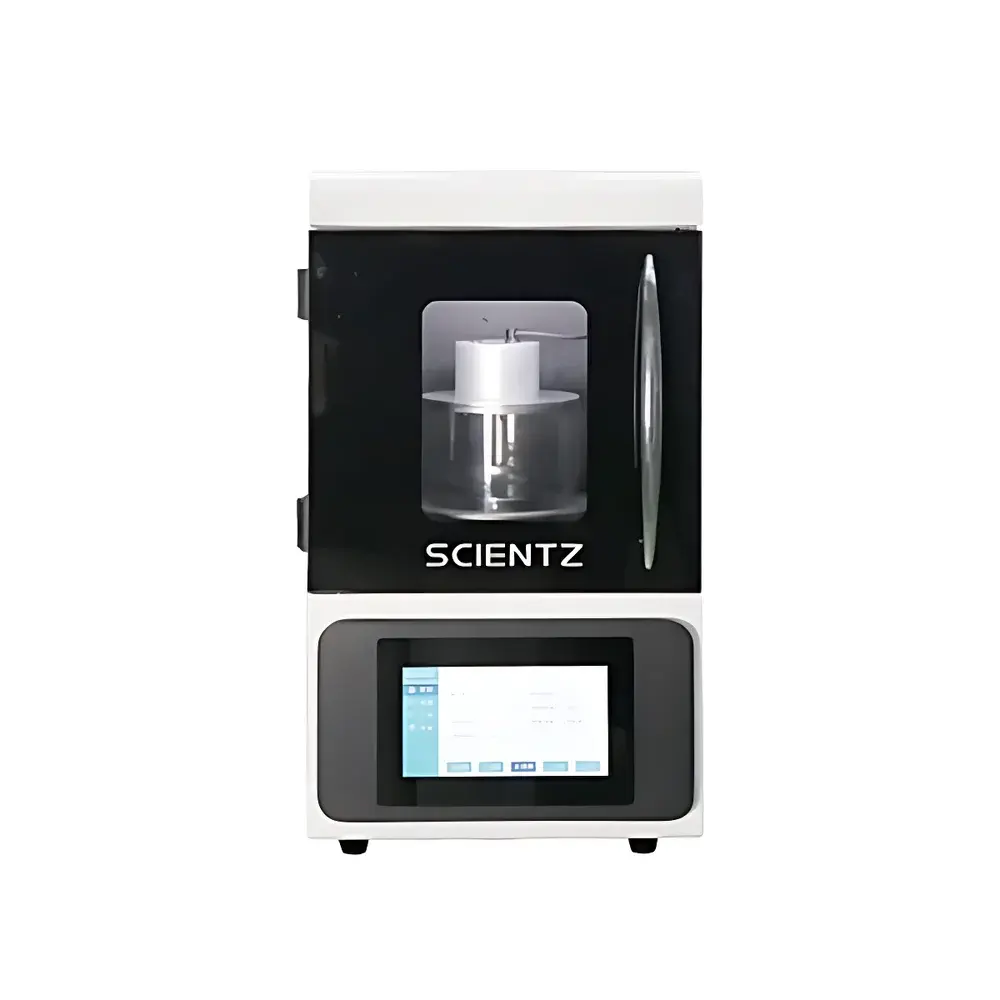
Ningbo Scientz SCIENTZ-08-IIIC Non-Contact Cup-Horn Ultrasonic Cell Disruptor
| Brand | Ningbo Scientz |
|---|---|
| Origin | Zhejiang, China |
| Manufacturer Type | Direct Manufacturer |
| Instrument Type | Non-Contact Ultrasonic Cell Disruptor |
| Ultrasonic Power Output | 1800 W |
| Operating Frequency | 20 kHz (±0.5 kHz) |
| Sample Volume Capacity | 900 mL |
| Sample Throughput | 1 tube per cycle (rotating holder supports single-tube continuous rotation) |
| Temperature Control | Integrated jacketed cup with external chiller compatibility (4–10 °C typical operational range) |
| Cooling Interface | Dual-layer borosilicate glass cup with external recirculating coolant port |
| Minimum Sample Volume | 5 µL |
| Acoustic Isolation | Built-in acoustic enclosure with transparent viewing window |
| Compliance | Designed for GLP-compliant workflows |
Overview
The Ningbo Scientz SCIENTZ-08-IIIC is a non-contact, cup-horn-style ultrasonic cell disruptor engineered for high-fidelity, reproducible lysis of biological samples under controlled thermal conditions. Unlike probe-based sonicators, this system employs focused ultrasonic energy transmitted through the walls of a sealed, double-jacketed borosilicate glass cup—eliminating direct transducer contact with the sample. This architecture inherently prevents cross-contamination, probe erosion particulates, and aerosol generation, making it suitable for biosafety level 2 (BSL-2) and higher applications including mycobacterial lysis and viral chromatin preparation. The device operates at a fundamental frequency of 20 kHz (±0.5 kHz), delivering up to 1800 W of acoustic power with precise duty-cycle and amplitude control. Its primary use case centers on chromatin shearing for ChIP-seq, native ChIP, and other epigenomic assays where fragment size distribution, reproducibility, and nucleic acid integrity are critical performance metrics.
Key Features
- Non-contact acoustic coupling: Energy transmission via a water-coupled cup horn eliminates physical probe insertion, ensuring zero sample contamination and eliminating consumable wear.
- Temperature-stabilized processing: Dual-layer glass cup integrates with external chillers to maintain sample temperatures between 4–10 °C—critical for preserving protein–DNA interactions during chromatin fragmentation.
- Rotating sample holder: Motor-driven continuous rotation of the centrifuge tube ensures uniform exposure to the acoustic field, minimizing localized hotspots and improving inter-sample consistency.
- High-efficiency thermal exchange: Optimized wall geometry and coolant flow path in the jacketed cup yield superior heat dissipation versus standard bath sonicators.
- Micro-volume compatibility: Validated for consistent lysis of as little as 5 µL of nuclear suspension—enabling precious clinical or low-input single-cell derived samples to be processed without dilution.
- Integrated acoustic shielding: Fully enclosed cabinet with laminated acrylic viewport reduces ambient noise to <65 dB(A) at 1 m, meeting laboratory occupational safety thresholds.
Sample Compatibility & Compliance
The SCIENTZ-08-IIIC accommodates standard microcentrifuge tubes (1.5–2.0 mL), cryovials, and custom cylindrical vessels up to 900 mL total volume. It has been validated for lysis of Gram-positive and Gram-negative bacteria, yeast, mammalian cells (including primary neurons and stem cells), and tissue homogenates. The closed-system design complies with WHO BSL-2 containment recommendations and supports workflows aligned with CLIA, CAP, and ISO 15189 pre-analytical standards. When operated with audit-trail-capable external chillers and logged parameter settings, the instrument supports traceability required under FDA 21 CFR Part 11 for regulated bioanalytical laboratories.
Software & Data Management
While the SCIENTZ-08-IIIC operates via an embedded tactile interface with programmable time, amplitude, and pulse parameters, full traceability requires integration with external lab information systems (LIS) or electronic lab notebooks (ELN). Users may export timestamped operation logs (start/stop time, power setting, cycle count) via USB. For GxP environments, we recommend pairing with a validated chiller equipped with RS485 or Ethernet output to capture real-time coolant temperature and flow rate—enabling correlation of thermal drift with fragment size distribution data generated downstream by Bioanalyzer or TapeStation.
Applications
- Chromatin immunoprecipitation (ChIP) and CUT&RUN/CUT&Tag sample preparation
- Shearing of crosslinked and native chromatin for next-generation sequencing library construction
- Extraction of membrane proteins and inclusion bodies from recombinant E. coli
- Preparation of subcellular fractions for proteomics and metabolomics
- Disruption of tough-walled microorganisms (e.g., Mycobacterium smegmatis, Bacillus subtilis)
- Homogenization of frozen tissue sections prior to RNA extraction
- Emulsification and nano-dispersion of lipid-based delivery systems
FAQ
Is the SCIENTZ-08-IIIC compatible with automated liquid handlers?
Yes—its footprint and height allow integration into semi-automated workcells; however, robotic arm access requires third-party mounting brackets and I/O signal interfacing.
Can I validate the sonication efficiency using standard reference materials?
Yes—NIST-traceable DNA shearing standards (e.g., NA12878 genomic DNA) are routinely used to establish fragment size distributions via capillary electrophoresis; we provide application notes outlining SOPs for such qualification.
Does the system support multi-tube parallel processing?
No—the rotating single-tube holder is optimized for uniform energy delivery; parallel processing requires multiple units or alternative platforms such as focused-ultrasonicator arrays.
What chiller specifications are recommended for sustained 4 °C operation?
A recirculating chiller with ≥1 L/min flow rate, ±0.1 °C temperature stability, and 10–15 °C minimum setpoint is required; we list qualified models in the technical appendix.
How often does the cup require calibration or verification?
Annual verification of acoustic power output using calorimetric methods (per ASTM E2810) is recommended; cup integrity should be inspected visually before each use for microfractures or etching.