
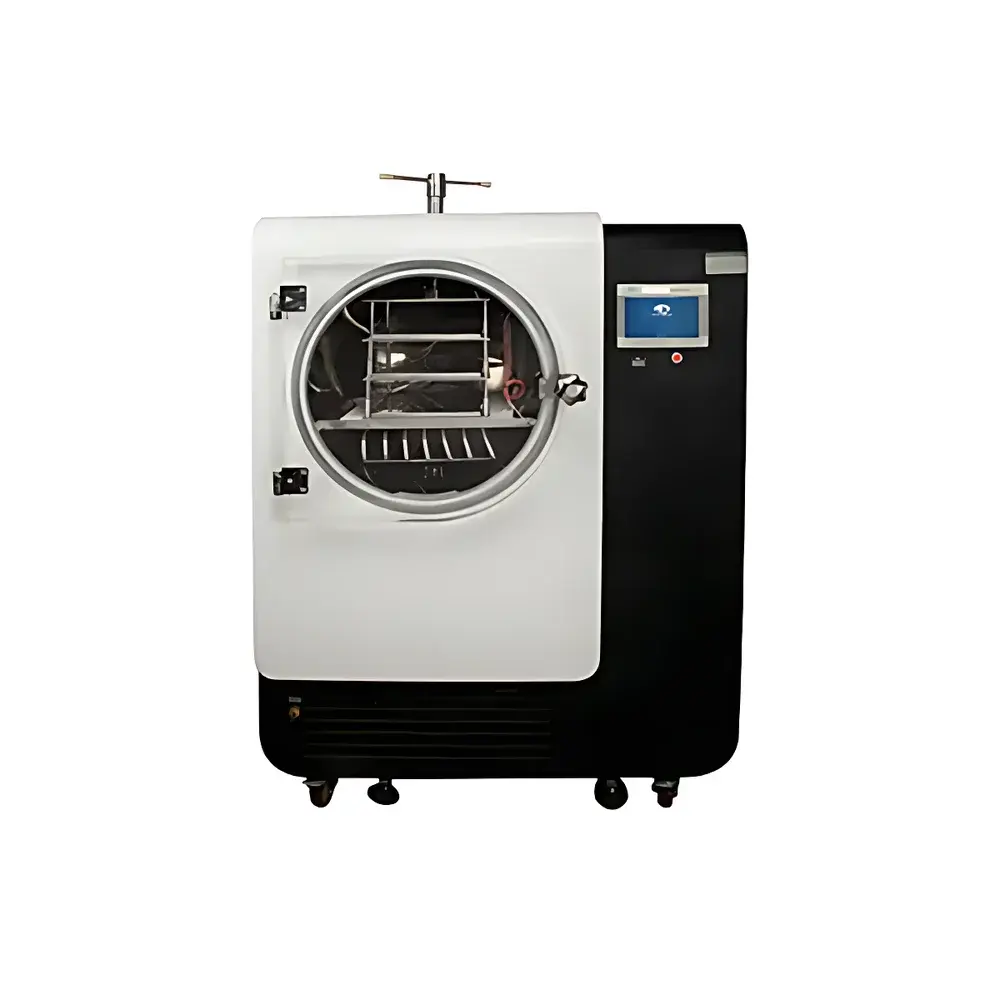
Ningbo Scientz SCIENTZ-100YG/B Silicon-Oil Heated Shelf-Type Freeze Dryer
| Brand | Ningbo Scientz |
|---|---|
| Origin | Zhejiang, China |
| Manufacturer Type | Direct Manufacturer |
| Instrument Type | Shelf-Type (In-Situ) Freeze Dryer |
| Application Scale | Pilot-Scale |
| Lyophilization Area | 0.21 m² |
| Ultimate Vacuum (Empty Chamber) | ≤5 Pa |
| Condensate Capacity | 4 kg/24 h |
| Cold Trap Temperature (Empty) | ≤−70 °C |
| Dimensions (L×W×H) | 750 × 640 × 1200 mm |
Overview
The Ningbo Scientz SCIENTZ-100YG/B is a pilot-scale, in-situ silicon-oil heated shelf-type freeze dryer engineered for precise, reproducible lyophilization of thermally sensitive biological, pharmaceutical, and environmental samples. It operates on the fundamental principles of sublimation under deep vacuum: frozen water is removed directly from the solid to vapor phase without passing through the liquid state, preserving structural integrity, bioactivity, and chemical stability. Unlike resistance-heated or steam-jacketed systems, this model employs a closed-loop silicon-oil circulation system to regulate shelf temperature—enabling accurate, uniform thermal control across all shelves during both freezing and primary/secondary drying stages. Its integrated cold trap and drying chamber architecture minimizes footprint while maintaining robust vacuum integrity and thermal separation between condensation and sample zones. Designed for method development and small-batch process validation, the SCIENTZ-100YG/B supports GLP-aligned workflows in academic, governmental, and industrial R&D laboratories.
Key Features
- Silicon-oil heating system with PID algorithm control ensures ±3 °C temperature uniformity across shelves after equilibrium—critical for consistent drying kinetics and product homogeneity.
- Pilot-scale capacity with 0.21 m² shelf area and 4 kg/24 h condensate removal rate, suitable for batch sizes ranging from 1–5 L total volume.
- Integrated cold trap operating at ≤−70 °C (empty), equipped with high-efficiency refrigeration using imported compressors and real-time pressure monitoring for compressor protection.
- PLC-based programmable controller with color touchscreen interface; supports up to 40-segment temperature/vacuum profiles per cycle, with automatic data logging of shelf temperature, cold trap temperature, chamber pressure, and silicon-oil temperature.
- Three-tier user permission system (Operator / Technician / Administrator) compliant with audit trail requirements for regulated environments.
- Transparent polycarbonate drying chamber—single-piece molded, corrosion-resistant, non-porous, and vacuum-tight—enables full visual monitoring of ice sublimation and cake formation.
- Configurable vacuum management: programmable vacuum pump start delay (based on cold trap temperature), cumulative pump runtime tracking, optional oil mist filter, and auto differential-pressure valve to prevent backstreaming.
Sample Compatibility & Compliance
The SCIENTZ-100YG/B accommodates diverse sample formats including vials (2–50 mL), Petri dishes, trays, and custom T-frame configurations (optional). It is routinely deployed for lyophilizing aqueous solutions containing proteins, peptides, enzymes, vaccines, nucleic acids, microbial cultures, soil extracts, plant tissues, food matrices, and polymer dispersions. The system meets mechanical and operational prerequisites for adherence to ISO 22000 (food safety), ASTM F2476 (lyophilization process validation), and USP (sterile processing considerations). While not pre-certified for GMP manufacturing, its data integrity features—including timestamped parameter logging, U盘-exportable CSV files, and optional UPS backup—support 21 CFR Part 11 readiness when paired with validated software protocols.
Software & Data Management
All process parameters are recorded at user-defined intervals (1–60 s) and stored internally with time-stamped metadata. Historical cycles can be replayed graphically via the onboard HMI or exported to USB for offline analysis in Excel or MATLAB. Optional PC-based upper-computer software enables remote monitoring, multi-unit fleet management, and report generation compliant with laboratory quality systems. Freeze-drying curves may be duplicated, edited, and archived indefinitely; alarm logs—including ambient overtemperature warnings and vacuum deviation events—are retained in tabular format with severity tagging and resolution timestamps.
Applications
- Pharmaceutical R&D: formulation screening of injectables, stability studies of biologics, and lyoprotectant optimization for monoclonal antibodies and mRNA-LNPs.
- Food science: preservation of probiotics, enzymatic extracts, and functional ingredients while retaining volatile compounds and sensory attributes.
- Environmental analysis: preparation of soil, sediment, and wastewater sludge samples for elemental speciation (e.g., ICP-MS) and organic contaminant profiling (e.g., GC-MS).
- Cultural heritage conservation: controlled dehydration of water-damaged archival documents and parchment without hydrolytic degradation.
- Agricultural research: stabilization of fungal spores, plant tissue explants, and seed priming agents for long-term storage and viability assessment.
- Academic training: hands-on instruction in mass transfer theory, heat balance modeling, and critical point determination (via optional eutectic temperature probe).
FAQ
What is the difference between “in-situ” and “manifold” freeze drying?
In-situ lyophilization refers to freezing and drying occurring within the same chamber, eliminating manual transfer and enabling precise shelf temperature control throughout all phases—essential for reproducible pilot-scale process development.
Can the SCIENTZ-100YG/B be used for sterile processing?
It is not supplied with ISO 5 cleanroom certification or SIP capability; however, the stainless-steel (SUS304) frame and smooth internal surfaces allow for validated cleaning-in-place (CIP) procedures prior to aseptic filling operations.
Is the vacuum level adjustable during the drying cycle?
Yes—vacuum setpoints can be programmed per drying segment, and optional vacuum regulation valves enable dynamic pressure control to optimize sublimation rate and minimize collapse risk.
What refrigerant is used in the cooling system?
The unit employs environmentally compliant R404A or R507 refrigerant (depending on production batch), compatible with standard service infrastructure and aligned with current EU F-Gas Regulation thresholds.
Does it support automated nitrogen backfilling?
An optional nitrogen purge interface is available, allowing programmable inert gas introduction post-drying to prevent oxidation and facilitate vial stoppering under controlled atmosphere.



