
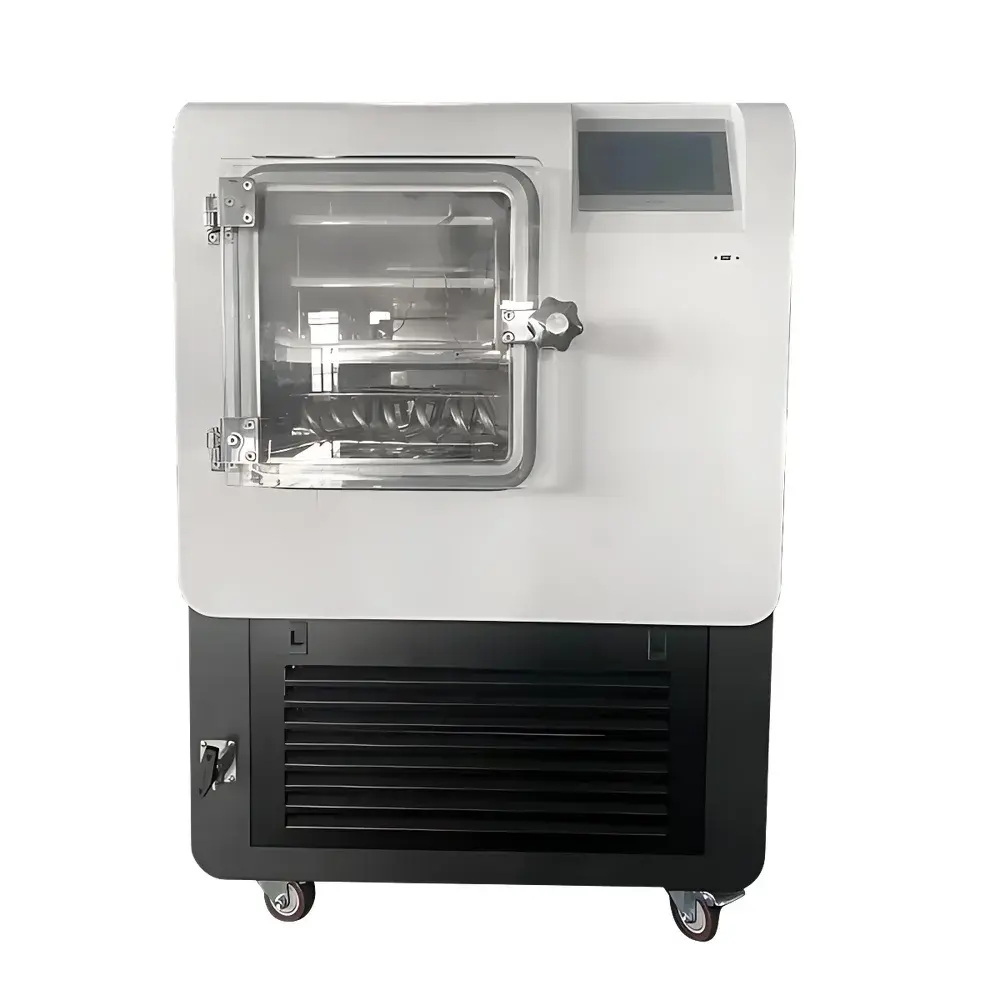
Ningbo Scientz SCIENTZ-20F/A Benchtop Pilot-Scale Silicone Oil Manifold Freeze Dryer
| Brand | Ningbo Scientz |
|---|---|
| Origin | Zhejiang, China |
| Manufacturer Type | OEM/ODM Manufacturer |
| Product Category | Domestic |
| Model | SCIENTZ-20F/A |
| Instrument Type | Standard Shelf-Type Freeze Dryer |
| Application Scale | Pilot-Scale |
| Lyophilization Area | 0.21 m² |
| Ultimate Vacuum (No Load) | ≤5 Pa |
| Ice Capacity (24 h) | 4 kg/24 h |
| Cold Trap Temperature (No Load) | ≤−70 °C |
| Dimensions (L×W×H) | 750 × 640 × 1200 mm |
Overview
The Ningbo Scientz SCIENTZ-20F/A is a pilot-scale, silicone oil–heated, in-situ freeze dryer engineered for precise thermal control and reproducible lyophilization of thermally sensitive biologicals, pharmaceuticals, and high-value research materials. It operates on the fundamental principle of sublimation under deep vacuum: frozen water is removed directly from the solid phase to vapor without passing through the liquid state, preserving macromolecular conformation, enzymatic activity, structural integrity, and chemical stability. This process is critical for stabilizing labile biologics—including monoclonal antibodies, viral vectors, plasmid DNA, serum proteins, live attenuated vaccines, and microbial cultures—where conventional drying methods induce denaturation or aggregation. The SCIENTZ-20F/A integrates a dual-stage cascade refrigeration system capable of achieving ≤−70 °C cold trap temperature (no load), ensuring efficient vapor capture and maintaining low-pressure stability throughout primary and secondary drying phases. Its in-situ shelf heating architecture eliminates the need for external pre-freezing, enabling direct freezing, annealing, and controlled ramping within the same chamber—essential for optimizing critical process parameters such as shelf temperature ramp rate, hold time at eutectic point, and residual moisture endpoint.
Key Features
- Silicone oil–based shelf heating system delivering ±1 °C temperature uniformity across the entire 0.21 m² drying surface (RA ≤ 0.5 µm surface finish, flatness tolerance ±0.5 µm)
- Industrial-grade PLC controller with 7-inch full-color touchscreen interface supporting real-time monitoring of shelf temperature, product temperature (via optional Pt100 probes), vacuum pressure, and cold trap temperature
- Pre-programmed and user-definable drying profiles: up to 40 recipes stored internally, each containing up to 40 editable segments (linear ramp, slope-controlled ramp, hold-at-temperature with timer)
- Comprehensive data logging with automatic timestamped storage; historical cycle replay, USB export for offline analysis, and audit-trail compliance per FDA 21 CFR Part 11 requirements
- Dual-chamber design with corrosion-resistant stainless steel cold trap (external coil configuration for easy cleaning) and optically clear aviation-grade acrylic door for visual process monitoring
- Integrated vacuum regulation system featuring a custom-engineered, corrosion-resistant vacuum pump (optional oil mist filter and auto differential pressure valve to prevent backstreaming)
- Multi-level access control (operator, engineer, administrator) supporting GMP-aligned operational accountability and change management protocols
- Uninterruptible power support readiness: automatic data save on power loss; optional UPS integration ensures continuity during transient grid events
Sample Compatibility & Compliance
The SCIENTZ-20F/A accommodates diverse sample formats including serum vials, glass bottles (2–50 mL), Petri dishes, scintillation vials, and custom trays—compatible with both open-container and stoppered configurations. Its design meets essential regulatory expectations for laboratory-scale lyophilization equipment used in GLP and early-phase GMP environments. While not certified as a Class A cleanroom device, its construction adheres to ISO 13485–aligned material specifications (316 stainless steel cold trap, food-grade silicone gaskets, non-outgassing internal coatings). The system supports validation documentation packages—including IQ/OQ templates—and interfaces with external temperature mapping tools for chamber qualification per ASTM F2697 and USP . It is routinely deployed in settings requiring traceable, repeatable drying cycles for reference standard preparation, stability study execution, and formulation development.
Software & Data Management
The embedded control software provides deterministic, event-driven cycle execution with configurable alarms (e.g., high ambient temperature, vacuum breach, shelf overtemperature). All process variables are logged at user-selectable intervals (1–60 s) and archived with digital signatures. Exported .csv files contain complete metadata: operator ID, batch number, start/stop timestamps, alarm logs, and parameter setpoints. Optional remote supervision is available via Ethernet-enabled mobile application (iOS/Android), allowing secure monitoring of active cycles and push notifications for critical status changes. Data integrity safeguards include write-protection of historical records, immutable audit trails, and role-based editing permissions—fully aligned with ALCOA+ principles for regulated laboratories.
Applications
This system serves cross-disciplinary applications requiring structural preservation and functional recovery post-drying: lyophilization of bacterial and fungal cultures for strain banking; stabilization of recombinant enzymes and diagnostic reagents; preparation of nanoparticle suspensions and catalyst precursors to inhibit agglomeration; dehydration of botanical extracts and traditional herbal compounds without thermal degradation; soil and sediment matrix drying for trace metal analysis (EPA Method 5035); archival drying of archival documents and museum specimens; and small-batch production of oral disintegrating tablets and ophthalmic dosage forms. It is widely adopted in university core facilities, national institutes (e.g., Chinese Academy of Sciences, CAAS), provincial CDCs, and biotech startups engaged in preclinical formulation work.
FAQ
What is the maximum batch capacity for vial-based lyophilization?
Based on 0.21 m² shelf area and standard 10 mL serum vials (20 mm diameter), typical loading is ~330 vials per cycle.
Does the system support eutectic point determination?
Yes—optional co-integrated freeze-drying microscope or external eutectic analyzer (e.g., DSC or impedance-based systems) can be synchronized via analog I/O or Modbus TCP.
Is the cold trap condenser accessible for maintenance?
Yes—the external coil design allows full access to the condenser surface without disassembly; cleaning is performed using ethanol or isopropanol wipes.
Can the SCIENTZ-20F/A be integrated into a cleanroom environment?
It is rated for ISO Class 8 (Class 100,000) environments; optional HEPA-filtered air purge and static-dissipative housing upgrades are available upon request.
What validation support is provided?
Scientz supplies IQ/OQ protocol templates, calibration certificates for integrated sensors (traceable to NIST standards), and FAT/SAT documentation packages for turnkey installation verification.



