
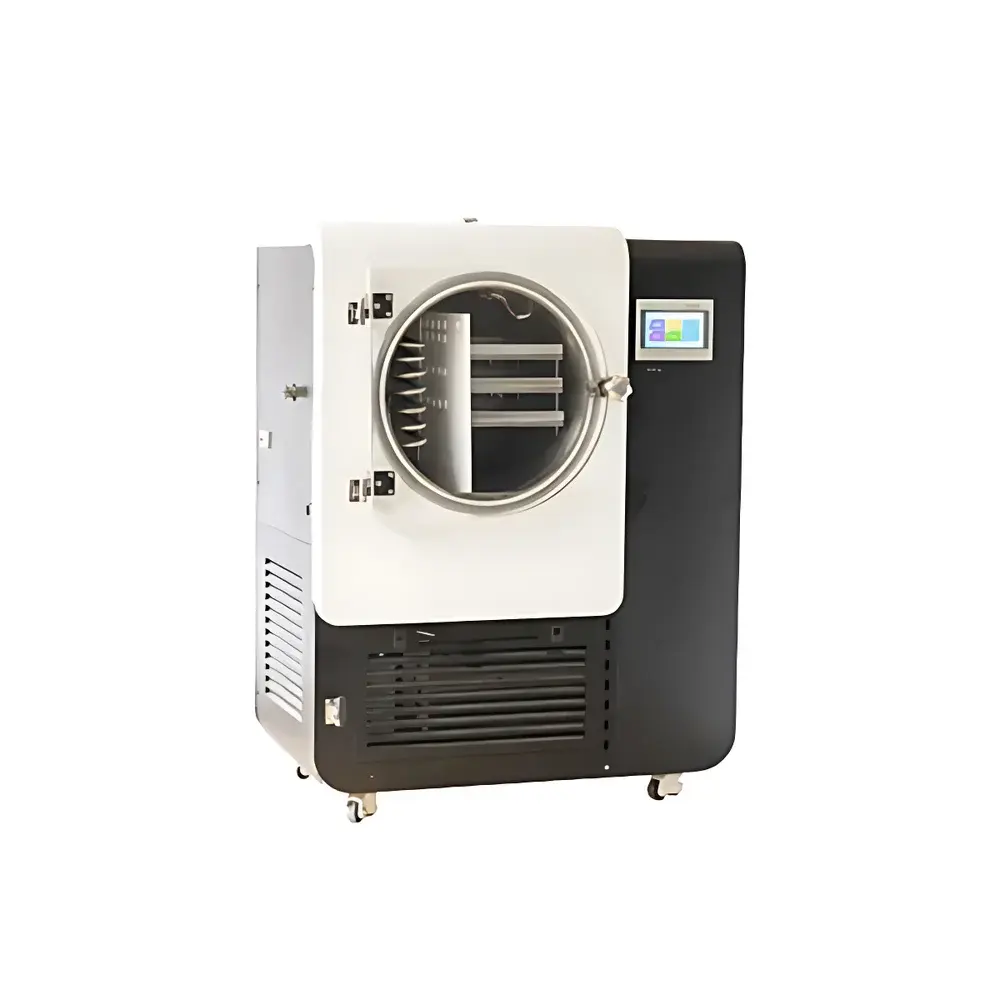
Ningbo Scientz SCIENTZ-30YG/A Benchtop Silicon-Oil Heated Pilot-Scale Freeze Dryer
| Brand | Ningbo Scientz |
|---|---|
| Origin | Zhejiang, China |
| Manufacturer Type | OEM Manufacturer |
| Instrument Type | Standard Shelf-Type Freeze Dryer |
| Application Scope | Pilot-Scale Development |
| Lyophilization Area | 0.21 m² |
| Ultimate Vacuum (Empty Chamber) | ≤5 Pa |
| Condensate Capacity (24 h) | 4 kg/24 h |
| Cold Trap Temperature (Empty) | ≤−70 °C |
| Dimensions (L×W×H) | 750 × 640 × 1200 mm |
Overview
The Ningbo Scientz SCIENTZ-30YG/A is a pilot-scale, silicon-oil heated, in-situ freeze dryer engineered for reproducible lyophilization process development and small-batch production under controlled thermal and vacuum conditions. It operates on the fundamental principles of sublimation—removing water from frozen samples via primary drying (ice sublimation under vacuum) followed by secondary drying (desorption of bound moisture)—with precise regulation of shelf temperature, chamber pressure, and cold trap performance. Unlike resistance-heated systems, this model employs a closed-loop silicon-oil circulation system to deliver uniform thermal energy across all shelves, minimizing axial and radial temperature gradients (<±3 °C after stabilization). Its integrated cold trap and drying chamber architecture reduces footprint while maintaining structural integrity per ISO 22081 and ASTM F2697 compliance frameworks for laboratory freeze drying equipment. Designed for GLP-aligned workflows, the unit supports full traceability of critical process parameters—including shelf temperature, product temperature (via optional PT100 probes), vacuum level, and condenser load—enabling robust method transfer from R&D to scale-up.
Key Features
- Integrated silicon-oil heating/cooling system with PID-controlled thermal management for ±0.5 °C setpoint accuracy and <±3 °C inter-shelf uniformity
- Stainless steel 304 frame construction with corrosion-resistant surface finish compliant with ISO 14644-1 Class 8 cleanroom compatibility
- PLC-based control system with 7-inch true-color touchscreen interface supporting multi-level user permissions (operator, engineer, administrator)
- Up to 40-segment programmable freeze-drying cycles, with selectable linear or ramped heating profiles and real-time deviation alerts
- Automated vacuum sequencing: vacuum pump activation delayed until cold trap reaches preset temperature (e.g., −60 °C), extending pump service life and reducing oil contamination risk
- Onboard data logging with automatic timestamped storage of shelf temperature, chamber pressure, cold trap temperature, and silicon-oil loop status
- USB export capability for raw CSV datasets; compatible with third-party LIMS and ELN platforms via standard RS485/Modbus RTU protocol
- Optional accessories include inert gas (N₂ or Ar) purge valve, eutectic point measurement module, external T-frame support, and -80 °C cascade refrigeration upgrade
Sample Compatibility & Compliance
The SCIENTZ-30YG/A accommodates vials (10–50 mL), trays (up to 200 mm × 200 mm), and custom sample holders for heterogeneous matrices including biological tissues, microbial cultures, pharmaceutical suspensions, soil extracts, botanical specimens, and polymer solutions. Its 0.21 m² shelf area and 4 kg/24 h condensation capacity align with USP requirements for small-scale lyophilization validation studies. The unit meets IEC 61000-6-3 (EMC) and IEC 61010-1 (safety) standards. Vacuum system design incorporates optional oil mist filter and auto-balanced differential vacuum valve to prevent backstreaming—critical for FDA 21 CFR Part 11–compliant environments where audit trails and electronic signature integrity are mandated. All wetted parts contact-grade materials conform to USP Class VI biocompatibility testing.
Software & Data Management
The embedded control firmware records ≥10,000 data points per cycle at user-configurable intervals (1–60 s), storing time-stamped values for shelf temperature, chamber pressure, cold trap temperature, and silicon-oil inlet/outlet delta-T. Data files are saved in UTF-8 encoded CSV format with header metadata (cycle ID, operator ID, start/end timestamps, alarm log summary). USB port enables direct export to Windows/Linux workstations; optional PC-based software provides curve overlay comparison, statistical process control (SPC) charting, and PDF report generation with digital signature fields. Remote monitoring is supported via Ethernet (TCP/IP) or optional Wi-Fi module, enabling integration into centralized lab infrastructure management systems. Audit trail functionality logs all parameter changes, user logins, and alarm acknowledgments with immutable timestamps—fully compliant with ALCOA+ data integrity principles.
Applications
This freeze dryer serves cross-disciplinary research and quality control applications requiring high-fidelity process mapping and batch consistency. In food science labs, it supports optimization of freeze-dried fruit powders, probiotic formulations, and ready-to-eat pet nutrition products. Environmental laboratories utilize it for soil and sediment sample stabilization prior to heavy metal or organic contaminant analysis (EPA Method 5035A). Academic pharmacology groups apply it to lyophilize monoclonal antibodies, mRNA-LNP complexes, and herbal extract fractions under low-temperature desiccation protocols. Cultural heritage institutions deploy it for non-destructive dehydration of archival documents and parchment artifacts. Additionally, it fulfills QC needs in agrochemical residue testing (AOAC 2007.01), forensic toxicology sample prep, and nanomaterial dispersion preservation—where residual moisture content must remain <1.5% w/w per ISO 13485 Annex A guidelines.
FAQ
What is the maximum batch size supported by the SCIENTZ-30YG/A?
Based on its 0.21 m² shelf area and 4 kg/24 h condensate capacity, typical batch loads range from 1.2–3.0 L of aqueous solution (assuming 5–15% solids content), corresponding to ~1.5–2.5 kg total mass per cycle.
Does the system support real-time product temperature monitoring?
Yes—optional calibrated PT100 sensors can be inserted directly into representative vials or trays; temperature readings are synchronized with shelf and chamber data streams in the control log.
Is the unit suitable for GMP manufacturing environments?
While classified as a pilot-scale R&D instrument, its PLC architecture, electronic audit trail, user access controls, and data export capabilities meet foundational requirements for Stage 1–2 process validation per ICH Q5C and Q8(R2); full GMP qualification requires site-specific IQ/OQ/PQ protocols.
Can the vacuum level be actively regulated during primary drying?
Yes—the optional vacuum regulation module enables dynamic pressure control between 1–50 Pa using feedback from a capacitance manometer, facilitating optimized sublimation rates without ice collapse.
What refrigeration upgrade options are available?
A cascade compressor configuration is available to achieve ≤−80 °C cold trap temperature, recommended for low-eutectic-point formulations such as protein buffers or high-concentration polysaccharide solutions.



