
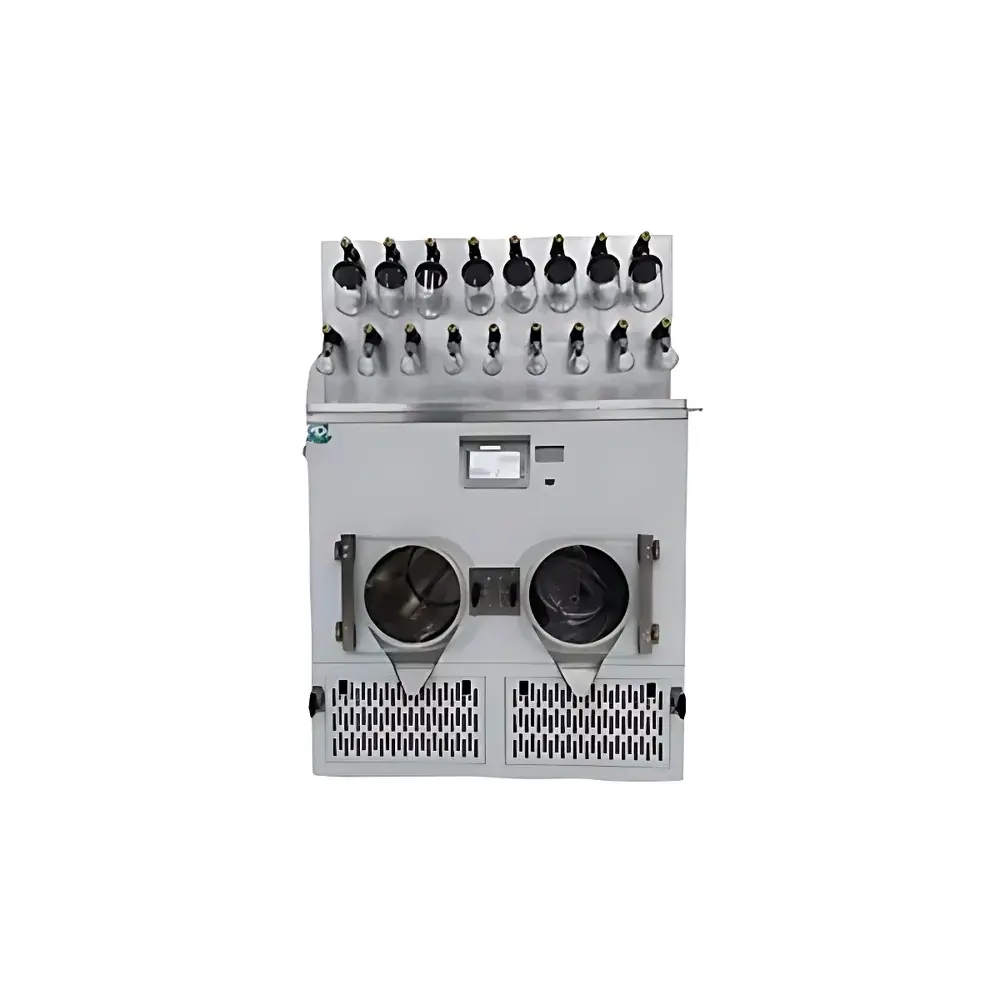
Ningbo Scientz SCIENTZ-34T T-Frame Dual Cold Trap Freeze Dryer
| Brand | Ningbo Scientz |
|---|---|
| Origin | Zhejiang, China |
| Manufacturer Type | Direct Manufacturer |
| Instrument Type | Standard Shelf-Type Freeze Dryer |
| Application Scale | Pilot-Scale |
| Lyophilization Area | 0.21 m² |
| Ultimate Vacuum (No Load) | ≤5 Pa |
| Condensate Capacity (24 h) | 4 kg/24 h |
| Cold Trap Temperature (No Load) | ≤−70 °C |
| Dimensions (L×W×H) | 750 × 640 × 1200 mm |
Overview
The Ningbo Scientz SCIENTZ-34T is a pilot-scale T-frame freeze dryer engineered for continuous, high-reliability lyophilization in R&D laboratories and small-batch production environments. Unlike conventional single-cold-trap systems, the SCIENTZ-34T integrates a dual independent cold trap architecture—each equipped with its own dedicated Embraco (Italy-sourced) hermetic compressor—to eliminate operational downtime during defrost cycles. This design implements true alternating condensation operation: while one cold trap actively captures water vapor under vacuum, the other undergoes active defrosting via electric heating and drainage, without interrupting the primary drying process. The system maintains stable chamber vacuum and thermal integrity throughout transition phases, preventing sample collapse, melt-back, or bubble formation—a critical requirement for thermolabile biologics, pharmaceutical intermediates, and sensitive research specimens. Its working principle relies on sublimation under deep vacuum (≤5 Pa) at cryogenic condensation temperatures (≤−70 °C), enabling efficient removal of bound and unbound moisture from frozen matrices while preserving structural integrity and bioactivity.
Key Features
- Dual independent cold traps with three Embraco compressors (two for primary condensation, one redundant or load-balanced)—enabling uninterrupted 24/7 operation
- T-frame mechanical architecture supporting simultaneous loading/unloading of 34 wide-mouth or 34 flask-type vessels via rubber-sealed valves
- Automated cold trap switching logic: triggered by ice mass detection or user-defined time intervals (24 h / 48 h)
- Integrated defrost management: automatic heating, condensate drainage, and post-defrost recooling sequence with vacuum hold capability
- Stainless steel chamber and cold trap housings compliant with ISO 14644-1 Class 7 cleanroom-compatible surface finish
- Front-access service panel for rapid maintenance of compressors, vacuum lines, and electrical controls
Sample Compatibility & Compliance
The SCIENTZ-34T accommodates standard lyophilization vessels including 20–50 mL wide-mouth glass bottles and 25–100 mL Erlenmeyer (flask-type) containers, secured via 34 individually controllable silicone-sealed valves. It supports aqueous, buffer-based, and low-viscosity formulations typical in vaccine development, enzyme stabilization, and natural product preservation. The system meets mechanical safety requirements per IEC 61010-1 and electromagnetic compatibility per EN 61326-1. While not certified for GMP manufacturing, its architecture supports GLP-compliant documentation workflows—including manual logbook integration—and is compatible with external audit-ready data capture when paired with validated third-party SCADA systems. Vacuum performance aligns with ASTM F2338-04 (Standard Test Method for Measuring Moisture Permeation Through Packaging Materials) reference conditions.
Software & Data Management
The SCIENTZ-34T operates via an embedded industrial-grade HMI (Human-Machine Interface) with tactile buttons and a 7-inch resistive LCD display. It provides real-time monitoring of chamber pressure, cold trap temperatures (both units), condensate accumulation status, and compressor runtime. All setpoints—including target vacuum, shelf temperature (if optional heated shelf installed), and defrost timing—are configurable and stored in non-volatile memory. Event logs record start/stop timestamps, trap switching events, defrost initiation/completion, and alarm triggers (e.g., overpressure, compressor fault). Data export is supported via USB 2.0 port in CSV format. Though the unit does not natively support FDA 21 CFR Part 11 electronic signatures or audit trail encryption, its deterministic control logic and timestamped event logging enable retrospective validation in regulated environments when used within documented SOP frameworks.
Applications
- Pilot-scale lyophilization of monoclonal antibodies, recombinant proteins, and plasmid DNA formulations
- Stabilization of probiotic cultures, diagnostic reagents, and reference standards for QC labs
- Preparation of porous scaffolds for tissue engineering and nanomaterial composites
- Moisture removal from botanical extracts, fermented broths, and microbial lysates without thermal degradation
- Method development and cycle optimization prior to transfer to industrial-scale freeze dryers
FAQ
Does the SCIENTZ-34T support shelf temperature control?
No—the SCIENTZ-34T is a manifold-style (non-shelf-heating) freeze dryer. Product temperature is controlled solely via chamber pressure and cold trap efficiency. Optional heated shelves are not available for this model.
Can both cold traps operate simultaneously during normal drying?
No—by design, only one cold trap is active during lyophilization; the second remains in standby or defrost mode to ensure optimal condensation surface area and vacuum stability.
What vacuum pump is recommended for optimal performance?
A two-stage oil-lubricated rotary vane pump with ≥4 m³/h pumping speed and ultimate vacuum ≤1×10⁻² mbar is advised. Dry scroll pumps may be used but require careful evaluation of vapor load tolerance.
Is remote monitoring or Ethernet connectivity available?
Not natively—the system lacks built-in Ethernet, Wi-Fi, or Modbus interfaces. Integration with external supervisory systems requires analog signal tapping or USB-based periodic data pull.
How is compliance with ISO 22000 or USP <1211> addressed?
The unit itself is not certified to these standards; however, its repeatable vacuum/temperature profiles, traceable event logging, and robust mechanical design facilitate alignment with USP <1211> lyophilization process validation principles when incorporated into a site-specific quality system.



