
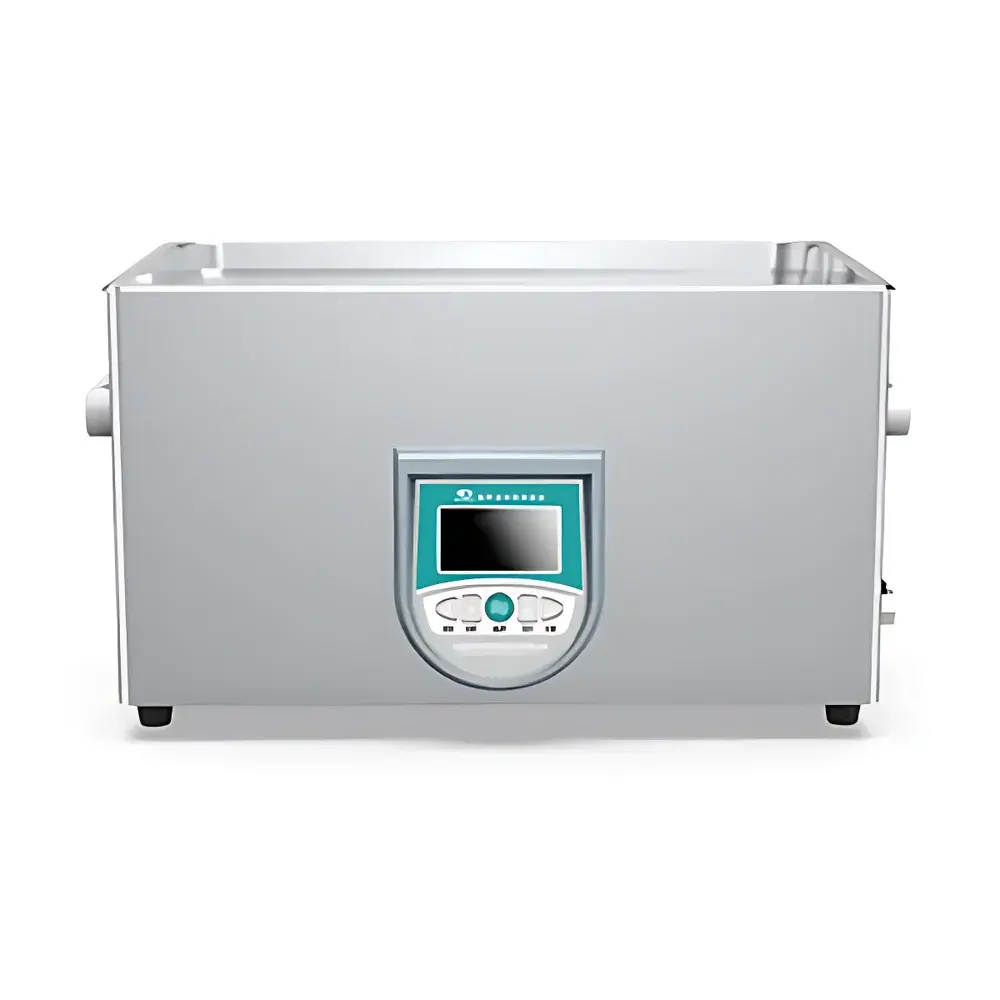
Ningbo Scientz UTE-720 Ultrasonic Herbal Extraction System
| Brand | Ningbo Scientz |
|---|---|
| Origin | Zhejiang, China |
| Manufacturer Type | Direct Manufacturer |
| Country of Origin | China |
| Model | UTE-720 |
| Ultrasonic Power | 720 W (0–100% adjustable) |
| Tank Capacity | 22.5 L |
| Temperature Control Range | Ambient to 80 °C |
| Timer Range | 1–999 min |
| Construction | Stainless Steel (Interior & Exterior Housing + Sound-Dampening Lid) |
| Frequency Options | Multi-frequency (compliant with Chinese Pharmacopoeia requirements) |
Overview
The Ningbo Scientz UTE-720 Ultrasonic Herbal Extraction System is an engineered solution for laboratory-scale and pilot-scale phytochemical isolation, designed specifically to meet the rigorous methodological standards outlined in the Chinese Pharmacopoeia (ChP). It operates on the principle of high-intensity ultrasonic cavitation—where piezoelectric transducers convert high-frequency electrical energy into mechanical vibrations transmitted through the tank wall into the extraction solvent. This induces transient microbubble formation, growth, and violent collapse (inertial cavitation), generating localized shockwaves, microstreaming, and shear forces exceeding 104 Pa at the solid–liquid interface. These physical effects disrupt plant cell walls and enhance mass transfer kinetics without thermal degradation, enabling efficient release of thermolabile bioactive compounds—including alkaloids, flavonoids, saponins, and polysaccharides—from complex botanical matrices.
Key Features
- Adjustable Ultrasonic Power Output: Precisely tunable from 0% to 100% of nominal 720 W output, allowing optimization across diverse herb particle sizes, solvent viscosities, and target compound polarities.
- Integrated Temperature Regulation: PID-controlled heating system maintains solvent temperature between ambient and 80 °C with ±1.5 °C accuracy, critical for preserving heat-sensitive constituents and complying with ChP monograph stipulations.
- Digital Timer with Memory Function: Programmable extraction duration from 1 to 999 minutes; automatic power-off and parameter retention upon unexpected power interruption ensures protocol reproducibility and GLP-aligned workflow integrity.
- Corrosion-Resistant Construction: Fully stainless steel (304 grade) tank interior, exterior housing, and acoustically damped lid provide long-term resistance to organic solvents (e.g., ethanol, methanol, ethyl acetate) and aqueous acidic/basic media.
- Multi-Frequency Compatibility: Designed to accommodate interchangeable transducer modules operating at frequencies aligned with ChP-recommended ranges (e.g., 25 kHz, 40 kHz, 60 kHz), supporting method development per herb-specific extraction protocols.
- Real-Time Operational Feedback: Large backlit LCD displays set time, actual elapsed time (countdown), temperature setpoint, and real-time power level—enabling full traceability during extraction runs.
Sample Compatibility & Compliance
The UTE-720 accommodates dried, powdered, or sliced herbal materials—including roots (e.g., Angelica sinensis), barks (e.g., Cinnamomum cassia), flowers (e.g., Chrysanthemum morifolium), and seeds (e.g., Semen Strychni)—within its 22.5 L capacity tank. Solvent compatibility includes water, ethanol/water mixtures, methanol, acetone, and low-concentration acid/base solutions. All operational parameters align with ChP General Chapters 2201 (Extraction Methods) and 2202 (Determination of Extractive Values). While not certified to ISO/IEC 17025, the system supports method validation under GLP and GMP frameworks when integrated with documented SOPs, calibration logs, and audit-ready electronic records.
Software & Data Management
The UTE-720 operates via embedded firmware without external PC dependency. However, all parameter settings—including time, temperature, power level, and start/stop timestamps—are stored in non-volatile memory and can be manually logged for batch documentation. For laboratories requiring 21 CFR Part 11 compliance, optional RS-232 or USB-to-serial interfaces enable integration with validated LIMS or ELN platforms for automated data capture, user authentication, and electronic signature support—subject to site-specific validation protocols.
Applications
- Standardized preparation of reference extracts for HPLC/UHPLC method development and validation
- Routine quality control testing of raw herbal materials per ChP specifications
- Preliminary screening of extraction efficiency across solvent systems and frequency settings
- Supporting pharmacognosy research on cell wall disruption kinetics and compound diffusion profiles
- Small-batch production of botanical actives for preformulation studies in TCM product development
FAQ
Is the UTE-720 compliant with international pharmacopoeial standards beyond the Chinese Pharmacopoeia?
The system’s operational flexibility (frequency, temperature, power, timing) enables alignment with USP <511> and EP 2.8.27 guidelines for ultrasonic-assisted extraction, though formal certification requires lab-specific method validation.
Can the unit be used with flammable solvents such as hexane or diethyl ether?
No. The UTE-720 lacks explosion-proof certification and is not rated for Class I, Division 1 hazardous environments. Use only with solvents having flash points above 60 °C.
What maintenance is required for sustained cavitation performance?
Transducer coupling surfaces must be inspected monthly for delamination or corrosion; tank bottom should be cleaned after each use to prevent residue buildup affecting acoustic transmission efficiency.
Does the system support continuous operation over multiple cycles without cooldown?
Yes—its forced-air cooling system permits uninterrupted operation up to 999 minutes per cycle; however, extended >4-hour runs require periodic solvent replenishment and thermal equilibrium verification.
How is traceability ensured for regulatory submissions?
All user-defined parameters are retained in device memory; laboratories must implement supplementary procedural controls (e.g., logbooks, screen-photo documentation, or interfaced ELN entries) to satisfy ALCOA+ data integrity principles.



