
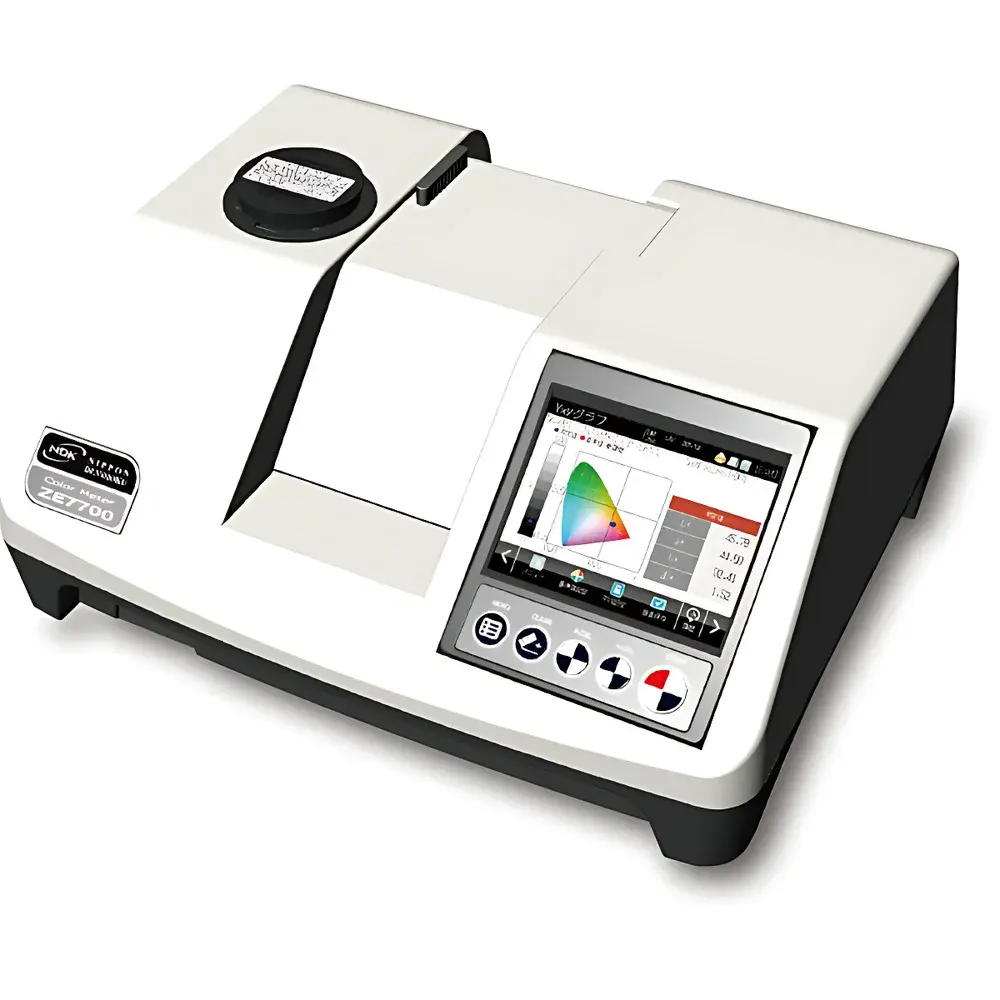
NIPPON DENSHOKU NE5500 Benchtop Spectrophotometric Color Difference Meter
| Brand | NIPPON DENSHOKU |
|---|---|
| Origin | Japan |
| Model | NE5500 |
| Instrument Type | Benchtop |
| Optical Geometry | 8°/diffuse (d) for reflectance |
| Light Source | White LED (rated lifetime: 20,000 h) |
| Spectral Range | 400–700 nm (10 nm interval) |
| Repeatability | ΔE*ab ≤ 0.03 |
| Measurement Time | ~6.5 s |
| Aperture Options (Reflectance) | LAV Φ22 mm (Φ28 mm), MAV Φ6 mm (Φ10 mm), SAV Φ4 mm (Φ6 mm) |
| Aperture (Transmittance) | Φ12 mm |
| Display | 5.7-inch TFT color LCD |
| Data Storage | Internal memory (100 reference + 2,000 measurement records), SD card (FAT32), CSV export |
| Interfaces | USB, parallel port, SD slot |
| Operating Environment | 15–35 °C, ≤80 % RH (non-condensing) |
| Power | AC 100–240 V, 50/60 Hz, ≤25 VA |
| Dimensions & Weight | 425 × 350 × 188 mm, ~8 kg |
Overview
The NIPPON DENSHOKU NE5500 is a high-precision benchtop spectrophotometric color difference meter engineered for rigorous industrial and laboratory color quality control. Based on dual-beam, post-dispersion optical architecture with a diffraction grating monochromator and CMOS linear image sensor, it delivers spectral reflectance and transmittance data across the visible spectrum (400–700 nm at 10 nm intervals). Its 8°/diffuse (8/d) geometry for reflectance measurements complies with ISO 7724-1, CIE No. 15, and ASTM E308, ensuring compatibility with international colorimetric standards. For transmittance, the 0°/0° configuration enables accurate evaluation of clear liquids, films, and transparent solids—critical in pharmaceutical, chemical, and polymer applications where batch-to-batch color consistency must be quantified objectively and traceably.
Key Features
- Stable white LED illumination with 20,000-hour operational lifetime—eliminates lamp replacement cycles and associated photometric drift.
- Triple aperture system (LAV/MAV/SAV) for flexible sample coverage: accommodates large-area coatings (Φ22 mm), small printed areas (Φ6 mm), or fine particulates (Φ4 mm), all with standardized field-of-view calibration.
- Open-sliding transmission chamber with 110 mm wide access and spring-loaded sample holder—enables rapid loading of rigid plates up to 25 mm wide, standard cuvettes (up to 10 mm path length), and disposable test tubes without alignment tools.
- Real-time dual-illuminant display: simultaneous L*a*b* values under two user-selected CIE illuminants (e.g., D65 and A), essential for metamerism assessment in pigment formulation and quality release testing.
- Comprehensive color space support: XYZ, Yxy, L*a*b*, L*C*h*, CIELAB, CIELCH, plus specialized indices including YI (ASTM E313-05 & D1925), whiteness (CIE, ASTM), yellowness index (WI), and APHA/Gardner scales for liquid clarity grading.
- Advanced color difference algorithms: ΔE*ab, ΔE94, ΔE00, and ΔE(CMC) with configurable tolerances—enabling pass/fail decisions aligned with internal QC specifications or customer-facing color acceptance criteria.
Sample Compatibility & Compliance
The NE5500 supports heterogeneous sample forms without accessory dependency: solid surfaces (painted panels, molded plastics), opaque powders (pigments, cement), translucent gels, viscous liquids (inks, syrups), thin films (PET, PVC), and rigid substrates (glass, metal sheets). Its mechanical design meets IEC 61010-1 safety requirements for laboratory equipment. All color calculations adhere to CIE 15:2018 and ISO/CIE 11664 series standards. When used with optional color management software, audit trails, user authentication, and electronic signatures comply with FDA 21 CFR Part 11 for regulated environments—including pharmaceutical excipient color verification and cosmetic raw material release per USP .
Software & Data Management
Data acquisition and reporting are fully supported via the proprietary NE5500 PC software, which enables full spectral data export (CSV), comparative analysis across multiple batches, and generation of GLP-compliant reports with timestamped metadata. Internal memory stores 100 reference spectra and 2,000 measurement records; SD card (FAT32) extends storage for long-term trend analysis. USB interface allows direct instrument control from Windows-based workstations. The system supports automated calibration verification using certified ceramic tiles traceable to NIST SRM 2035, and includes coefficient-based data correction for legacy method alignment. Parallel port output facilitates integration with legacy label printers for on-floor QC documentation.
Applications
- Paint & Coatings: Batch matching of automotive OEM finishes and architectural paints against master standards under D65 and F10 illuminants.
- Pharmaceuticals: Quantitative color assessment of tablets, capsules, and liquid suspensions per USP , including yellowing detection in API stability studies.
- Food & Beverage: Objective evaluation of fruit pulp browning, dairy product yellowness (WI), and beverage clarity (APHA) across production lines.
- Plastics & Polymers: Monitoring thermal degradation-induced discoloration in extruded profiles and injection-molded components.
- Ink & Printing: Spot color verification on packaging substrates, especially critical for brand-critical CMYK overprints requiring ΔE00 < 1.0.
- Cement & Construction Materials: Standardized gray scale assessment of Portland cement and ready-mix concrete pigments per ASTM C150.
FAQ
What is the spectral resolution and sampling interval of the NE5500?
The instrument acquires spectral data at 10 nm intervals across 400–700 nm, yielding 61 discrete wavelength channels. It does not provide sub-nanometer resolution; its design prioritizes repeatability and industrial robustness over ultra-fine spectral discrimination.
Can the NE5500 measure metamerism quantitatively?
Yes—it calculates metameric index (MI) and displays side-by-side L*a*b* values under two simultaneously selected illuminants (e.g., D65 and A), enabling objective assessment of visual color match failure under varying lighting conditions.
Is the device compliant with FDA 21 CFR Part 11 for electronic records?
The hardware supports audit trail logging and user-level access control when operated with the validated NE5500 software suite. Full Part 11 compliance requires site-specific validation, including electronic signature implementation and secure backup procedures.
What is the maximum thickness of a solid sample that can be placed on the reflectance stage?
The sample stage accommodates specimens up to 50 mm in height. For taller samples, optional elevated fixtures maintain optical alignment while preserving 8/d geometry integrity.
Does the NE5500 support custom color tolerance ellipsoids (e.g., CMC l:c)?
Yes—ΔE(CMC) is implemented with adjustable lightness (l) and chroma (c) parameters (default 2:1), allowing users to define perceptually uniform acceptance limits aligned with human visual response models.






