
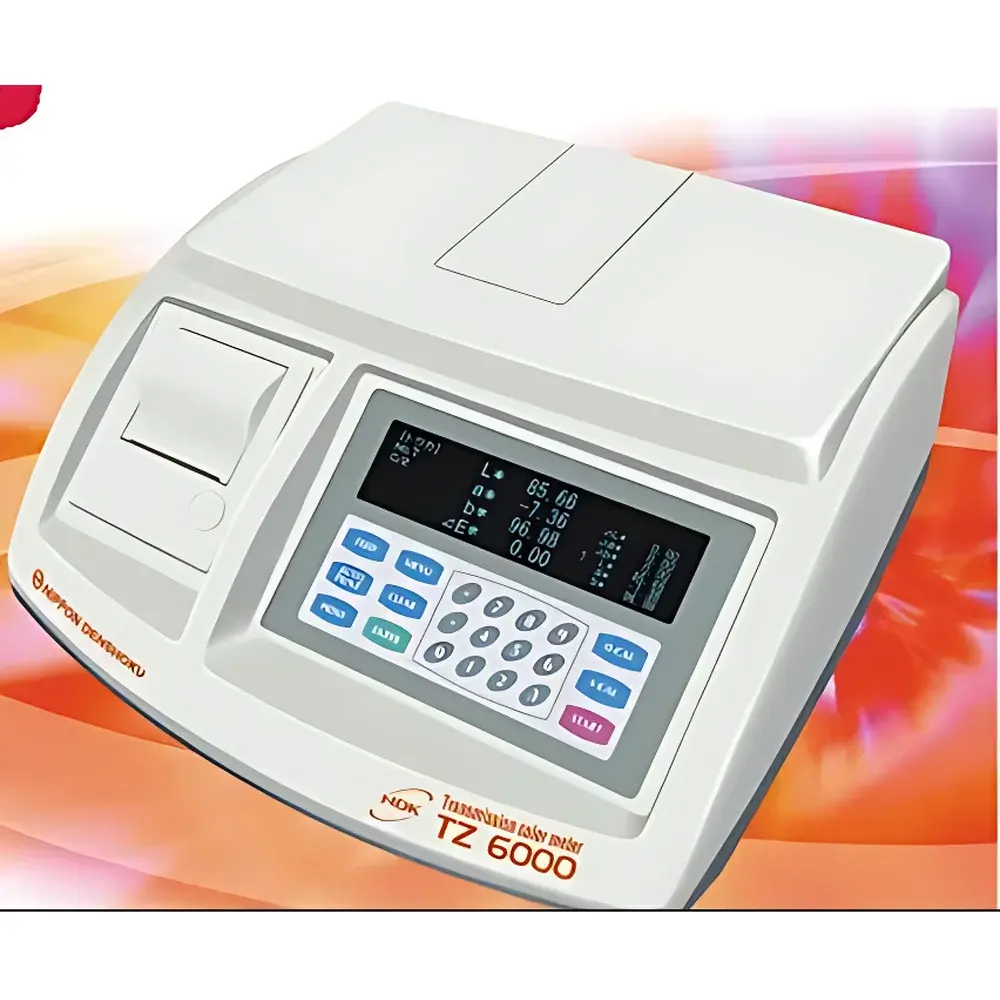
NIPPON DENSHOKU TZ-6000 Long-Path Transmittance Colorimeter
| Brand | NIPPON DENSHOKU |
|---|---|
| Origin | Japan |
| Model | TZ-6000 |
| Light Source | 12 V / 4 A Halogen Lamp (20 W) |
| Illumination/Viewing Geometry | n-D (Normal-Diffuse, optimized for transmittance) |
| Aperture | 14 mm × 45 mm |
| Measurement Area | 7 mm Ø (illuminated), 20 mm Ø (incident port) |
| Compliance | JIS Z 8722, JIS Z 8729, JIS Z 8730, JIS Z 8715, ASTM E 308, ASTM E 313, ASTM D 1925, ISO 7724, CIE Publication No. 15.2 |
| Accuracy | ΔE* ≤ ±0.02 (std. dev., measured 20× on white reference after 20-min warm-up) |
| Interface | RS-232C |
| Dimensions | 425 mm (W) × 415 mm (D) × 189 mm (H) |
| Weight | 13 kg |
| Power | 100–240 V AC, 50/60 Hz, 140 W |
| Operating Environment | 10–40 °C, 30–80 % RH (non-condensing) |
Overview
The NIPPON DENSHOKU TZ-6000 Long-Path Transmittance Colorimeter is a precision optical measurement instrument engineered for high-accuracy color evaluation of transparent and semi-transparent samples via transmitted light. Unlike reflectance-based colorimeters, the TZ-6000 employs a dual-beam optical architecture with n-D (normal-diffuse) illumination and viewing geometry—specifically calibrated to meet transmittance-specific metrological requirements defined in JIS Z 8722, ASTM E 308, and ISO 7724. Its extended optical path enhances sensitivity for low-absorbance liquids and thin polymer films, enabling robust quantification of subtle chromatic deviations across industrial and regulatory color scales including APHA (Harzen), Gardner, Saybolt, and ASTM D 1925. The instrument utilizes a stabilized 12 V / 4 A halogen lamp (20 W) as its spectral source, ensuring consistent irradiance output across the visible spectrum (380–780 nm), with photometric stability maintained through active thermal regulation and real-time reference monitoring.
Key Features
- Long-path optical design optimized for transmittance measurements of low-turbidity liquids (e.g., pharmaceutical solvents, edible oils, polymer solutions) and thin translucent substrates (e.g., photographic film, PET sheets)
- Dual-beam compensation system minimizes drift from lamp aging or ambient temperature fluctuations, supporting measurement repeatability with ΔE* standard deviation ≤ ±0.02 under controlled warm-up conditions
- Comprehensive color space support: CIE L*a*b*, L*C*h°, XYZ, Yxy, CIE Whiteness (WCIE, WLab), Yellowness Index (YI E313, YI D1925), Optical Density (OD), and chromatic difference metrics (ΔE*, ΔE94, ΔECMC [1:1 & 2:1])
- Pre-loaded industry-standard color scales: APHA/Harzen (for water clarity and chemical purity), Gardner (for resins and varnishes), Saybolt (for petroleum products), and ASTM D 1925 (for plastics and coatings)
- Ergonomic footswitch integration enables hands-free operation during high-throughput QA/QC workflows, reducing operator-induced variability
- Large-format sample aperture (14 mm × 45 mm) accommodates irregularly shaped or oversized specimens while maintaining uniform illumination across the measurement field
Sample Compatibility & Compliance
The TZ-6000 is validated for use with homogeneous liquid samples (e.g., acetone, ethanol, glycerin, aqueous formulations) and planar transparent solids (e.g., cellulose acetate film, polycarbonate sheets, glass filters). Sample cell thickness must be compatible with the instrument’s fixed optical path length; recommended cuvette path lengths range from 10 mm to 100 mm depending on analyte absorbance. All measurement protocols align with GLP-compliant laboratory practices. The device satisfies technical requirements for color assessment under JIS Z 8722 (method for color measurement of transparent objects), ASTM E 313 (calculating yellowness and whiteness indices), and ISO 7724-2 (instrumental colorimetry—part 2: color measuring instruments). Data traceability is supported via RS-232C serial output, enabling integration into LIMS environments requiring audit-ready records per FDA 21 CFR Part 11 when paired with compliant software.
Software & Data Management
The TZ-6000 interfaces with NIPPON DENSHOKU’s proprietary PC-based software suite (sold separately), which provides full configuration control, statistical process monitoring (SPC), batch reporting, and customizable pass/fail criteria based on user-defined tolerances. Raw spectral data is not stored internally; instead, all computed colorimetric values—including ΔL*a*b*, ΔE*, and deviation vectors—are timestamped and exportable in CSV or XML format. Audit trails record operator ID, measurement date/time, calibration status, and environmental sensor readings (if external sensors are connected). Software supports multi-user permission levels and electronic signature capture, facilitating compliance with ISO/IEC 17025 and GMP documentation standards.
Applications
- Pharmaceutical manufacturing: APHA color testing of purified water (USP ), excipient solutions, and sterile injectables
- Petrochemical QA: Saybolt color grading of lubricants, jet fuels, and distillates per ASTM D 156
- Coatings & resins: Gardner scale evaluation of alkyd varnishes, epoxy prepolymers, and UV-curable monomers
- Food & beverage: Yellowness Index (YI E313) tracking in refined vegetable oils and corn syrups
- Photographic & display materials: Transmission density and hue uniformity verification of color filter arrays and LCD substrates
- Academic research: Quantitative correlation of molecular conjugation length with APHA/Gardner values in synthetic polymer series
FAQ
What is the minimum required sample volume for liquid measurements?
For standard 10-mm-path cuvettes, ≥3 mL is recommended. For longer-path cells (e.g., 50 mm), volume increases proportionally; always ensure full beam coverage without meniscus interference.
Can the TZ-6000 measure turbid or opaque samples?
No—it is strictly designed for transmittance mode and requires optically clear or near-clear specimens. Hazy or scattering samples require reflectance instrumentation (e.g., spectrophotometers with integrating spheres).
Is calibration traceable to NIST or other national standards?
Yes—NIPPON DENSHOKU provides optional factory calibration certificates traceable to JCSS (Japan Calibration Service System), which maintains mutual recognition agreements with NIST and PTB under the ILAC MRA framework.
Does the instrument support automatic wavelength calibration?
No—wavelength accuracy is ensured by factory alignment of the interference filter set; routine verification uses certified transmission reference filters (e.g., Holmium oxide), not onboard self-calibration.
How frequently should the white reference tile be replaced?
Under typical lab conditions (clean environment, infrequent handling), the sintered PTFE reference standard retains stability for ≥24 months; annual verification against a master reference is advised per ISO/IEC 17025 clause 6.4.10.



