
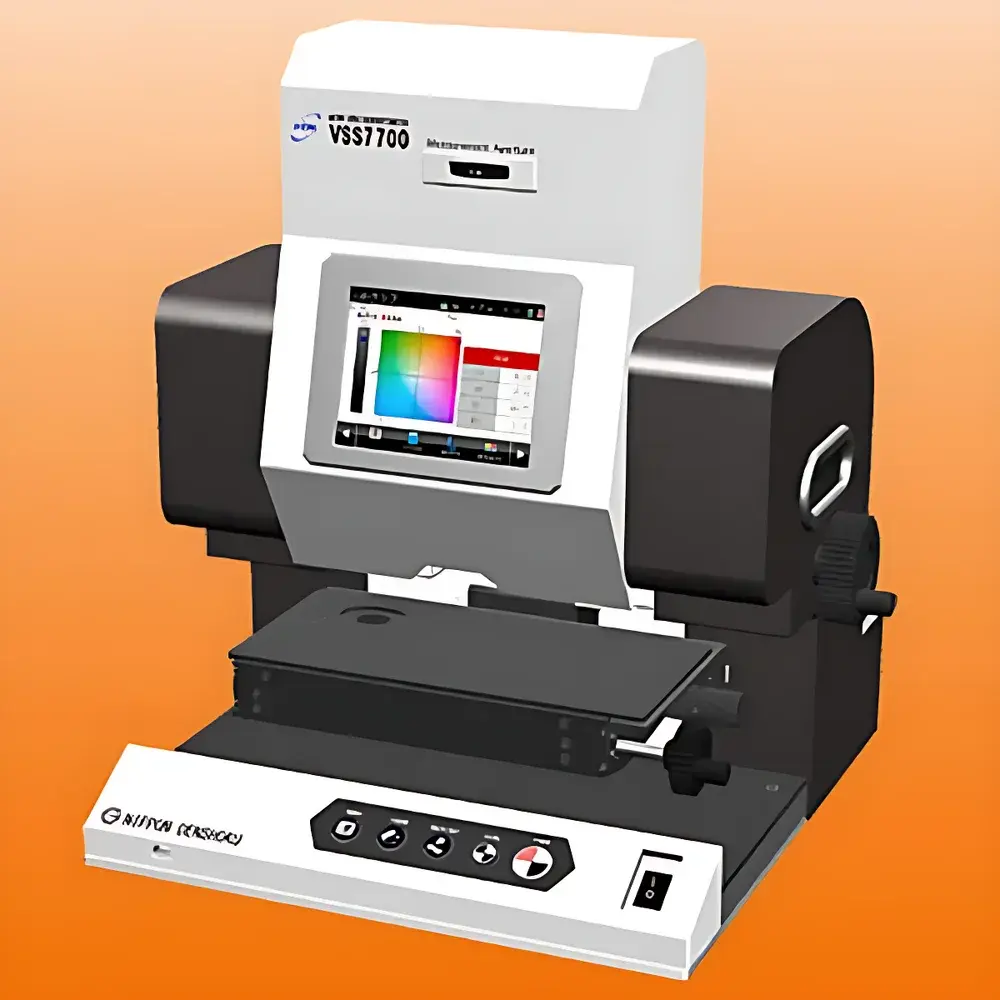
NIPPON DENSHOKU VSS7700 Micro-Area Spectrophotometric Colorimeter & Reflectance Meter
| Brand | NIPPON DENSHOKU |
|---|---|
| Origin | Japan |
| Model | VSS7700 |
| Product Type | Spectrophotometric Colorimeter |
| Instrument Type | Benchtop |
| Optical Geometry | 45/0° |
| Light Source | Tungsten Halogen Lamp |
| Spectral Range | 380–780 nm |
| Measurable Spot Sizes | Ø0.03 mm, Ø0.05 mm, Ø0.2 mm, Ø0.5 mm |
| Display | 5.7-inch Full-Color LCD |
| Sample Stage | XYZ Adjustable Platform (250 × 120 mm) |
| Optional Accessories | Integrated CCD Imaging System, Specular Component Measurement Head (U-shaped geometry), VSS7700 Color Management Software |
Overview
The NIPPON DENSHOKU VSS7700 is a high-precision benchtop spectrophotometric colorimeter and reflectance meter engineered for micro-area spectral measurement of heterogeneous, textured, or spatially constrained samples. Utilizing a 45/0° optical geometry compliant with ISO 5-4 and CIE No. 15, the instrument eliminates directional bias from surface texture while ensuring stable illumination and detection conditions. Its core measurement principle relies on diffraction-grating-based spectral analysis across the visible spectrum (380–780 nm), delivering full spectral data (10 nm interval, 31 channels) for calculation of CIE tristimulus values (XYZ), chromaticity coordinates (x,y; L*a*b*, L*C*h°), whiteness/yellowness indices, and absolute reflectance (%R) at user-defined wavelengths. Designed specifically for R&D labs and QC environments in coatings, printed electronics, dental materials, precision plating, and display manufacturing, the VSS7700 addresses a critical gap in non-contact, sub-millimeter color and reflectance metrology where conventional integrating sphere or 8°/d instruments lack spatial resolution.
Key Features
- Micrometer-precision spot size selection: Four calibrated apertures — Ø0.03 mm, Ø0.05 mm, Ø0.2 mm, and Ø0.5 mm — enable quantitative color and reflectance assessment of fine features such as solder mask boundaries, thin-film transistor pixels, enamel layers, and metallic coating defects.
- Integrated high-resolution CCD imaging system: A coaxial color camera provides real-time visual confirmation of measurement location, facilitating accurate targeting without physical contact—essential for fragile, heat-sensitive, or electrostatically charged substrates.
- Motorized XYZ sample stage: With 250 mm × 120 mm travel range and ±0.01 mm repeatability, the platform supports automated multi-point mapping and large-part profiling while maintaining optical alignment integrity.
- Dedicated 5.7-inch TFT-LCD interface: Displays spectral curves, color difference vectors (ΔE*ab, ΔE*00), pass/fail status against stored standards, calibration history, and scheduled verification prompts—all in English-language UI.
- Tungsten halogen light source with thermal stabilization: Ensures spectral stability over extended operation cycles (>2,000 hours MTBF) and compliance with ASTM E308 spectral computation protocols.
Sample Compatibility & Compliance
The VSS7700 accommodates flat, curved, or irregularly shaped specimens up to 50 mm in height and 300 mm in lateral dimension. Its non-contact design eliminates pressure-induced spectral shift common in contact probes—particularly relevant for soft polymer films, cured dental composites, and anodized aluminum. The system conforms to JIS Z 8722 (Diffuse/Specular Reflectance Measurement), ASTM E308 (Computation of Color Coordinates), ASTM E313 (Yellowness Index), and ISO/CIE 11664-4 (CIE 1931 colorimetric observer). For regulated industries, optional firmware enables audit-trail logging per FDA 21 CFR Part 11 requirements when used with validated VSS7700 Color Management Software.
Software & Data Management
The optional VSS7700 Color Management Software (v3.2+) runs on Windows 10/11 and provides full traceability for GLP/GMP workflows. It supports database-driven standard library management, statistical process control (SPC) charting (X-bar/R, Cp/Cpk), spectral deviation overlays, batch report generation (PDF/CSV/XLSX), and secure user-level access control. Raw spectral data (.spc) and metadata (operator ID, timestamp, instrument serial, aperture setting, calibration certificate ID) are embedded in each export file. Integration with enterprise LIMS via ODBC or REST API is supported upon configuration.
Applications
- Automotive OEMs: Quantifying color consistency of interior trim seams, laser-marked identification codes, and PVD-coated fasteners.
- Dental laboratories: Validating shade matching of ceramic veneers and composite restoratives against Vita Classical and Bleachedguide 3D-MASTER standards.
- Flat-panel display manufacturers: Measuring chromaticity uniformity across individual RGB subpixels and OLED emissive layer edge transitions.
- Printed electronics: Verifying inkjet-deposited conductive traces’ optical density and hue stability under UV curing.
- Electroplating facilities: Assessing reflectance homogeneity of Ni-P and Au flash layers on PCB edge connectors and RF shielding components.
FAQ
What is the smallest measurable area supported by the VSS7700?
The instrument offers four factory-calibrated spot sizes: Ø0.03 mm (30 µm), Ø0.05 mm (50 µm), Ø0.2 mm (200 µm), and Ø0.5 mm (500 µm). Calibration certificates document spectral irradiance uniformity and geometric accuracy for each aperture.
Does the VSS7700 support specular component included (SCI) and excluded (SCE) measurements?
Standard configuration operates in SCE mode (45/0°). An optional U-shaped specular reflectance head enables SCI-capable measurement for high-gloss metallic or lacquered surfaces, meeting ASTM D2244 and ISO 7724-2 requirements.
Is the CCD imaging system used solely for positioning, or does it contribute to measurement correction?
The CCD provides live visual feedback only; all spectral data originate from the dedicated grating spectrometer. However, image capture timestamps are synchronized with spectral acquisition for forensic traceability.
Can the VSS7700 be integrated into automated production lines?
Yes—via RS-232, USB Virtual COM, or Ethernet TCP/IP interfaces, the instrument supports remote command execution (SCPI-compliant), trigger input/output signals, and real-time data streaming for inline QA systems.
What calibration standards are supplied with the instrument?
Each unit ships with NIST-traceable ceramic white tile (L* = 94.5 ± 0.2), black glass trap (L* = 0.5 ± 0.1), and aperture verification target. Annual recalibration services are available through NIPPON DENSHOKU’s ISO/IEC 17025-accredited facility in Yokohama.




