
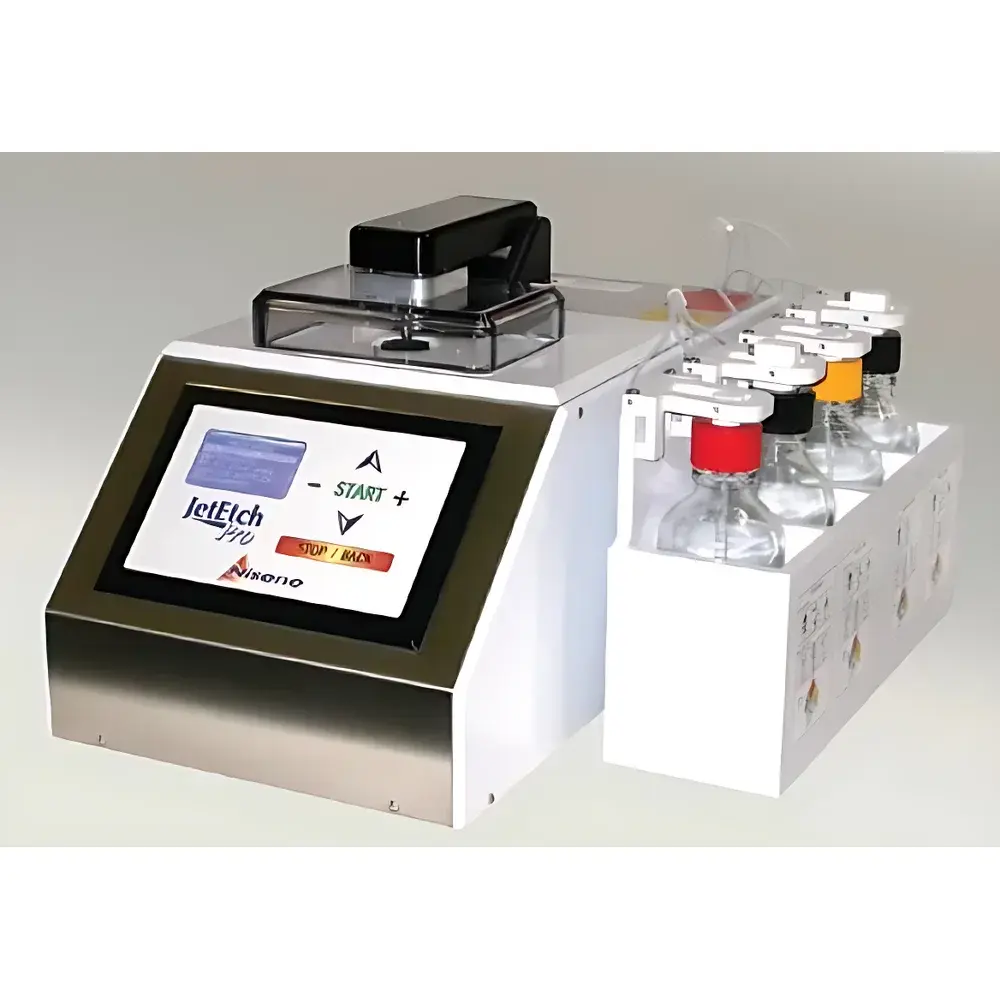
Nisene JetEtch Pro Automated Wet-Chemical IC Decapsulation System
| Brand | Nisene |
|---|---|
| Origin | USA |
| Model | JetEtch Pro |
| Certifications | CE, SEMI S2-93, SEMI S2-2000 |
| Power | 350 W @ 95–130 VAC or 210–250 VAC |
| Dimensions (H×W×D) | 290 × 290 × 419 mm (11.5″ × 11.5″ × 16.5″) |
| Weight | 17 kg (38 lb) |
| Compressed Air | 4.2 kg/cm² (60–100 psi) |
| Nitrogen Supply | 2.8 L/min (0.1 ft³/min) |
| Etchant Flow Rates | Pulse mode: 1, 2, 5, or 1–10 mL/min |
| Vortex mode | 1–6 mL/min |
| Temperature Range | HNO₃: 20–90 °C |
| H₂SO₄ | 20–250 °C |
| Mixed acids | 20–100 °C |
| Etch Time | 1–1800 s (1 s increments) |
| Heating Ramp Time | 0–120 s (1 s increments) |
| Acid Reservoirs | Four 500 mL or 1 L bottles (33/38/40/45 mm cap diameter) |
| Programmable Methods | 100 user-defined protocols |
| Etchant Options | Fuming nitric acid, fuming sulfuric acid, concentrated sulfuric acid, nitric–sulfuric mixtures (ratios: 6:1, 5:1, 4:1, 3:1 in either direction) |
| Rinse Options | Cold H₂SO₄, cold HNO₃, or no rinse |
| Etch Modes | Vortex spray, pulsed spray, and dual-mode sequencing |
| Patented Processes | CuProtect™ (US Patent 8,945,343 B2), TotalProtect™ (US Patent 9,543,173 B2), PlasmaEtch™ (US Patent 9,548,227 B2) |
Overview
The Nisene JetEtch Pro is an automated, precision-engineered wet-chemical decapsulation system designed for the controlled, reproducible removal of polymer-based encapsulants from integrated circuit (IC) packages. Operating on electrochemically assisted acid etching principles—leveraging proprietary voltage-modulated reaction kinetics—the JetEtch Pro enables selective exposure of die surfaces without compromising bond wires, lead frames, or metallization integrity. Unlike manual or thermal debonding methods, this system performs etching under inert gas (N₂) purged, pressurized chamber conditions, minimizing oxidation of copper interconnects and suppressing hazardous fume generation. Its core architecture integrates real-time temperature regulation, digitally metered acid delivery, and programmable spray dynamics to ensure sub-millimeter spatial control over etch depth and lateral profile—critical for failure analysis (FA), reverse engineering, and quality assurance workflows in semiconductor laboratories.
Key Features
- Patented CuProtect™ technology (US Patent 8,945,343 B2): Applies precise DC bias to suppress copper wire corrosion during nitric acid etching—enabling clean, oxide-free bond wire inspection.
- TotalProtect™ process (US Patent 9,543,173 B2): Combines voltage modulation with active cooling to stabilize exothermic reactions—essential for high-thermal-load packages such as PBGA and flip-chip BGA.
- PlasmaEtch™ module (US Patent 9,548,227 B2): Optional microwave-induced plasma discharge tube for low-acid, non-liquid surface activation prior to wet etch—reducing total acid consumption by up to 40%.
- Vortex and pulsed spray delivery: Dual-mode fluidics provide tunable impingement energy—vortex for uniform planar removal, pulse for localized trenching or step profiling.
- 100-user-programmable method storage: Each protocol stores acid type, concentration ratio, temperature setpoint, flow rate, dwell time, ramp duration, rinse selection, and gas purge parameters.
- Real-time thermal feedback loop: PID-controlled heating elements with ±0.5 °C stability across full operating range (20–250 °C).
- Integrated safety architecture: CE-marked enclosure, SEMI S2-93/S2-2000 compliant exhaust interface, automatic lid interlock, and fail-safe acid shutoff valves.
Sample Compatibility & Compliance
The JetEtch Pro accommodates a comprehensive range of commercial IC package types—including DIP, SIP, PLCC, SOIC, QFP, OFP, PBGA, flip-chip BGA, and wafer-level CSP—via interchangeable fixture plates and precision-aligned opening masks. All fixtures are CNC-machined from chemically inert PTFE and PVDF to prevent cross-contamination. The system complies with international laboratory safety and equipment standards: CE marking confirms conformity with EU Machinery Directive 2006/42/EC and Electromagnetic Compatibility Directive 2014/30/EU; SEMI S2-93 and S2-2000 certifications verify mechanical integrity, chemical resistance, and operator protection under semiconductor fab environments. For regulated QA/QC labs, audit-ready operation logs—including timestamped parameter changes, method execution history, and error codes—are retained locally and exportable via USB for FDA 21 CFR Part 11–aligned documentation.
Software & Data Management
The JetEtch Pro runs on a dedicated embedded Linux OS with a 7-inch resistive touchscreen GUI. Navigation follows a guided workflow: “Load Sample → Select Method → Confirm Parameters → Initiate Run.” No coding or scripting is required; all settings are adjusted via intuitive sliders and dropdown menus. Every run generates a tamper-evident log file containing method ID, start/end timestamps, actual vs. setpoint temperature curves, acid flow calibration data, and chamber pressure trace. Logs support CSV export for integration into LIMS platforms or FA reporting suites. Optional Ethernet connectivity enables remote monitoring and centralized fleet management—though no cloud upload occurs without explicit user authorization, preserving data sovereignty per ISO/IEC 27001 requirements.
Applications
- Failure root cause analysis: Exposing delamination, voiding, wire bond lift, or die attach defects beneath epoxy mold compound (EMC) or silicone gel encapsulants.
- Design verification: Validating layout-to-die alignment, metal layer continuity, and passivation integrity post-packaging.
- Counterfeit detection: Identifying inconsistencies in die markings, backgrinding artifacts, or unexpected metallization stacks.
- Process qualification: Assessing encapsulant adhesion strength, moisture resistance, and thermal cycling reliability through controlled de-encapsulation and subsequent SEM/EDS inspection.
- Reliability testing support: Preparing samples for HAST, TCT, or HTSL stress testing where encapsulant removal is required prior to electrical characterization.
FAQ
What package types does the JetEtch Pro support?
Standard fixtures cover DIP, SOIC, PLCC, QFP, PBGA, flip-chip BGA, and CSP. Custom masks can be fabricated for emerging fan-out or 2.5D interposer packages upon request.
Can the system handle high-temperature encapsulants like polyimide or liquid crystal polymer (LCP)?
Yes—when configured with sulfuric acid at 220–250 °C and TotalProtect™ active cooling, the JetEtch Pro achieves controlled ablation of thermally stable polymers without substrate warpage.
Is method validation supported for GLP/GMP environments?
Absolutely. Full parameter traceability, electronic signature capability (via optional USB keyboard), and IQ/OQ documentation templates are provided to meet ISO 17025 and ICH Q5A compliance requirements.
How is acid waste managed and neutralized?
Waste is collected in sealed, vented 1 L HDPE bottles rated for concentrated HNO₃/H₂SO₄. Neutralization must occur externally per local EPA/state regulations; the system includes pH-stable tubing and chemically resistant seals to prevent leakage during transfer.
Does the JetEtch Pro require facility exhaust ducting?
It interfaces directly with standard lab fume hoods via 4-inch duct flange. Optional inline scrubber modules (NaOH or Ca(OH)₂) are available for standalone installation where central exhaust is unavailable.






