
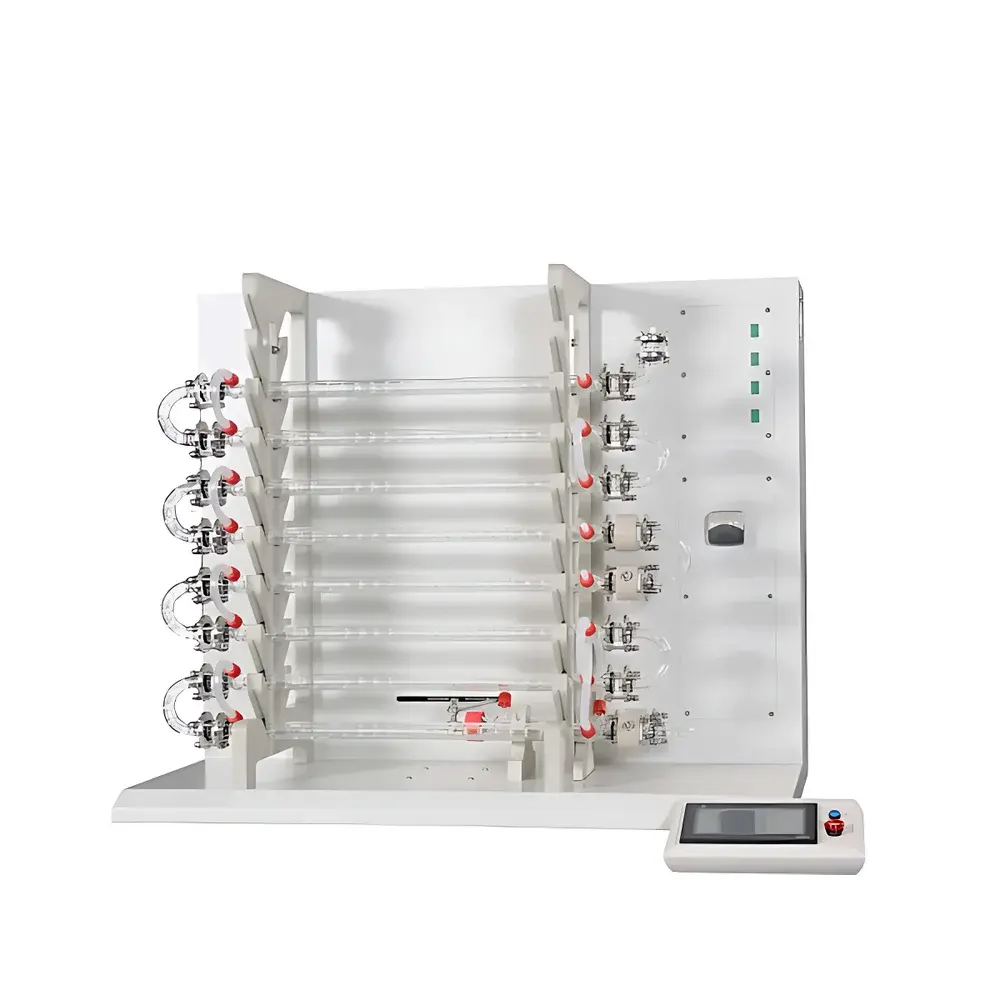
Nitech DN15 Continuous Flow Reactor and Crystallizer
| Origin | UK |
|---|---|
| Manufacturer Type | Authorized Distributor |
| Origin Category | Imported |
| Model Range | DN15 Series |
| Price Range | USD 110,000 – 138,000 |
Overview
The Nitech DN15 Continuous Flow Reactor and Crystallizer is an integrated, jacketed tubular platform engineered for precise control of reaction kinetics and crystallization thermodynamics under continuous flow conditions. Based on plug-flow and segmented-flow principles, the system utilizes positive-displacement peristaltic pumping to deliver consistent residence time distribution (RTD), while internal static mixers—comprising precisely spaced pistons and baffles—ensure rapid radial homogenization without mechanical agitation. All fluidic pathways are double-walled and fully jacketed, enabling independent thermal zoning via external recirculating chillers or heaters (−20 °C to +120 °C typical). This architecture supports both isothermal and gradient-based crystallization protocols, with real-time process understanding enabled by multiple standardized probe ports (e.g., for in-line Raman, ATR-FTIR, focused beam reflectance measurement [FBRM], or particle vision and measurement [PVM]). Designed for seamless transition from lab-scale process development to pilot and manufacturing-scale implementation, the DN15 complies with fundamental engineering requirements for continuous pharmaceutical manufacturing (CPM) and Quality by Design (QbD) frameworks.
Key Features
- Modular, fully jacketed tubular reactor–crystallizer architecture with independent temperature zoning across up to four discrete thermal sections
- Integrated static mixing elements (piston-baffle configuration) ensuring high radial dispersion and narrow residence time distribution (RTD)
- Multiple standardized 1/4″–28 UNF threaded ports for in-line sensor integration (Raman, FBRM, PVM, pH, conductivity) or offline sampling
- Dual-purpose secondary inlets for controlled seed addition, antisolvent dosing, or reagent quenching at defined axial positions
- Scalable design: identical fluid dynamics and heat/mass transfer characteristics preserved from DN15 (lab scale) to DN50/DN100 industrial variants
- Material options include 316L stainless steel, Hastelloy C-276, and PFA-lined configurations for corrosion-resistant operation under acidic, basic, or halogenated solvent conditions
- Pressure-rated up to 10 bar(g) with optional pressure-regulated back-pressure regulators (BPRs) for gas-evolving reactions or supercritical fluid applications
Sample Compatibility & Compliance
The DN15 accommodates a broad range of process streams—including viscous organic solutions, aqueous suspensions, gas–liquid slurries, and heterogeneous catalytic mixtures—with minimal fouling risk due to smooth bore tubing and absence of dead volumes. It supports crystallization of APIs (e.g., paracetamol, ibuprofen), fine chemical intermediates, pigment precursors, and polymerization initiators under cGMP-aligned workflows. The system is compatible with ASTM E2500-13 (science-based approach to equipment qualification), ISO 9001:2015, and ICH Q5A–Q5E guidelines. When configured with audit-trail-enabled software and electronic signatures, it meets FDA 21 CFR Part 11 requirements for regulated environments. Full documentation packages—including DQ/IQ/OQ protocols, material certifications (EN 10204 3.1), and FAT/SAT reports—are available upon request.
Software & Data Management
The DN15 operates via Nitech’s proprietary FlowControl Suite—a deterministic, real-time control environment supporting synchronized pump speed regulation, temperature setpoint ramping, and sensor data acquisition at ≥10 Hz. All operational parameters (flow rates, jacket temperatures, pressure, and sensor outputs) are timestamped and logged in HDF5 format, enabling traceability and post-run multivariate analysis (MVA). The software exports compliant CSV and XML files for integration into LIMS, MES, or PAT (Process Analytical Technology) platforms. Optional modules include predictive crystallization modeling (using population balance equations coupled with thermodynamic solubility databases) and automated parameter optimization via DoE-driven feedback loops.
Applications
- Pharmaceutical: Polymorph screening, anti-solvent crystallization of high-potency APIs, continuous melt crystallization for chiral resolution
- Fine Chemicals: Nitration, sulfonation, and diazotization under safe, low-holdup conditions
- Agrochemicals: Controlled precipitation of active ingredients with tailored particle size distribution (PSD)
- Specialty Polymers: Step-growth and chain-growth polymerizations with inline viscosity monitoring
- Food & Personal Care: Emulsification of lipid-based actives, controlled nucleation of cocoa butter analogues, and crystallization of natural colorants
- Energy: Catalytic hydrogenation of bio-oil fractions, continuous synthesis of metal–organic framework (MOF) precursors
FAQ
What is the minimum and maximum residence time achievable with the DN15 system?
Residence time ranges from 10 seconds to over 60 minutes, adjustable via flow rate (0.1–50 mL/min) and reactor volume (standard 15 mL, extendable to 100 mL with modular inserts).
Can the DN15 be operated under inert or vacuum conditions?
Yes—equipped with Swagelok VCR fittings and optional purge ports; compatible with nitrogen, argon, or vacuum (<5 mbar abs) operation when paired with appropriate BPRs and vent management.
Is remote monitoring and control supported?
Yes—FlowControl Suite includes secure OPC UA server functionality for integration into plant-wide SCADA systems and remote access via TLS-encrypted web interface.
How is cleaning-in-place (CIP) performed?
The system supports full CIP using programmable solvent flush sequences (e.g., water → ethanol → acetone) with flow reversal capability and conductivity-based endpoint detection.
Does Nitech provide process development support?
Yes—Nitech offers collaborative process intensification services including kinetic modeling, crystallization mechanism studies, and tech-transfer documentation aligned with ICH Q8–Q11 principles.



