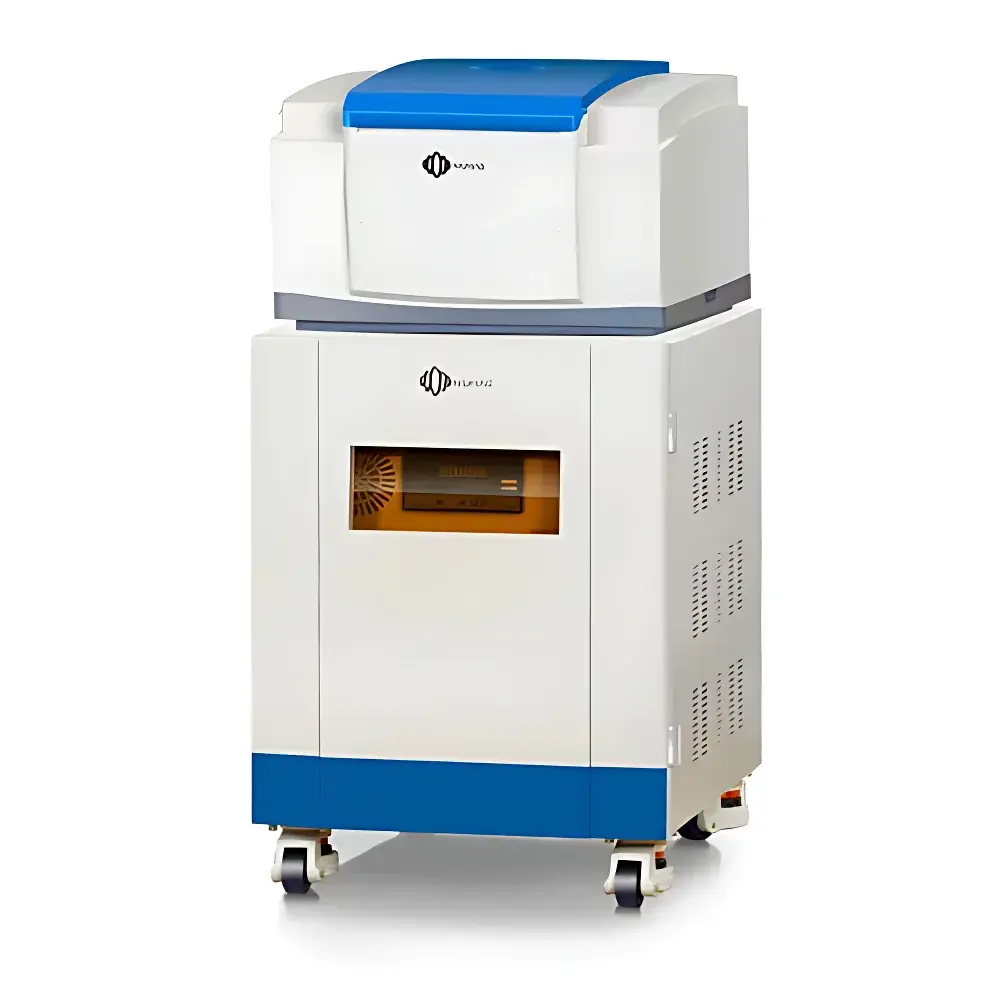
NIUMAG PQ001-ftc Low-Field NMR Analyzer for Fluorinated Coating Quantification on Fibers and Textiles
| Brand | NIUMAG |
|---|---|
| Origin | Jiangsu, China |
| Manufacturer Type | Authorized Distributor |
| Country of Origin | China |
| Model | PQ001-ftc |
| Pricing | Available Upon Request |
| Magnet Type | Permanent Magnet |
| Magnetic Field Strength | 0.5 ± 0.08 T |
| Probe Coil Diameter | 25 mm |
| Nucleus Detected | ¹⁹F (Fluorine-19) |
| Calibration Requirement | 3–6 Certified Fluorine Reference Standards |
| Typical Measurement Time | 30 s – 3 min per sample |
| Sample Form Compatibility | Powder, Granule, Film, Bulk Fabric, Woven/Nonwoven Textile Specimens |
| Detection Principle | Quantitative ¹⁹F NMR Signal Integration Proportional to Total Fluorine Mass |
Overview
The NIUMAG PQ001-ftc is a dedicated low-field nuclear magnetic resonance (LF-NMR) analyzer engineered for rapid, non-destructive quantification of fluorine content in fluorinated coatings applied to fibers, yarns, woven and nonwoven textiles, and technical fabrics. Unlike conventional destructive wet-chemical methods—such as ion-selective electrode (ISE) analysis or ion chromatography (IC)—the PQ001-ftc leverages the intrinsic magnetic resonance properties of the 19F nucleus. As fluorine-19 is 100% naturally abundant and possesses high gyromagnetic ratio and sensitivity, it delivers strong, reproducible NMR signals directly proportional to total fluorine mass in the sample volume. The system operates at a stable static field of 0.5 ± 0.08 T generated by a temperature-compensated permanent magnet assembly, eliminating cryogen dependency and enabling robust deployment in QC laboratories, production floors, and R&D environments. Its 25 mm diameter radiofrequency probe accommodates heterogeneous textile geometries without requiring homogenization, cutting, or solvent extraction—making it suitable for inline process monitoring and routine batch verification.
Key Features
- Quantitative 19F NMR detection with no chemical reagents, solvents, or sample digestion
- Measurement time per sample: 30 seconds to 3 minutes, depending on signal-to-noise requirements and fluorine concentration
- Non-invasive and fully non-destructive—enables repeated measurements on identical specimens across time or treatment cycles
- Insensitive to sample surface morphology, color, dye chemistry, or coating uniformity; signal originates from bulk fluorine distribution
- Minimal operator training required—intuitive software interface with guided calibration and one-click measurement protocols
- Calibration based on 3–6 traceable fluorine reference standards (e.g., polytetrafluoroethylene, fluorinated surfactants, or certified coated fabric standards)
- Robust mechanical architecture designed for industrial environments: vibration-damped base, EMI-shielded enclosure, and ambient temperature operation (15–35 °C)
- Integrated hardware diagnostics and automated shimming routines ensure long-term measurement stability
Sample Compatibility & Compliance
The PQ001-ftc accepts diverse physical forms without preprocessing: intact fabric swatches (up to 25 mm diameter), cut yarn segments, nonwoven sheets, coated films, and powdered finishing agents. It complies with ISO/IEC 17025 general requirements for competence of testing and calibration laboratories when operated under documented SOPs. While not intrinsically FDA 21 CFR Part 11 compliant, its data export architecture supports integration into validated LIMS or ELN platforms with audit-trail-enabled workflows. Method validation per ASTM D7263 (Standard Test Method for Determination of Fluorine Content in Polymers by NMR) is achievable through user-defined qualification protocols. The instrument meets CE electromagnetic compatibility (EMC) Directive 2014/30/EU and Low Voltage Directive 2014/35/EU requirements.
Software & Data Management
The proprietary Niumag NMR Studio v4.x software provides full spectral acquisition, peak integration, baseline correction, and calibration curve generation using linear or polynomial regression. All raw FID data, processed spectra, calibration logs, and measurement metadata are stored in vendor-neutral HDF5 format with embedded timestamps, operator ID, and instrument configuration parameters. Export options include CSV, PDF reports, and XML for traceability. Batch mode supports scheduled unattended measurements with auto-flagging of outliers beyond user-defined tolerance bands. Audit trail functionality records all parameter modifications, calibration events, and report generations—supporting GLP/GMP-aligned documentation practices when deployed within controlled quality systems.
Applications
- Verification of fluorocarbon-based water/oil repellent (DWR) coating dosage on outdoor apparel, workwear, and medical textiles
- Process control during roll-to-roll fluorination treatments in finishing lines
- Stability assessment of fluorinated finishes after laundering, abrasion, or UV exposure
- Quantitative comparison of alternative fluorine-free vs. legacy C6/C8 fluorochemical formulations
- Quality conformance testing against customer specifications (e.g., ≤ 100 ppm F for eco-label compliance)
- Supporting restricted substance lists (RSL) audits per ZDHC MRSL v3.1 and OEKO-TEX® STANDARD 100
- Research into fluorine migration mechanisms in multilayer laminates and composite textiles
FAQ
Does the PQ001-ftc require liquid helium or cryogenic cooling?
No. It employs a permanent magnet system operating at ambient temperature with passive thermal stabilization.
Can the instrument differentiate between organic and inorganic fluorine species?
No. It measures total fluorine mass concentration. Chemical speciation requires high-field NMR or complementary techniques such as XPS or TOF-SIMS.
Is sample weighing required before measurement?
Yes—mass input is essential for reporting results in absolute units (e.g., wt% or ppm F). A calibrated analytical balance (0.0001 g resolution) is recommended.
What is the lower limit of detection for fluorine in typical textile substrates?
Under standard conditions (3-min acquisition, 1 g sample), LOD is approximately 20–50 ppm F, dependent on substrate density and background signal.
Can the same instrument be used for moisture or oil content analysis in other materials?
Yes—the platform supports optional 1H NMR modules for water/oil quantification in polymers, foods, and petrochemicals, though separate calibration is required.