
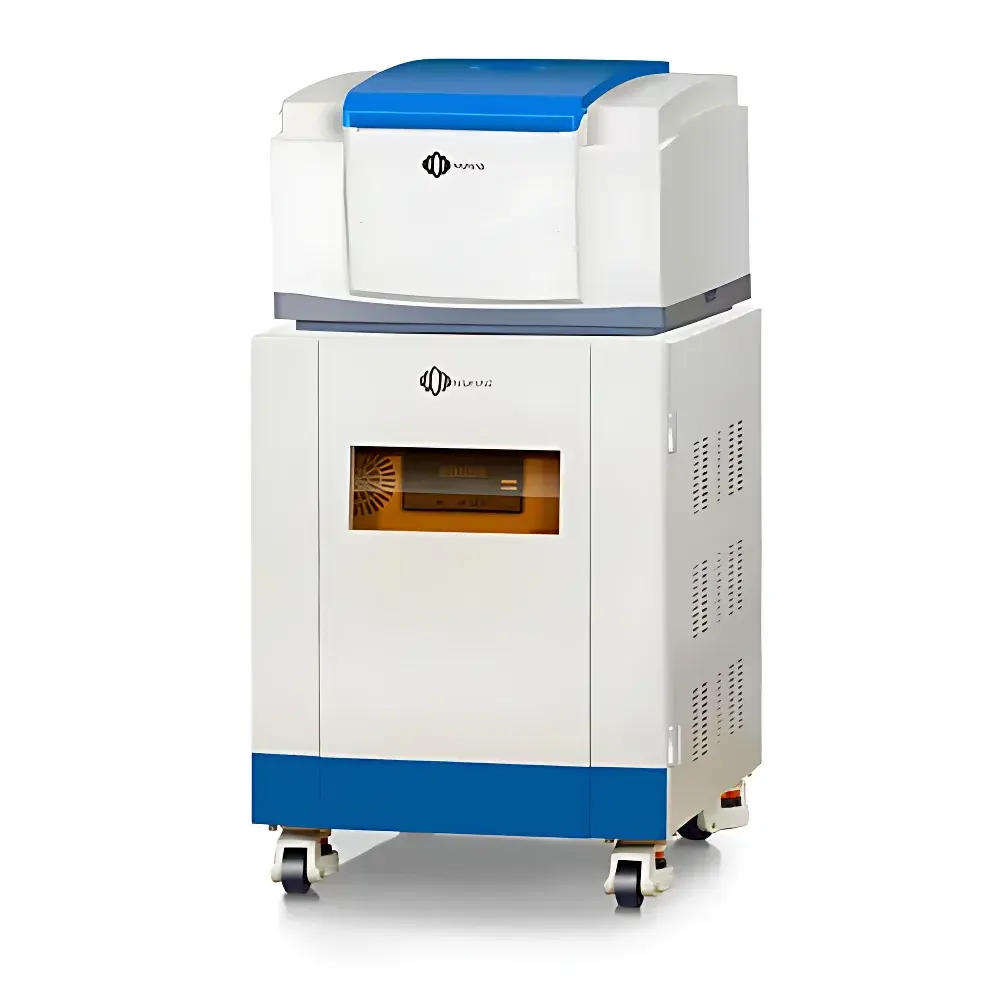
NIUMAG PQ001 Low-Field Nuclear Magnetic Resonance (LF-NMR) Particle Dispersion and Stability Analyzer
| Brand | NIUMAG |
|---|---|
| Origin | Jiangsu, China |
| Manufacturer Type | Authorized Distributor |
| Product Origin | Domestic (China) |
| Model | PQ001-PQ |
| Measurement Time | 1–3 minutes |
Overview
The NIUMAG PQ001 Low-Field Nuclear Magnetic Resonance (LF-NMR) Particle Dispersion and Stability Analyzer is a dedicated benchtop instrument engineered for quantitative assessment of colloidal and suspension stability, particle surface interaction, and dispersion behavior in liquid-phase systems. Unlike optical or sedimentation-based methods, the PQ001 leverages low-field NMR relaxometry—specifically transverse relaxation time (T2) distribution analysis—to non-invasively probe hydrogen proton mobility at the particle–liquid interface. This principle enables direct correlation between relaxation dynamics and physical parameters such as effective particle surface area, hydration layer thickness, and interfacial affinity—without sample dilution, labeling, or centrifugation. Designed for routine QC and R&D laboratories, the system operates at a fixed magnetic field strength (typically 0.05–0.1 T), ensuring robust signal reproducibility and minimal hardware sensitivity to environmental fluctuations. Its compact architecture supports integration into GMP-aligned workflows where traceability, method validation, and operator independence are critical.
Key Features
- Non-destructive, solvent-compatible analysis of concentrated suspensions (up to 60% w/w solids) without dilution or filtration
- Quantitative T2 relaxometry with high signal-to-noise ratio (SNR) optimized for aqueous and organic dispersions
- Integrated pulse sequence library including CPMG (Carr–Purcell–Meiboom–Gill) for accurate multi-exponential decay fitting
- Automated measurement cycle completed within 1–3 minutes per sample—enabling high-throughput screening of formulation variants
- Modular hardware design compliant with IEC 61000-6-3 (EMC) and IEC 61010-1 (safety) standards
- Temperature-controlled sample chamber (optional) supporting isothermal studies from 5 °C to 45 °C
Sample Compatibility & Compliance
The PQ001 accommodates standard 10–15 mm OD NMR tubes and custom-insertable vials for viscous pastes or slurries. It is validated for use with carbon black, graphene oxide, metal oxides (e.g., TiO2, SiO2), polymer nanoparticles, and pharmaceutical active ingredients (APIs) dispersed in water, ethanol, ethylene glycol, and polar aprotic solvents. Data acquisition and reporting support alignment with GLP and GMP documentation requirements, including audit trail logging, user access control, and electronic signature readiness per FDA 21 CFR Part 11 guidelines. While not certified to ISO 13321 or ASTM D7827 (which pertain to dynamic light scattering), its NMR-derived metrics are referenced in peer-reviewed literature for dispersion quality assessment across ISO/TC 24/SC 4 working groups on nanomaterial characterization.
Software & Data Management
The proprietary PQ001 Analysis Suite provides a validated, menu-driven interface compliant with ICH Q9 principles for analytical method control. Key modules include: (1) Pulse parameter setup with real-time shimming feedback; (2) Automated T2 inversion using non-negative least-squares (NNLS) algorithms; (3) Comparative overlay of multiple decay curves with statistical confidence intervals; (4) Export of raw FID data (ASCII), processed T2 distributions (CSV), and summary reports (PDF). All software operations generate timestamped metadata—including operator ID, instrument serial number, calibration status, and environmental sensor readings (temperature/humidity)—ensuring full data lineage for regulatory submissions.
Applications
- Ceramics: Monitoring dispersion state during wet milling and slip casting to reduce defect formation
- Nanotechnology: Quantifying surfactant adsorption density and desorption kinetics on nanoparticle surfaces
- Electronics: Optimizing CMP slurry rheology and abrasive particle stability under shear
- Inks & Coatings: Correlating pigment surface hydrophobicity with jetting reliability and film uniformity
- Energy Storage: Evaluating carbon nanotube dispersion homogeneity in battery electrode slurries prior to coating
- Pharmaceuticals: Differentiating API wetting behavior across polymorphs and salt forms via hydration shell mapping
- Biopolymers: Characterizing nanocellulose network formation and anti-agglomeration efficacy of enzymatic modifiers
FAQ
What physical parameter does the PQ001 actually measure?
It measures the transverse relaxation time (T2) distribution of hydrogen nuclei in the dispersion medium, which reflects local molecular mobility constrained by particle surface interactions.
Can the PQ001 replace laser diffraction or DLS for particle size analysis?
No—it does not report primary particle diameter. Instead, it infers effective surface area and dispersion quality through relaxation heterogeneity, making it complementary—not substitutive—to sizing techniques.
Is method validation required before routine use?
Yes. Users must establish system suitability criteria (e.g., T2 repeatability ≤5% RSD, reference standard stability over 24 h) per ICH Q2(R2) guidance.
Does the instrument require cryogens or permanent magnet maintenance?
No. It employs a permanent magnet with passive temperature stabilization; no liquid helium, nitrogen, or active shimming coils are needed.
How is data integrity ensured during multi-user operation?
Role-based login, encrypted database storage, and immutable audit logs comply with ALCOA+ principles for regulated environments.



