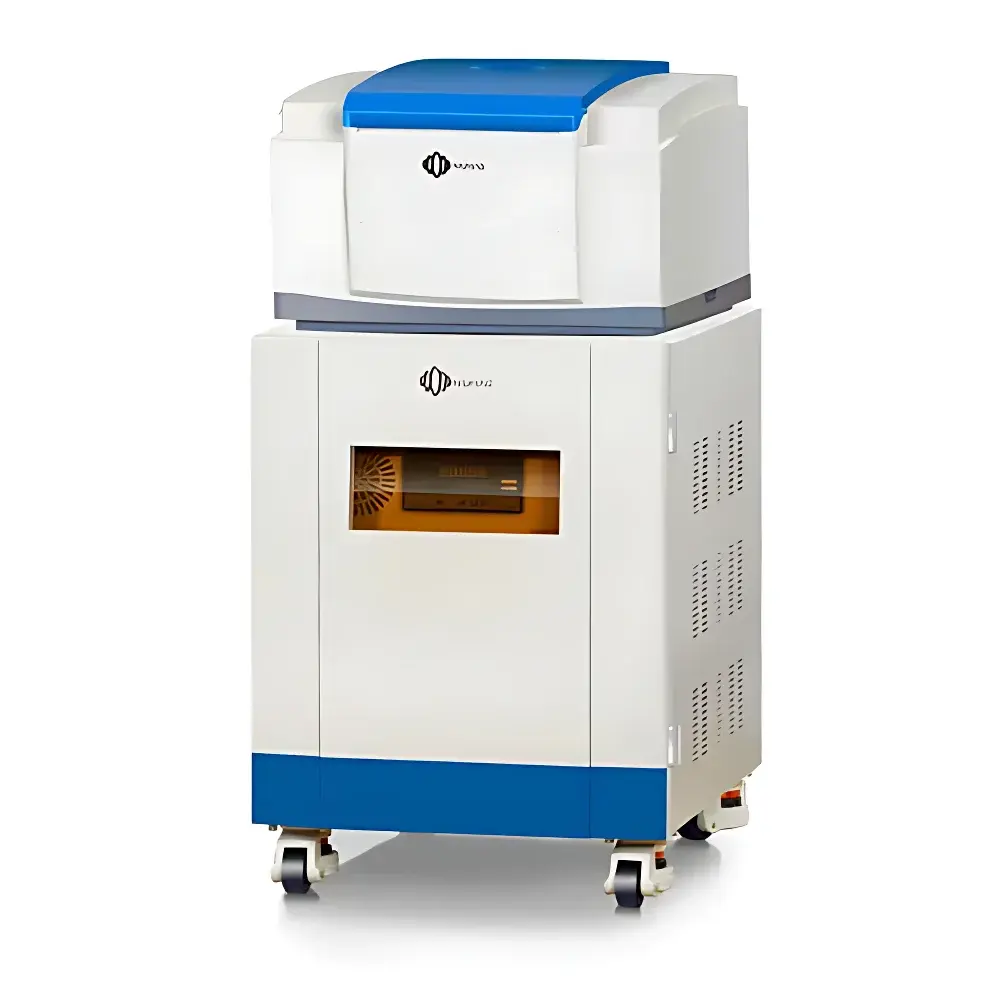
NIUMAG PQ001-p Pulsed Nuclear Magnetic Resonance Analyzer for Polymerization Kinetics Monitoring
| Brand | NIUMAG |
|---|---|
| Origin | Jiangsu, China |
| Manufacturer Type | Authorized Distributor |
| Regional Classification | Domestic (China) |
| Model | PQ001-p |
| Pricing | Upon Request |
| Magnetic Field Strength | 0.5 ± 0.05 T |
| Probe Coil Diameter | Ø25 mm |
| Measurement Principle | Low-Field Pulsed NMR (¹H), T₂ Relaxation Analysis via CPMG Sequence |
Overview
The NIUMAG PQ001-p is a benchtop pulsed nuclear magnetic resonance (pNMR) analyzer engineered for non-invasive, real-time monitoring of polymerization kinetics in synthetic and natural polymer systems. Operating at a stable low-field strength of 0.5 ± 0.05 T, it leverages proton (¹H) spin dynamics to quantify molecular mobility changes during chain growth. As monomers undergo covalent linkage into macromolecules, local segmental motion slows significantly—reflected directly in the transverse relaxation time (T₂). The PQ001-p captures this evolution quantitatively using the Carr–Purcell–Meiboom–Gill (CPMG) pulse sequence, which suppresses static field inhomogeneity effects and isolates true spin–spin relaxation decay. Unlike destructive or calorimetric methods, pNMR requires no labeling, chemical derivatization, or sample dilution—enabling repeated measurements on the same reaction aliquot under controlled temperature conditions. Its design prioritizes robustness for routine use in QC laboratories and compatibility with process-oriented workflows, including offline batch sampling and semi-automated kinetic profiling.
Key Features
- Low-field permanent magnet system (0.5 T) with high thermal stability and minimal drift over extended acquisition periods
- Ø25 mm dedicated RF probe optimized for homogeneous excitation and signal reception across viscous and heterogeneous polymerizing media
- Integrated CPMG pulse sequence generator with adjustable echo spacing (τ) and echo train length (n), enabling precise T₂ distribution analysis
- Real-time FID and multi-echo decay acquisition with 16-bit ADC resolution and configurable signal averaging
- Compact footprint (W × D × H: 420 × 350 × 280 mm) suitable for fume hoods, gloveboxes, or controlled-environment chambers
- Compliance-ready architecture supporting audit trails, user access levels, and electronic signature protocols aligned with GLP and GMP documentation requirements
Sample Compatibility & Compliance
The PQ001-p accommodates standard NMR tubes (Ø10 mm and Ø15 mm), sealed vials, and custom reaction vessels compatible with its 25 mm vertical bore. It supports liquid-phase, gel-phase, and early-stage viscous prepolymers—including acrylates, epoxies, polyesters, polyurethanes, and biopolymer precursors. No solvent removal or drying is required; measurements are performed directly on as-reacted samples. The instrument conforms to IEC 61000-6-3 (EMC emission standards) and IEC 61010-1 (safety requirements for laboratory equipment). Data integrity features—including immutable raw FID storage, timestamped parameter logs, and operator ID tagging—support compliance with FDA 21 CFR Part 11 when deployed within validated analytical procedures.
Software & Data Management
Control and analysis are executed via NIUMAG’s proprietary MesoMR software suite (v4.2+), running on Windows-based host PCs. The interface provides intuitive sequence setup, real-time signal visualization, and automated T₂ inversion using non-negative least squares (NNLS) algorithms. Export formats include CSV (decay curves), TXT (T₂ distribution spectra), and PDF reports with embedded metadata (pulse parameters, temperature, operator ID, calibration status). Batch processing mode enables unattended kinetic series analysis—e.g., time-resolved T₂ mapping across 24+ sequential samples. All data files are stored with SHA-256 checksums to ensure forensic traceability. Optional API integration supports LIMS connectivity (via HL7 or RESTful endpoints) for enterprise-scale data aggregation.
Applications
- Quantification of monomer conversion vs. time in free-radical, anionic, cationic, and condensation polymerizations
- Correlation of T₂ decay profiles with molecular weight development (validated against SEC/GPC benchmarks)
- In-process detection of gel point onset in thermoset resins via abrupt T₂ reduction and distribution narrowing
- Assessment of initiator efficiency and inhibition effects through comparative T₂ kinetics under varied catalyst loadings
- Stability screening of reactive intermediates in pharmaceutical polymer synthesis (e.g., PEGylation reagents)
- Educational use in polymer science curricula for hands-on demonstration of relaxation physics and kinetic modeling
FAQ
Can the PQ001-p measure absolute molecular weight?
No—it does not provide absolute Mw or Mn values. However, calibrated T₂ trends correlate strongly with average chain length in homopolymer systems when referenced against orthogonal techniques such as GPC.
Is temperature control integrated?
The base system operates at ambient temperature. An optional Peltier-controlled sample holder (−10 °C to +80 °C, ±0.5 °C stability) is available for Arrhenius-based kinetic studies.
What sample volume is required?
Minimum detectable volume is 0.3 mL in a standard 10 mm OD tube; optimal signal-to-noise is achieved with 0.8–1.2 mL.
Does the instrument require cryogens or shimming?
No. It uses a permanent magnet and gradient-tuned passive shimming—zero liquid helium, zero daily shimming protocol.
How is data validated for regulatory submissions?
Raw FID and processed T₂ distributions are stored with embedded acquisition metadata; software supports 21 CFR Part 11-compliant electronic signatures when configured with domain-authenticated Windows accounts and encrypted storage.