
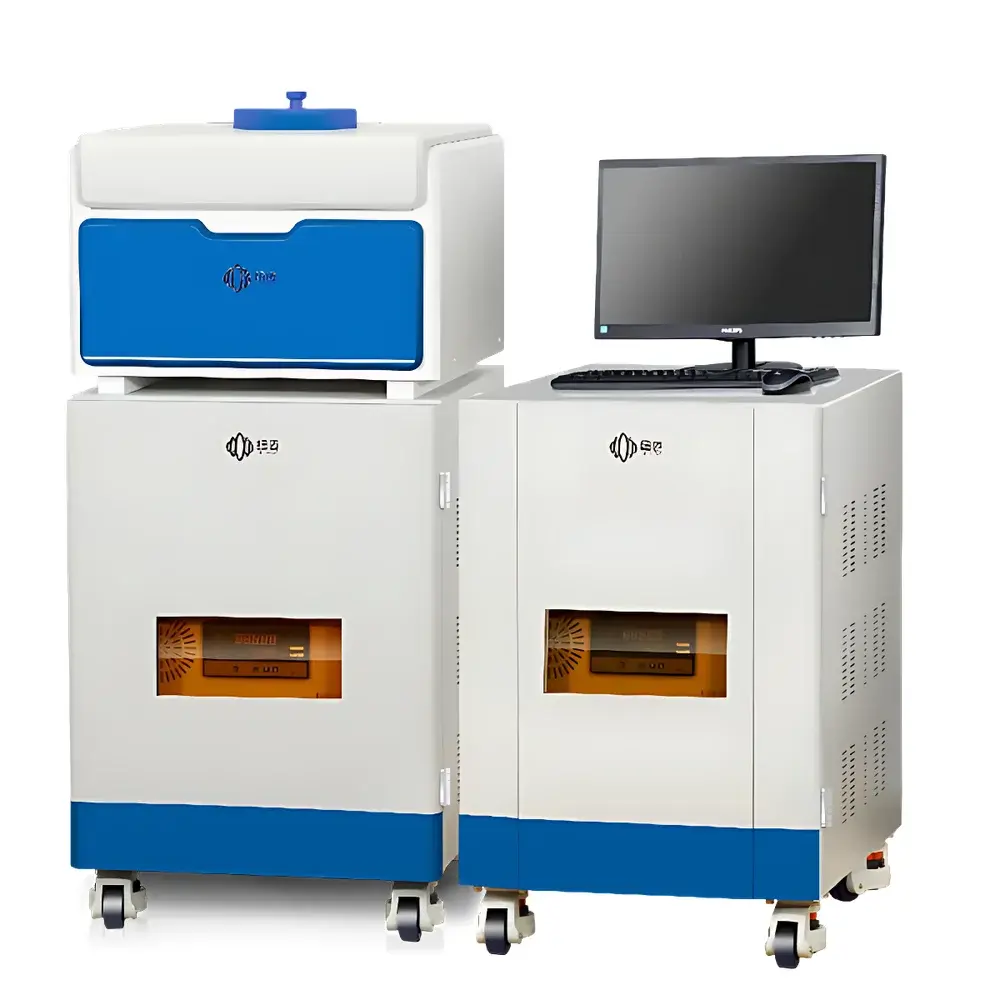
NIUMAG VTMR20-010V-2 Low-Field Nuclear Magnetic Resonance Analyzer for Crosslinking Degree Quantification in Sodium Hyaluronate Hydrogels
| Brand | NIUMAG |
|---|---|
| Origin | Jiangsu, China |
| Model | VTMR20-010V-2 |
| Instrument Type | Low-Field NMR Analyzer |
| Sample Type | Solid-Liquid Hybrid |
| Magnet Type | Permanent Magnet |
| Static Magnetic Field Strength | 0.5 ± 0.05 T |
| Temperature Control Range (Standard) | 25–130 °C |
| Optional Cryo/High-Temp Module | –100 to 200 °C |
| Pulse Sequence | Modified Spin-Echo CPMG (MSE-CPMG) |
| Measurement Time | ≤2 min per sample |
| Detection Nucleus | ¹H |
| Applications | Crosslinking density, T₂ relaxation distribution, phase-separated water dynamics, polymer segment mobility quantification |
Overview
The NIUMAG VTMR20-010V-2 is a dedicated low-field nuclear magnetic resonance (LF-NMR) analyzer engineered for quantitative assessment of crosslinking degree in sodium hyaluronate (NaHA) hydrogels and related biopolymeric networks. Unlike destructive or indirect methods (e.g., swelling ratio, sol-gel fractionation), this instrument leverages the intrinsic sensitivity of ¹H spin relaxation to local molecular mobility—directly probing the heterogeneous dynamics of water and polymer segments within the hydrogel matrix. The core measurement principle relies on transverse relaxation time (T₂) distribution analysis: highly mobile water molecules (bulk-like phase) exhibit long T₂ components (>10 ms), semi-restricted water in nanopores or interfacial domains shows intermediate T₂ (1–10 ms), while protons bound to rigid, crosslinked polymer segments decay rapidly (T₂ < 1 ms). By deconvoluting these T₂ populations via inverse Laplace transform (ILT) and correlating short-T₂ amplitude with crosslink density, the system delivers reproducible, calibration-free quantification traceable to fundamental NMR physics—not empirical correlations.
Key Features
- Optimized MSE-CPMG pulse sequence enabling sub-millisecond dead-time signal recovery, significantly enhancing resolution of ultra-short T₂ components critical for crosslink quantification.
- Integrated temperature-controlled probe with standard 25–130 °C range; optional extended module supports cryogenic (–100 °C) and high-temperature (200 °C) studies for glass transition (Tg) mapping and thermal stability profiling.
- Non-invasive, non-destructive operation: no chemical derivatization, solvent extraction, or sample drying required—preserving native hydration state and structural integrity across repeated measurements.
- Rapid acquisition: full T₂ distribution obtained in ≤120 seconds per sample, supporting high-throughput QC in formulation development and batch release testing.
- Robust permanent magnet architecture (0.5 ± 0.05 T) ensures field homogeneity <0.5 ppm over 20 mm DSV and eliminates cryogen dependency—ideal for regulated lab environments.
Sample Compatibility & Compliance
The VTMR20-010V-2 accepts cylindrical samples up to Ø18 mm × H40 mm, accommodating hydrated NaHA hydrogels, composite scaffolds, injectable formulations, and hybrid polymer systems (e.g., NaHA–gelatin, NaHA–chitosan). Its solid-liquid dual-mode capability enables simultaneous characterization of both polymer network rigidity and entrapped aqueous phases. Data acquisition and processing comply with ISO/IEC 17025 requirements for analytical instrument validation. Software supports audit trail logging, electronic signatures, and 21 CFR Part 11-compliant user access control when deployed under GLP/GMP frameworks. All T₂ fitting algorithms are validated against NIST-traceable reference standards for relaxation time metrology.
Software & Data Management
NIUMAG’s proprietary MesoMR software provides end-to-end workflow automation—from pulse sequence selection and parameter optimization to ILT inversion (non-negative least squares), peak integration, and statistical reporting. Built-in calibration modules allow correlation of T₂ amplitude ratios to absolute crosslink density (mol crosslinks/g polymer) using reference materials with known network topology. Raw FID data, processed T₂ spectra, and metadata (temperature, pulse spacing, scan number) are stored in HDF5 format for long-term archival and third-party analysis interoperability. Export options include CSV, PDF reports, and XML-compatible structured data for LIMS integration.
Applications
- Quantitative crosslink density mapping across NaHA hydrogel batches to ensure mechanical consistency (elastic modulus, compressive strength).
- Correlating T₂ spectral evolution with enzymatic degradation kinetics (e.g., hyaluronidase exposure) to assess network stability.
- Evaluating impact of crosslinker type (e.g., BDDE vs. EDC/NHS) and concentration on heterogeneity of water confinement.
- Monitoring thermal transitions: detection of Tg onset via abrupt T₂ shift in polymer-bound water fraction during controlled heating ramps.
- Characterizing competitive hydration in multi-polymer systems—e.g., displacement of NaHA-bound water by surfactants or drug molecules.
- Supporting regulatory submissions by providing orthogonal, physics-based evidence of structural equivalence between innovator and generic hydrogel products.
FAQ
How does LF-NMR differentiate crosslinked from non-crosslinked regions in NaHA hydrogels?
It resolves distinct ¹H T₂ relaxation components: crosslinked segments yield signals decaying within <1 ms due to restricted rotational diffusion; non-crosslinked chains produce intermediate T₂ (1–10 ms); free water contributes long-T₂ (>10 ms) peaks. Amplitude ratios quantify relative fractions.
Is method validation required before routine use?
Yes—per ICH Q2(R2), users must establish specificity, linearity (0.1–20% crosslink density), precision (RSD <3% for replicate gels), and robustness (pulse spacing, temperature, SNR variations). NIUMAG provides validation templates aligned with USP <1058>.
Can the system analyze opaque or turbid hydrogels?
Yes—NMR is insensitive to optical properties. Turbidity, color, or particulate content do not interfere with ¹H signal detection or T₂ quantification.
What sample preparation is needed?
Minimal: equilibrate hydrogel to target temperature, load into standard NMR tube (Ø10 mm), and insert into probe. No drying, freezing, or labeling required.
Does the instrument support kinetic studies?
Yes—time-resolved T₂ mapping (e.g., every 30 s during crosslinking reaction) is enabled via automated sequence triggering and real-time data streaming.




