
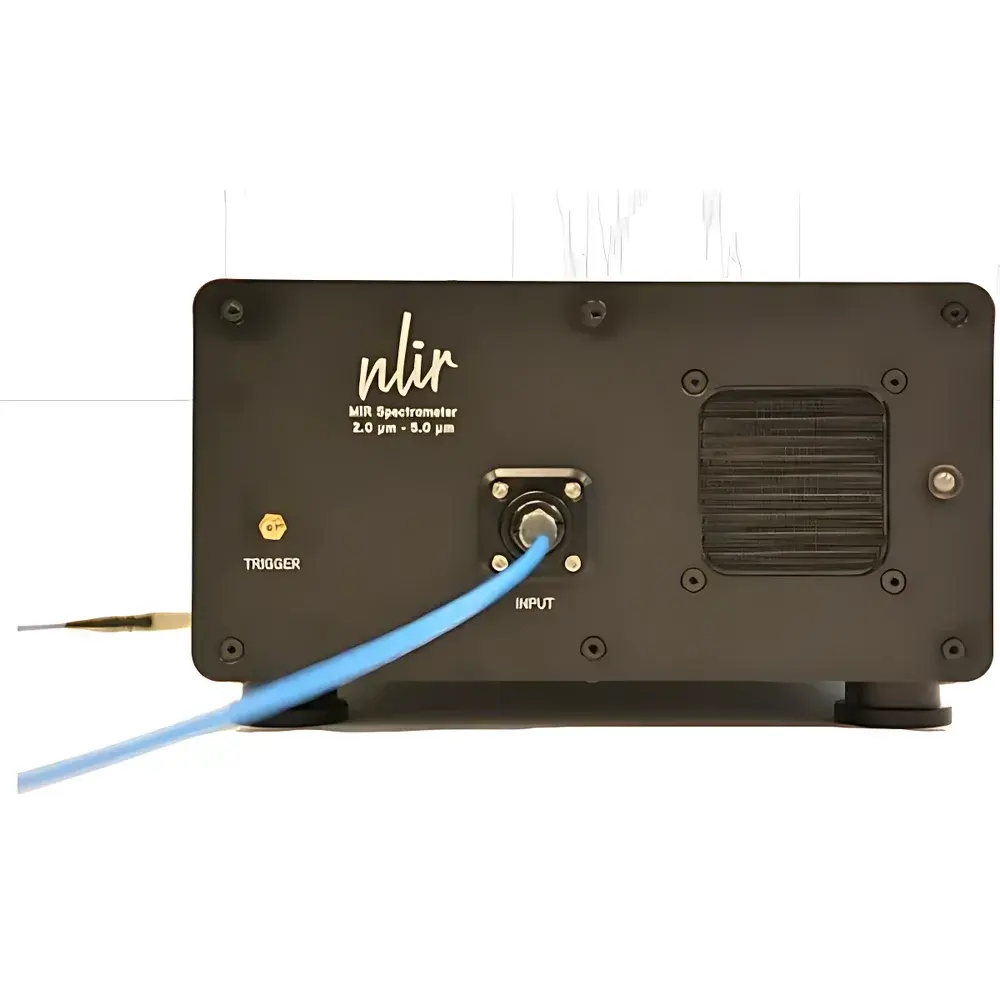
NLIR S2050-400 / S2050-1k / S2050-130k Upconversion-Based Mid-Infrared Spectrometer (2.0–5.0 µm)
| Brand | NLIR |
|---|---|
| Origin | Denmark |
| Model | S2050-400 / S2050-1k / S2050-130k |
| Spectral Range | 2.0–5.0 µm |
| Full-Spectrum Readout Rate | up to 130 kHz |
| Sensitivity | −80 dBm/nm |
| Resolution | down to 2.5 cm⁻¹ (2048-pixel detector array) |
| Input | fiber-coupled (SMF-28, FC/PC optional) |
| Software Interface | native GUI + MATLAB/Python/C (DLL) APIs |
| Compliance | compatible with GLP/GMP data integrity workflows via timestamped, audit-trail-enabled acquisition logs |
Overview
The NLIR S2050 series represents a paradigm shift in mid-infrared (MIR) spectroscopy through patented upconversion photonics. Unlike conventional MIR spectrometers—such as Fourier-transform infrared (FTIR), dispersive grating-based, or microbolometer-array instruments—the S2050 leverages nonlinear frequency upconversion to translate incident 2.0–5.0 µm radiation into the visible–near-infrared (VIS–NIR) range (typically ~650–900 nm). This enables detection using high-speed, low-noise silicon-based CMOS sensors instead of cryogenically cooled MCT or InSb detectors. The core optical architecture integrates a periodically poled lithium niobate (PPLN) crystal pumped by a stabilized 1064 nm laser, where sum-frequency generation (SFG) provides shot-noise-limited conversion efficiency and intrinsic wavelength calibration stability. As a result, the S2050 delivers real-time, single-shot spectral acquisition across its full bandwidth without mechanical scanning or interferometric path-length modulation—making it uniquely suited for dynamic, non-stationary, or transient MIR phenomena.
Key Features
- Ultra-high-speed full-spectrum acquisition: up to 130 kHz readout rate (S2050-130k), enabling time-resolved spectroscopy at microsecond temporal resolution
- High sensitivity: −80 dBm/nm noise-equivalent power (NEP) across 2.0–5.0 µm, achieved via optimized upconversion quantum efficiency and low-dark-current Si detector integration
- High spectral fidelity: 2048-pixel linear array with calibrated dispersion yielding resolution down to 2.5 cm⁻¹ (FWHM), traceable to NIST-traceable reference sources
- Fiber-coupled input (standard SMF-28, FC/PC connector); free-space collimated input option available via removable fiber adapter
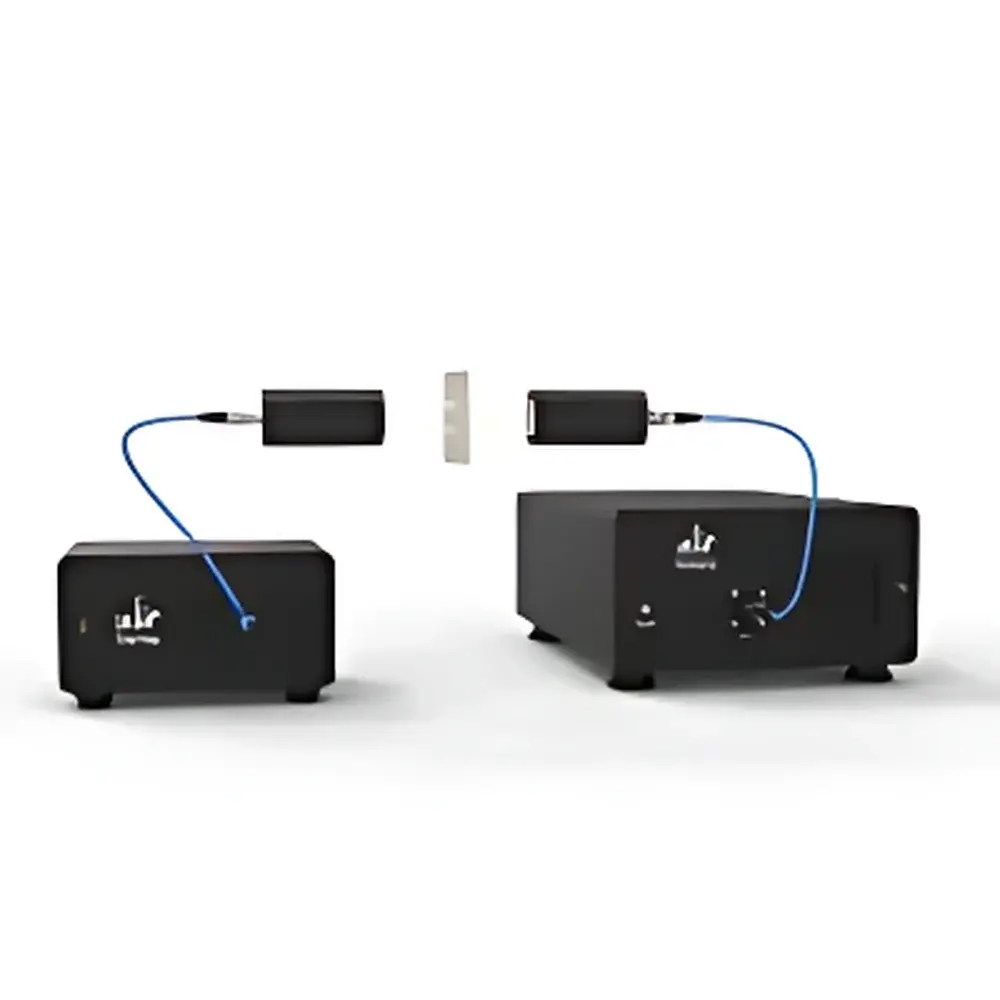
- Modular two-unit configuration: upconversion module + spectrometer head (total system mass ≈ 2 kg), designed for vibration-insensitive benchtop or OEM integration
- Real-time acquisition engine supporting external TTL triggering, hardware-synchronized multi-channel capture, and continuous streaming to RAM or SSD
Sample Compatibility & Compliance
The S2050 series supports non-contact, non-destructive analysis of gases, liquids, solids, thin films, and biological tissues without sample preparation. Its fiber-coupled design enables seamless integration with ATR probes, gas cells (e.g., multipass White cells), liquid flow cells, and free-space optical setups—including OCT interferometers and laser diagnostics platforms. All models comply with IEC 61326-1 (EMC for laboratory equipment) and operate within Class 1 laser safety limits per IEC 60825-1 when used with supplied pump lasers. Data acquisition software maintains full audit trails—including user ID, timestamp, instrument configuration, and raw binary metadata—supporting compliance with FDA 21 CFR Part 11, ISO/IEC 17025, and GLP/GMP documentation requirements. Spectral calibration files are digitally signed and version-controlled to ensure long-term measurement traceability.
Software & Data Management
The included SpectraView GUI provides real-time spectral visualization, background subtraction, dark correction, spectral averaging, and export in HDF5, CSV, and MAT formats. Acquisition modes include single-shot, burst-triggered, continuous streaming, and external-gated capture with sub-microsecond jitter. The software supports automated baseline correction (asymmetric least squares), peak identification (with customizable SNR thresholds), and transmission/absorbance conversion using user-defined reference spectra. For automated workflows, comprehensive APIs are provided for MATLAB (v2018b+), Python (3.8+, NumPy/Pandas compatible), and C/C++ (Windows/Linux DLLs with documented function signatures and error codes). All API calls generate immutable log entries synchronized with spectral timestamps, ensuring reproducibility in regulated environments.
Applications
- Real-time process monitoring: In-line thickness measurement of polymer films (e.g., PET, PS), solvent drying kinetics, and coating uniformity assessment during roll-to-roll manufacturing
- Laser characterization: Dynamic tracking of center wavelength drift, amplitude modulation, and mode-hopping in QCLs, ICLs, and OPOs at kHz–MHz rates
- Optical coherence tomography (OCT): Enabling kHz line-rate MIR-OCT for deep-tissue imaging with enhanced contrast in lipid-rich structures (Opt. Lett. 46, 4558, 2021)
- Gas sensing & emission analysis: Fast-response detection of hydrocarbons (CH₄, C₂H₆), CO, NO, and SF₆ in combustion exhaust or industrial stack monitoring
- Materials science: In situ analysis of thermal degradation, cross-linking kinetics, and crystallinity changes in polymers and pharmaceuticals
- Free-space optical communications: Characterization of atmospheric MIR transmission windows and adaptive optics feedback loops
FAQ
How does upconversion improve signal-to-noise ratio compared to direct MIR detection?
Upconversion shifts MIR photons into the Si detector’s optimal responsivity band (~400–1000 nm), where quantum efficiency exceeds 80%, dark current is <0.1 e⁻/pixel/s, and read noise is <1.5 e⁻ RMS—orders of magnitude better than uncooled microbolometers or thermopiles.
Can the S2050 be used with existing FTIR accessories?
Yes—standard ½” or 1″ optical mounts, KBr beam splitters, and commercial gas/liquid cells are mechanically and optically compatible when adapted to free-space input mode.
What is the minimum measurable exposure time?
The shortest programmable integration time is 1 µs (S2050-130k), limited only by detector readout speed—not by thermal time constants or mechanical inertia.
Is spectral calibration stable over temperature and time?
Yes—calibration is anchored to the fixed phase-matching condition of the PPLN crystal and pump laser wavelength; drift is <0.05 cm⁻¹ over 8 hours at ±1°C ambient fluctuation.
Does the system support synchronization with external lasers or delay stages?
Yes—TTL-compatible trigger input/output ports enable sub-100 ns jitter synchronization with pulsed lasers, choppers, or motion controllers for pump-probe or hyperspectral mapping applications.
Related Products





