
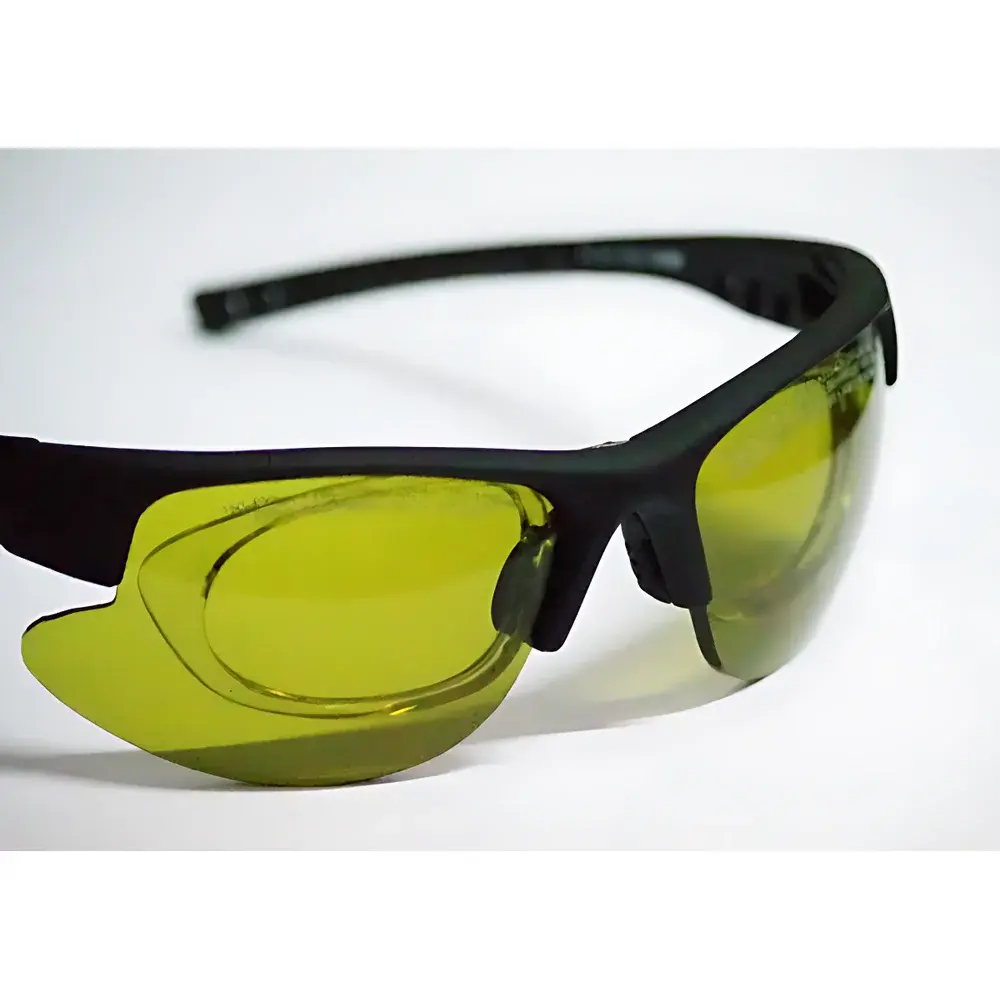
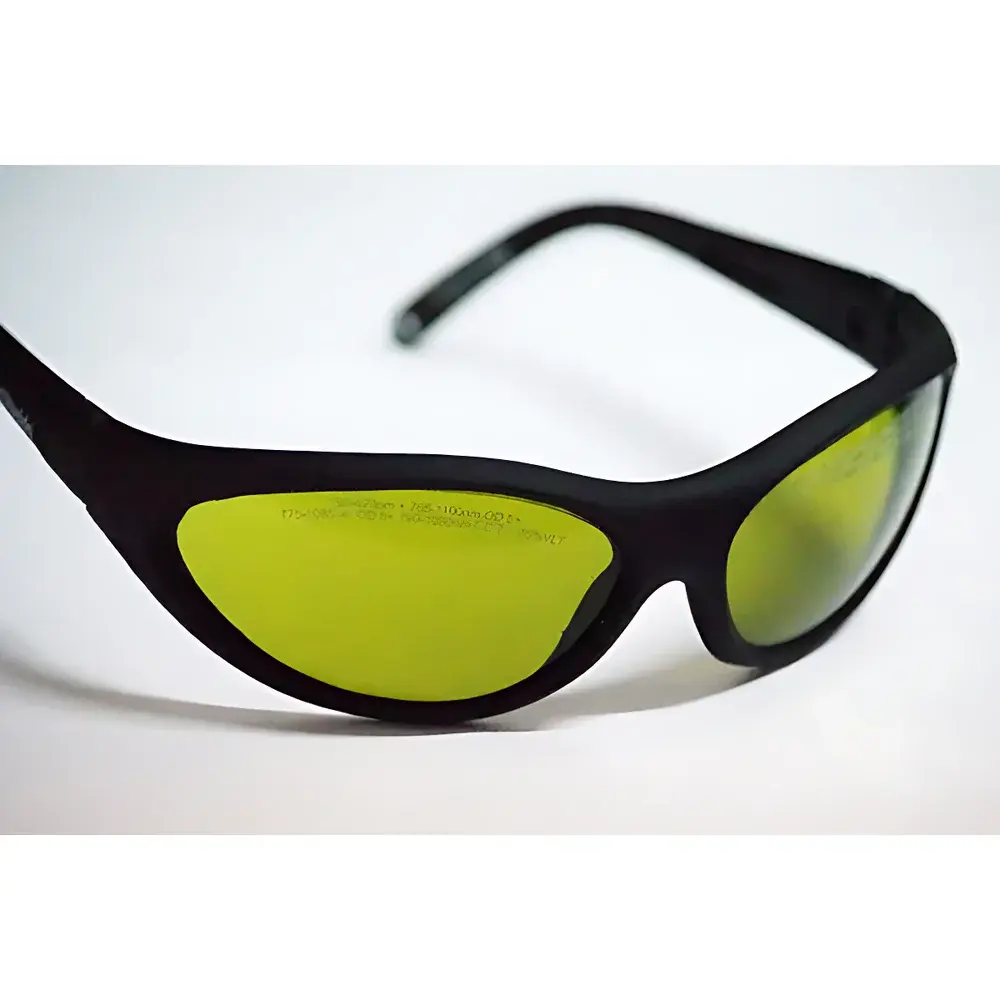
NoIR YG3 Professional Laser Safety Eyewear – USA Imported
| Brand | NoIR Laser |
|---|---|
| Origin | USA |
| Model | YG3 |
| Optical Density (OD) Range | OD 4+ across 190–11,000 nm |
| Lens Material | Hard-Coated Polycarbonate with Embedded Absorptive Dye |
| Frame Style | Over-Glasses Compatible |
| Compliance | ANSI Z136.1-2022, EN 207:2017 Class RB/RC/RD/RE |
Overview
The NoIR YG3 Professional Laser Safety Eyewear is a rigorously engineered optical protection device designed for personnel working with high-power laser systems across research laboratories, industrial manufacturing cells, medical laser suites, and defense-related optical test environments. Built upon NoIR Laser’s decades of expertise in laser radiation attenuation, the YG3 employs a proprietary formulation of absorptive dyes uniformly dispersed within optically homogeneous polycarbonate substrate—ensuring stable, wavelength-specific optical density (OD) without reliance on reflective coatings that may degrade under thermal or mechanical stress. Its certified spectral coverage spans 190 nm to 11,000 nm (0.19–11 µm), encompassing deep ultraviolet (DUV), visible, near-infrared (NIR), short-wave infrared (SWIR), mid-wave infrared (MWIR), and long-wave infrared (LWIR) emission bands generated by solid-state lasers (e.g., Nd:YAG, Ti:Sapphire, Er:YAG), gas lasers (e.g., Ar⁺, CO₂), diode lasers, and ultrafast amplified systems. The eyewear operates on a broadband absorption principle—not interference-based reflection—making it inherently stable against angle-of-incidence variation and immune to coating delamination or laser-induced damage threshold (LIDT) limitations common in coated optics.
Key Features
- Optical Density ≥4.0 (OD4+) across full 190–11,000 nm range—validated per ANSI Z136.1-2022 and EN 207:2017 test protocols for RB (continuous wave), RC (pulsed 10 ms) exposure classes.
- Hard-coated polycarbonate lenses with embedded absorptive dye matrix—eliminates surface reflectivity concerns while maintaining structural integrity under impact (meets ANSI Z87.1-2020 high-impact requirements).
- Scratch-resistant surface: Mechanical abrasion does not reduce optical density, as attenuation occurs volumetrically within the lens bulk rather than at the interface.
- Full peripheral shielding: Integrated top and side shields provide ≥180° lateral protection against stray reflections and off-axis beam exposure.
- Ergonomic over-glasses frame design with adjustable nose pads and flexible temple arms—compatible with prescription eyewear and suitable for extended wear during alignment, maintenance, or operational procedures.
- Includes protective storage case, non-abrasive microfiber cleaning cloth, and detachable lanyard for secure handling in dynamic lab or production floor environments.
Sample Compatibility & Compliance
The YG3 is validated for use with solid-state laser sources including Q-switched Nd:YAG (1064 nm, 532 nm, 355 nm, 266 nm), tunable Ti:Sapphire oscillators (680–1080 nm), fiber lasers (1030–1080 nm, 1550 nm), quantum cascade lasers (QCLs, 3–12 µm), CO₂ lasers (10.6 µm), and HeNe lasers (632.8 nm). It conforms to international laser safety standards including ANSI Z136.1-2022 (American National Standard for Safe Use of Lasers), EN 207:2017 (Personal Eye Protection Against Laser Radiation), and ISO 13694:2021 (Determination of Laser-Induced Damage Threshold of Optical Surfaces). Documentation includes traceable calibration reports and batch-specific spectral transmittance curves, supporting GLP/GMP audit readiness and institutional laser safety officer (LSO) program compliance.
Software & Data Management
While the YG3 is a passive optical device requiring no firmware or software integration, NoIR provides downloadable spectral attenuation data files (CSV and MATLAB-compatible .mat formats) for each production lot via their certified distributor portal. These datasets enable integration into institutional laser hazard analysis workflows—including custom MATLAB or Python-based Nominal Ocular Hazard Distance (NOHD) calculators, LSO-maintained safety databases, and electronic laboratory notebooks (ELNs) compliant with 21 CFR Part 11 requirements when paired with digital signature-enabled validation protocols. Distributors supply formal certificates of conformance and material declarations (RoHS, REACH) upon request.
Applications
- Laser alignment and beam path verification in ultrafast amplifier chains and optical parametric amplifiers (OPAs)
- Medical laser procedure support (dermatology, ophthalmology, dentistry) where multi-wavelength platform flexibility is required
- Industrial laser processing stations using multi-kilowatt fiber or disk lasers (1 µm and 10.6 µm)
- Defense R&D labs conducting directed energy weapon (DEW) component testing and countermeasure evaluation
- Academic physics laboratories performing nonlinear optics experiments involving harmonic generation and supercontinuum sources
- Quantum technology facilities operating trapped-ion or neutral-atom platforms with multiple laser cooling and repumping wavelengths
FAQ
Does the YG3 meet FDA requirements for clinical laser use?
Yes—the YG3 complies with FDA 21 CFR 1040.10 and 1040.11 requirements for laser protective equipment used in medical settings, and carries CE marking under the EU Medical Device Regulation (MDR) Annex I essential requirements for Class I devices.
Can the YG3 be cleaned with isopropyl alcohol?
Yes—lenses may be wiped with 70% isopropyl alcohol on the provided microfiber cloth; avoid acetone or chlorinated solvents which may compromise polycarbonate integrity.
Is there a replacement lens program available?
NoIR offers certified replacement lenses through authorized distributors, supplied with new spectral validation documentation and batch traceability—critical for institutions maintaining ISO/IEC 17025-accredited calibration records.
How often should laser safety eyewear be retested?
Per ANSI Z136.1-2022 Section 4.5.3, visual inspection must occur before each use; formal optical density verification is recommended annually or after any suspected exposure incident, using NIST-traceable spectrophotometric methods.






