
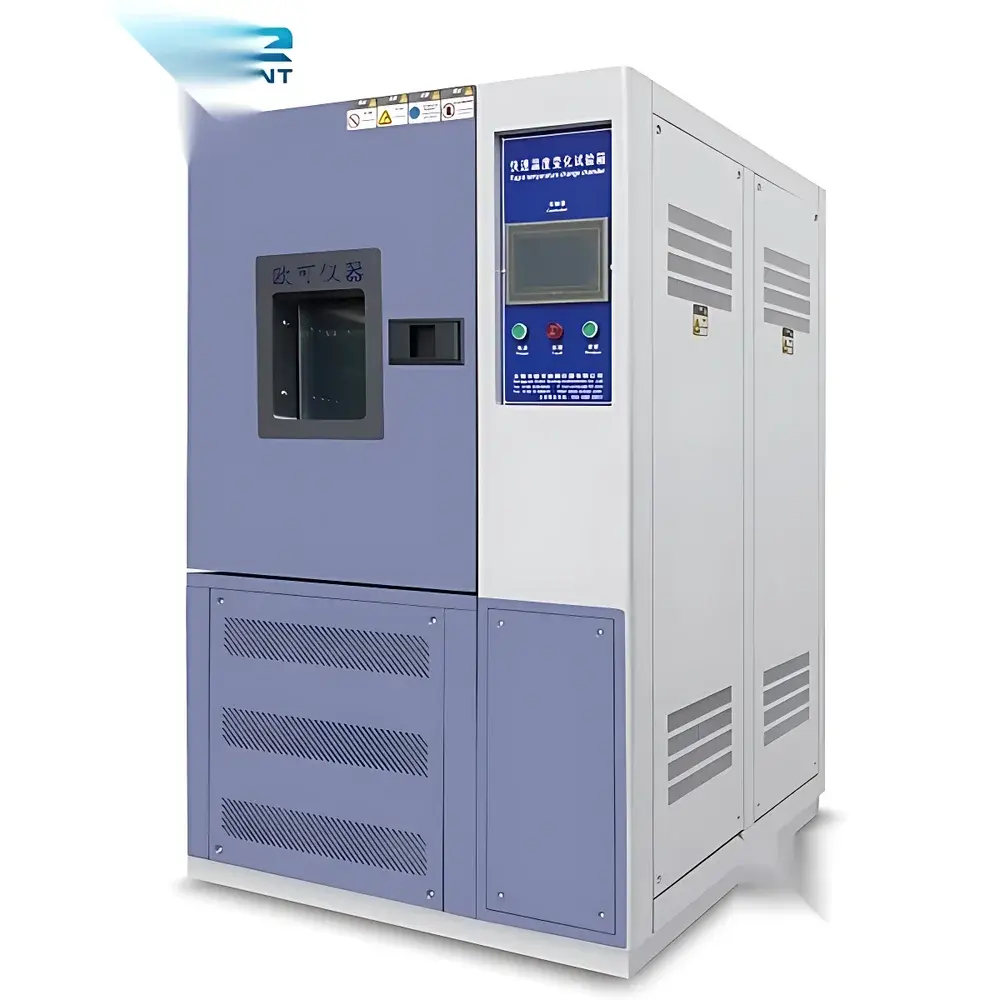
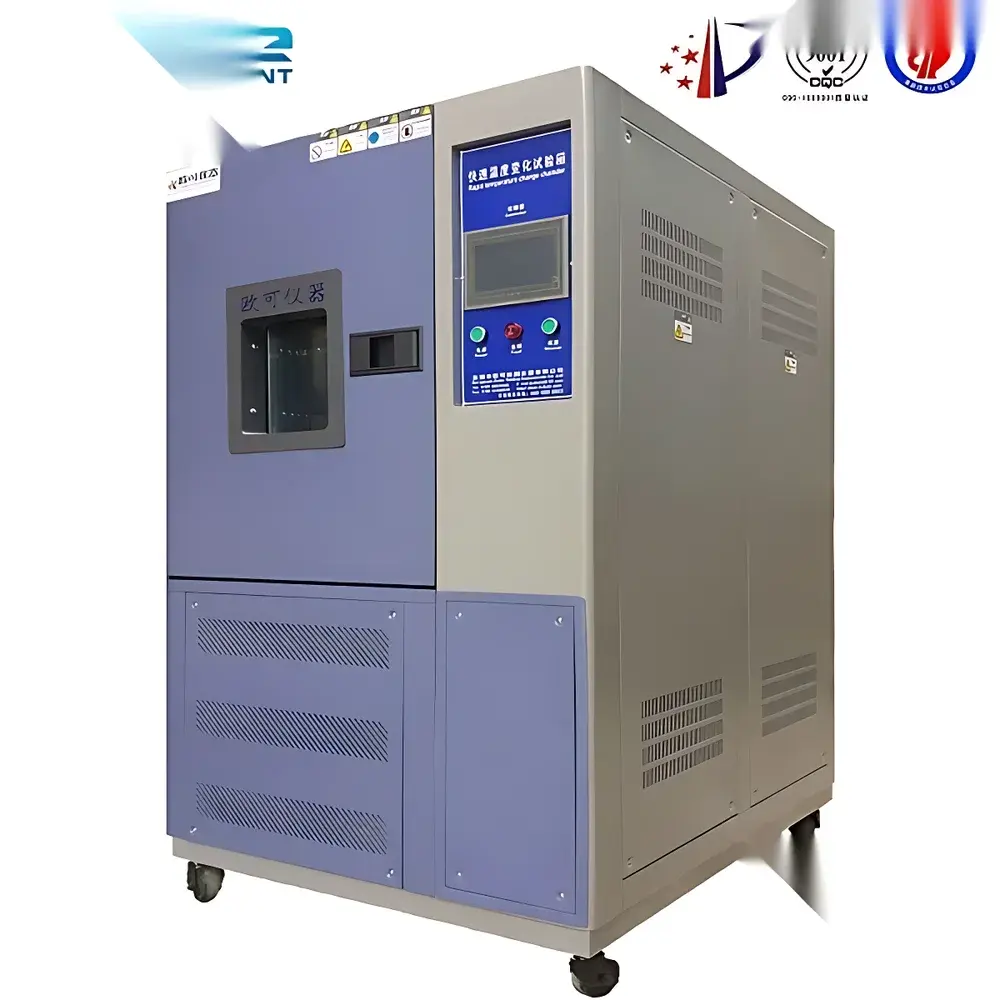
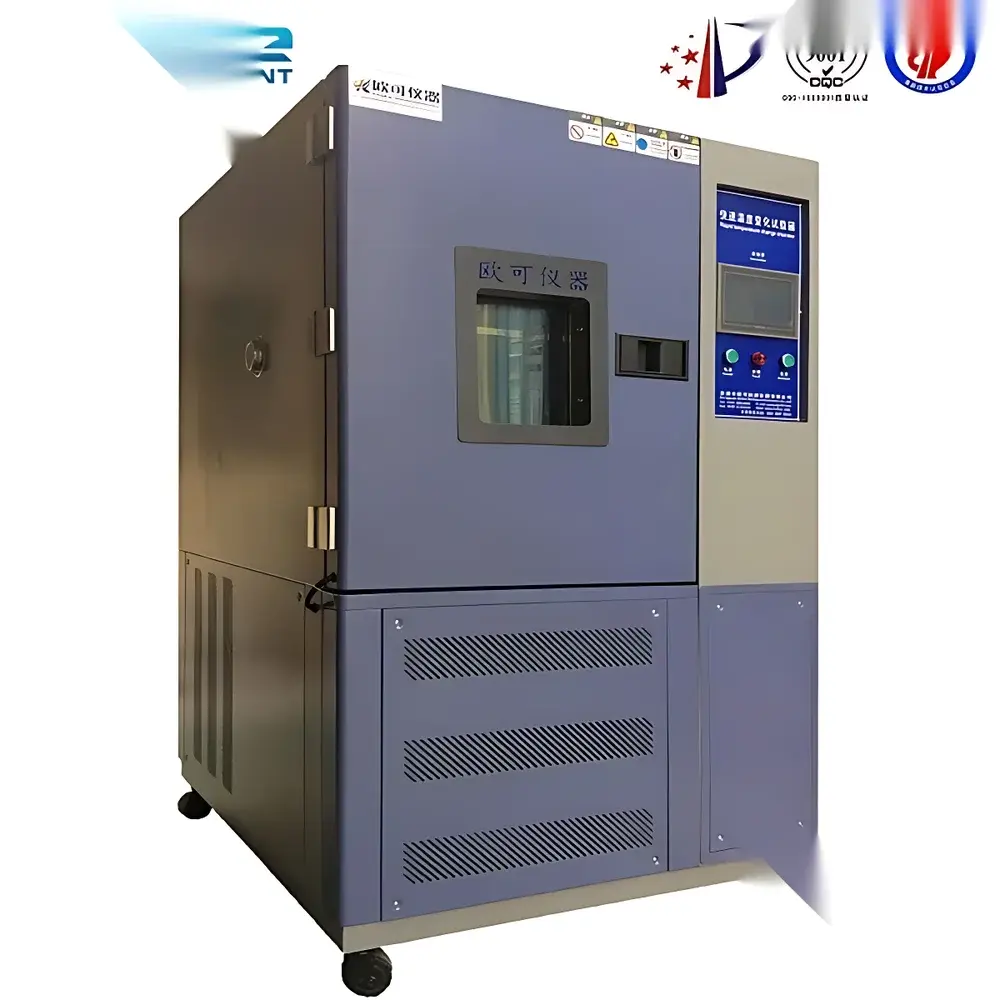
Nonlinear Rapid Temperature Cycling Chamber – Industrial-Grade Environmental Test System
| Brand | Other Brands |
|---|---|
| Origin | Imported |
| Manufacturer Type | Authorized Distributor |
| Capacity | 150 L / 408 L / 800 L |
| Internal Dimensions | 500×600×500 mm / 600×850×800 mm / 1000×1000×800 mm (W×H×D) |
| Temperature Range | −20 °C to +150 °C / −40 °C to +150 °C / −60 °C to +150 °C |
| Humidity Range | 20–98 %RH |
| Temp. Uniformity | ±0.5 °C |
| RH Uniformity | ±3 %RH |
| Temp. Stability | ±0.3 °C |
| RH Stability | ±2.5 %RH |
| Heating Rate | −40 °C to +100 °C in ≈45 min |
| Cooling Rate | +20 °C to −40 °C in ≈55 min |
| Refrigeration System | Dual-stage, hermetic imported compressors (air-cooled or water-cooled options) |
| Heating Method | Stainless steel finned heaters |
| Humidification | Surface evaporation with auxiliary humidifier, dry-run and overheat protection |
| Dehumidification | Refrigerant-based latent heat removal |
| Insulation | Rock wool + rigid polyurethane foam |
| Interior Material | SUS#304 stainless steel |
| Exterior Finish | Powder-coated steel or optional SUS#304 |
| Power Supply | AC 220 V / 380 V ±10 %, 1-phase or 3-phase, 50/60 Hz |
Overview
The Nonlinear Rapid Temperature Cycling Chamber is an industrial-grade environmental test system engineered for high-fidelity simulation of extreme thermal transients encountered in aerospace, automotive electronics, semiconductor packaging, and military-grade component qualification. Unlike linear ramp-rate chambers, this system implements nonlinear temperature profile control—enabling programmable acceleration/deceleration phases, dwell periods, and asymmetric heating/cooling kinetics aligned with real-world operational stress cycles (e.g., MIL-STD-810H Method 503.7, IEC 60068-2-14). Its dual-stage refrigeration architecture, combined with balanced temperature and humidity (BTH) regulation, ensures precise, repeatable execution of complex test sequences—including rapid transitions across −60 °C to +150 °C while maintaining tight uniformity (±0.5 °C) and stability (±0.3 °C) across the full working volume. Designed for compliance-driven validation labs, it supports traceable calibration per ISO/IEC 17025 requirements and integrates seamlessly into GLP/GMP audit workflows.
Key Features
- Nonlinear ramp profiling: Programmable variable-rate temperature transitions—critical for replicating field-relevant thermal shock dynamics without overshoot or thermal lag artifacts.
- Dual-stage refrigeration: Hermetically sealed, imported compressors with air- or water-cooled condensation options ensure stable low-temperature performance down to −60 °C and rapid recovery after thermal load changes.
- Balanced temperature-humidity (BTH) control: Independent PID-regulated heating, humidification, and refrigerant-based dehumidification subsystems eliminate cross-coupling effects between temperature and RH setpoints.
- Robust thermal insulation: Composite wall construction with rock wool backing and rigid polyurethane foam (≥100 mm thickness) minimizes thermal bridging and external ambient influence.
- Full-spectrum safety architecture: Twelve integrated interlocks—including compressor overload, refrigerant pressure fault, chamber overtemperature/overhumidity, water shortage detection, and independent upper-limit thermal cutoff—meet IEC 61000-6-2 EMC and UL 61010-1 safety standards.
- Modular interior configuration: Adjustable stainless-steel shelves, dual-layer anti-fog viewing window, standardized 50-mm test port (with silicone gasket), and LED interior lighting support diverse DUT geometries and in-chamber instrumentation.
Sample Compatibility & Compliance
The chamber accommodates payloads up to 120 kg (depending on selected model and mounting configuration) and supports a wide range of sample types—from PCB assemblies and battery modules to hermetically sealed sensors and optoelectronic housings. Internal dimensions (500×600×500 mm to 1000×1000×800 mm) and volume options (150 L to 800 L) allow scalability from benchtop reliability screening to full-system environmental stress screening (ESS). All models comply with key international test standards including ASTM D4332, IEC 60068-2-1 (cold), IEC 60068-2-2 (dry heat), IEC 60068-2-30 (damp heat cyclic), and JEDEC JESD22-A104. Optional calibration certificates are available with NIST-traceable reference sensors and uncertainty reporting per ISO/IEC 17025.
Software & Data Management
Equipped with a 7-inch color touchscreen HMI running embedded Linux, the system provides intuitive profile programming, real-time parameter visualization, and event-triggered data logging at user-defined intervals (minimum 1 s). Standard Ethernet (RJ45) and RS-485 interfaces enable integration with LabVIEW, MATLAB, or enterprise MES/QMS platforms. Optional software packages include PC-based control suite with CSV export, automated report generation (PDF/Excel), and FDA 21 CFR Part 11-compliant audit trail functionality—supporting electronic signatures, role-based access control, and immutable log archiving for regulated environments.
Applications
- Thermal cycling validation of automotive ECUs under ISO 16750-4 conditions
- Accelerated life testing of lithium-ion battery packs per UN 38.3 thermal shock protocols
- Qualification of avionics enclosures per DO-160G Section 4 (temperature) and Section 5 (humidity)
- Reliability assessment of MEMS devices and wafer-level packaging subjected to non-uniform thermal gradients
- Environmental stress screening (ESS) of medical device PCBs prior to ISO 13485 certification
- Material compatibility testing of conformal coatings and encapsulants under combined thermal/humidity aging
FAQ
What does “nonlinear” mean in this context?
It refers to the chamber’s ability to execute temperature ramps with programmable acceleration and deceleration—rather than fixed linear rates—enabling realistic simulation of transient thermal profiles observed during vehicle engine start-up, aircraft ascent/descent, or power-on/power-off events.
Can the system perform humidity cycling independently of temperature?
Yes. The BTH control architecture allows independent RH setpoint modulation within the operating temperature window, supporting tests such as damp heat cyclic (IEC 60068-2-30) and humidity storage (IEC 60068-2-78).
Is remote monitoring supported?
Standard Ethernet connectivity enables secure remote access via HTTP/HTTPS, allowing real-time status viewing, alarm notifications, and limited profile management through a browser-based interface.
What maintenance is required for long-term reliability?
Recommended quarterly checks include refrigerant pressure verification, condensate drain line inspection, humidifier tank cleaning, and calibration verification using accredited reference sensors—documented in the included maintenance log template.
Does the system meet electromagnetic compatibility (EMC) requirements?
Yes. Certified to IEC 61000-6-2 (immunity) and IEC 61000-6-3 (emissions) for industrial environments, with conducted and radiated emissions below Class A limits.



