
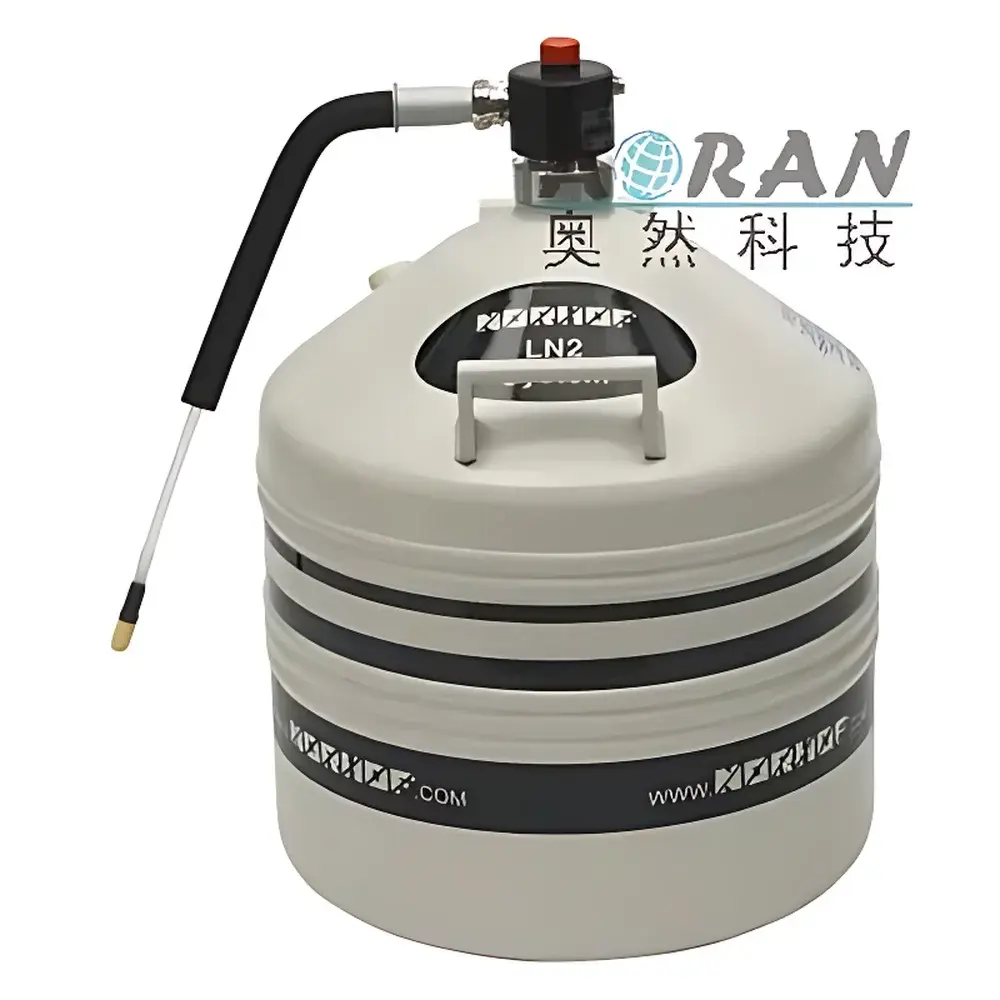
Norhof 455 Manual Liquid Nitrogen Dispensing System
| Brand | Norhof |
|---|---|
| Origin | Netherlands |
| Manufacturer Type | Authorized Distributor |
| Origin Category | Imported |
| Model | 455 |
| Price | €50,000 |
| Static Evaporation Rate | <0.5 L/day |
| Dispensing Flow Rate | Droplet-to-2 L/min (Fixed, Non-adjustable) |
| Operating Pressure | <200 mBar |
| Hose Pre-cooling Time | 10–40 s (Dependent on LN₂ Level) |
| Power Supply | 115 V / 230 V AC or 12 V AC/DC |
| Average Power Consumption | 10 W (Peak: 50 W) |
| Dewar Capacity | 35 L / 50 L |
| Dewar Diameter | 480 mm / 500 mm |
| Dewar Height | 643 mm / 727 mm |
| Empty/Full Weight | 13 / 41.5 kg (35 L) or 17 / 57.5 kg (50 L) |
| Standard Equipment | Controller, Power Unit, Interconnecting Cables |
| Optional Accessories | 5-Wheel Mobile Base (10 cm height), LN₂ Pump Mounting Bracket |
Overview
The Norhof 455 Manual Liquid Nitrogen Dispensing System is a purpose-engineered, pressure-free cryogenic transfer solution designed for precise, low-risk handling of liquid nitrogen (LN₂) in research laboratories, biobanks, and clinical sample processing environments. Unlike pressurized dispensing systems that rely on tank headspace pressure or external pumps, the Norhof 455 operates via gravity-assisted siphon flow initiated by a manually actuated solenoid valve—eliminating mechanical stress on dewars, minimizing thermal ingress, and ensuring inherently stable, vibration-free delivery. Its core architecture adheres to fundamental cryogenic engineering principles: passive thermal isolation, minimized surface-area-to-volume ratio in vapor-phase pathways, and elimination of dynamic pressure differentials that accelerate boil-off. This design directly supports long-term sample integrity in ultra-low-temperature workflows where thermal stability, operator safety, and LN₂ conservation are mission-critical.
Key Features
- Zero-pressure dispensing mechanism: No pressurization of the LN₂ dewar, eliminating risks of splashing, acoustic noise, structural vibration, and uncontrolled phase transition during transfer.
- Fixed-flow rate control: Delivers LN₂ at a consistent, user-selectable range—from gentle droplet dispensing up to 2 L/min—without adjustable throttling valves, ensuring repeatable volumetric delivery across shifts and operators.
- Ultra-low static evaporation rate: <0.5 L/day under ISO 23745-compliant ambient conditions (23 °C, 50% RH), achieved through high-efficiency multilayer vacuum insulation and optimized neck geometry.
- Minimal thermal load interface: Absence of mechanical valves within the cryogenic path prevents conductive heat leakage; all active components reside outside the cold zone, preserving dewar thermal efficiency.
- Flexible power compatibility: Supports universal input (115 V / 230 V AC) and low-voltage operation (12 V AC/DC), enabling integration into mobile platforms, cleanrooms with isolated power feeds, or backup battery systems.
- Low-power electronics: Average consumption of only 10 W (50 W peak during valve actuation) reduces facility load and enhances operational continuity during extended use cycles.
Sample Compatibility & Compliance
The Norhof 455 is validated for direct manual filling of small-format cryovessels including 2 mL vial racks, 96-well plates in cryo-boxes, cryo-straws, and compact dry-shippers (e.g., CryoEX, MVE DuraCold). It meets essential requirements for GLP-compliant biorepository operations per ISO 20387:2018 (Biobanking — General requirements for biobank quality management systems) and aligns with Annex A of ASTM F2656-22 (Standard Guide for Cryopreservation of Biological Materials). The system’s non-pressurized architecture satisfies IEC 61000-6-3 emission limits for laboratory electromagnetic environments and carries CE marking per EU Machinery Directive 2006/42/EC and Low Voltage Directive 2014/35/EU.
Software & Data Management
The Norhof 455 is a standalone manual system with no embedded firmware or digital logging capability—intentionally designed to avoid software validation burdens in regulated environments. All operational parameters (flow initiation time, duration, and cumulative usage intervals) are documented externally via lab notebooks or LIMS-integrated manual entry. For facilities requiring audit trails, optional integration with third-party PLC-based timers or barcode-triggered dispensing logs (via external relay interface) supports 21 CFR Part 11-compliant electronic records when paired with validated software platforms.
Applications
- Manual top-up of small-volume LN₂ storage units (e.g., cryo-canisters, portable dewars) without disturbing stored samples.
- Cryopreservation of sensitive cell lines and primary tissues where thermal shock from rapid LN₂ influx must be avoided.
- Controlled pre-cooling of analytical instrumentation components (e.g., NMR probe inserts, mass spectrometer ion sources).
- On-demand freezing of reagents or reaction mixtures in synthetic chemistry workflows requiring sub-196 °C quenching.
- Filling of dry-shippers prior to off-site transport of viable cells, embryos, or stem cell products under EMA/CAT and FDA guidance for biological shipping containers.
FAQ
Does the Norhof 455 require periodic calibration or maintenance?
No scheduled calibration is required; however, annual visual inspection of hose integrity, O-ring condition, and controller electrical connections is recommended per Norhof Technical Bulletin TB-LN2-455 Rev. 3.
Can the system be used with non-Norhof dewars?
Yes—provided the dewar features a standard CGA-680 outlet port and maintains internal pressure below 200 mBar during dispensing. Compatibility verification with dewar manufacturer documentation is advised.
Is the 5-wheel mobile base compatible with cleanroom flooring?
The polyurethane casters are non-marking and static-dissipative (10⁶–10⁹ Ω), certified to ISO 14644-1 Class 5 requirements when used with appropriate floor finish.
What is the expected service life of the solenoid actuator?
Rated for ≥500,000 operational cycles under nominal LN₂ temperature exposure (-196 °C), corresponding to >10 years of typical academic lab usage (≈100 dispenses/day).






