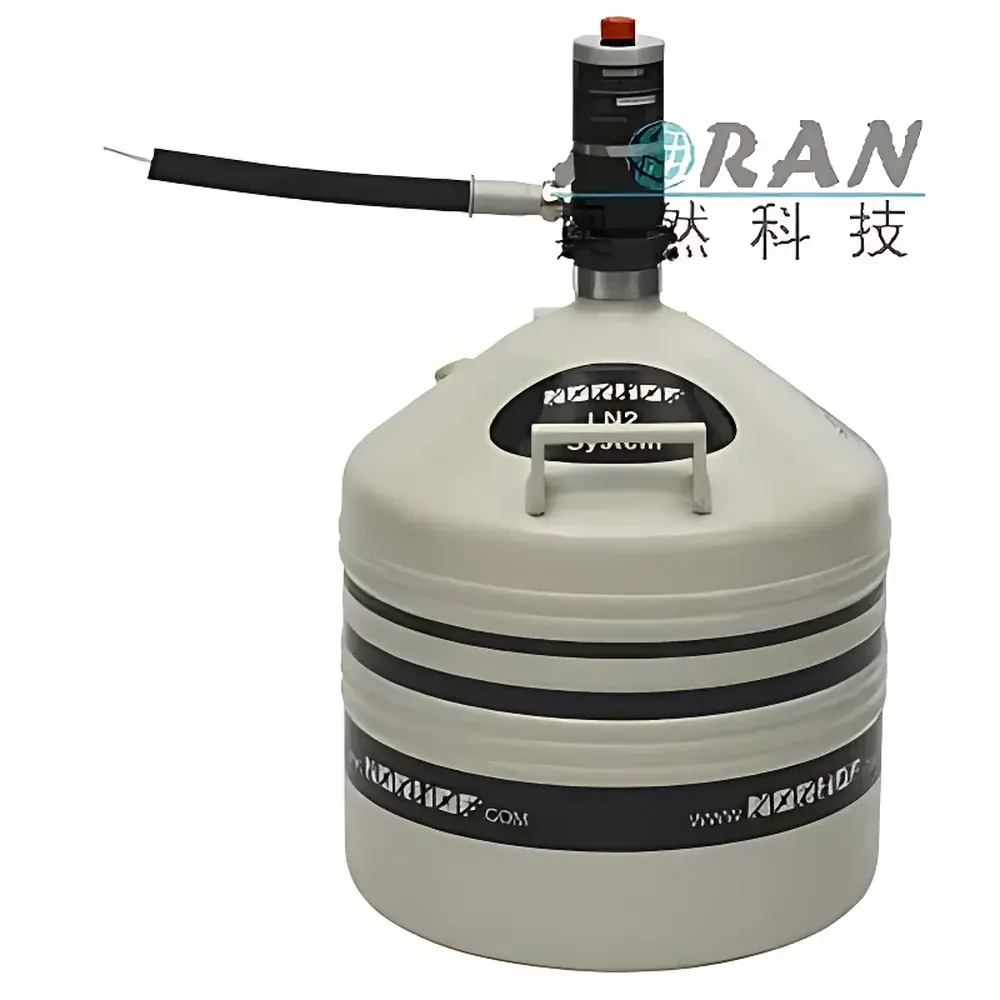
Norhof 606 Fully Automated Liquid Nitrogen Micro-Dispensing System
| Brand | Norhof |
|---|---|
| Origin | Netherlands |
| Model | 606 |
| Static Evaporation Rate | <0.5 L/day |
| Dispensing Flow Rate | 0.1 L/min (dropwise) |
| Operating Pressure | <300 mBar |
| Power Supply | 115/230 V AC or 12 V AC/DC |
| Average Power Consumption | 10 W (50 W during dispensing) |
| LN₂ Tank Capacities | 35 L / 50 L / 100 L |
| Tank Dimensions (Ø × H) | 480 × 791 mm / 500 × 875 mm / 500 × 1235 mm |
| Empty/Full Weight | 13/41.5 kg / 17/57.5 kg / 32/113 kg |
| Tubing | PTFE, OD 6.25 mm, ID 4 mm, insulated with 32 mm foam sheath |
| Control Interface | 5 V TTL trigger (on/off), RS232 serial command set |
| Software | PC-based monitoring suite with real-time pump status, alarm logging (empty tank, <5 L remaining, sensor fault, freeze detection), and mechanical overpressure relief valve |
Overview
The Norhof 606 Fully Automated Liquid Nitrogen Micro-Dispensing System is an engineered solution designed specifically for integration with differential scanning calorimeters (DSC) requiring precise, low-flow cryogenic cooling. Unlike conventional manual liquid nitrogen (LN₂) handling or pressurized gas-phase delivery systems, the 606 employs a positive-displacement peristaltic pump architecture coupled with closed-loop level sensing to deliver controlled, dropwise LN₂ directly into the DSC sample chamber. This ensures stable thermal baselines during extended low-temperature measurements—down to −196 °C—while minimizing thermal perturbation, condensation artifacts, and operator exposure. The system operates without mechanical valves or high-pressure regulators, eliminating heat ingress pathways and reducing parasitic boil-off. Its ultra-low static evaporation rate (<0.5 L/day) and thermally optimized PTFE tubing assembly (with 32 mm foam insulation) support unattended 24-hour operation under GLP-compliant laboratory conditions.
Key Features
- Dropwise micro-dispensing capability (adjustable down to 0.1 L/min) ensures consistent fill depth (~4 cm) in DSC crucibles while maintaining minimal flow during data acquisition
- Integrated capacitive liquid level sensor enables real-time feedback control; system halts dispensing automatically when target level is reached or when DSC signals cessation of cooling demand via 5 V TTL or RS232 interface
- No external control cabinet required—fully self-contained design includes pump, insulated tubing (1.6 m standard), phase separator, power supply, and embedded logic board
- Mechanical overpressure relief valve provides fail-safe protection against pressure buildup; independent freeze-detection circuitry triggers audible/visual alarms upon sensor icing or signal loss
- Low-power operation (10 W average, 50 W peak) supports compatibility with UPS-backed lab infrastructure; dual-voltage input (115/230 V AC or 12 V AC/DC) allows flexible deployment in mobile or field-configured labs
- PTFE-lined fluid path eliminates metal contamination risk and resists embrittlement at cryogenic temperatures; all wetted components conform to USP Class VI biocompatibility standards
Sample Compatibility & Compliance
The Norhof 606 is validated for use with major DSC platforms including PerkinElmer, TA Instruments, Mettler Toledo, and Shimadzu (optional adapter available for DSC-60). It complies with IEC 61000-6-3 (EMC emissions) and IEC 61010-1 (safety requirements for electrical equipment for measurement, control, and laboratory use). The system supports audit-ready operation under FDA 21 CFR Part 11 when used with validated PC software configurations—enabling electronic signatures, secure user access levels, and immutable event logs for pump activation, alarm events, and LN₂ level transitions. All hardware interfaces meet ISO/IEC 17025 traceability requirements for temperature-controlled instrumentation in accredited testing laboratories.
Software & Data Management
The included Windows-compatible monitoring application provides live visualization of pump status, LN₂ level trends, and cumulative dispensed volume. Alarm states—including tank depletion, residual LN₂ below 5 L threshold, sensor failure, and freeze detection—are timestamped and exportable in CSV format for QA/QC documentation. The software supports configurable notification thresholds and integrates with LabArchives or Electronic Lab Notebook (ELN) platforms via standardized API endpoints. Audit trail functionality records all user-initiated actions (e.g., manual override, calibration reset) with operator ID and system clock stamp—ensuring full compliance with GLP and GMP documentation mandates.
Applications
- Extended low-temperature DSC profiling of polymers, pharmaceuticals, and biomaterials requiring thermal stability across multi-day crystallization or glass transition studies
- High-reproducibility enthalpy quantification in regulatory submissions (ICH Q5C, USP ) where baseline drift must remain below ±0.05 mW over >12-hour runs
- Automated cryo-conditioning of biological samples prior to structural analysis (e.g., SAXS, cryo-EM grid preparation)
- Validation of thermal insulating materials using modulated DSC protocols under ISO 11357-1
- Long-term stability testing of battery electrolytes and solid-state conductors at sub-ambient temperatures
FAQ
Does the Norhof 606 require compressed air or external pressure sources?
No—it operates exclusively via electrically driven peristaltic pumping; no gas cylinders, regulators, or pressurized dewars are needed.
Can the system be integrated into a fully automated DSC workflow with third-party scheduling software?
Yes—RS232 command protocol supports bidirectional communication for start/stop synchronization and status polling; custom Python or LabVIEW drivers are available upon request.
What maintenance is required for long-term reliability?
Annual inspection of PTFE tubing integrity and recalibration of the capacitive level sensor using certified LN₂ reference volumes; no lubrication or consumable replacement is required.
Is the 606 compatible with hazardous location environments (e.g., Class I Div 2)?
Not inherently—however, explosion-proof enclosures and intrinsically safe barrier kits can be supplied as optional accessories for ATEX/IECEx-certified installations.
How does the system prevent ice formation inside the dispensing line?
The combination of continuous low-flow operation, vacuum-jacketed phase separator, and ambient-temperature thermal break in the insulated tubing minimizes moisture ingress and condensation nucleation points.
Related Products