
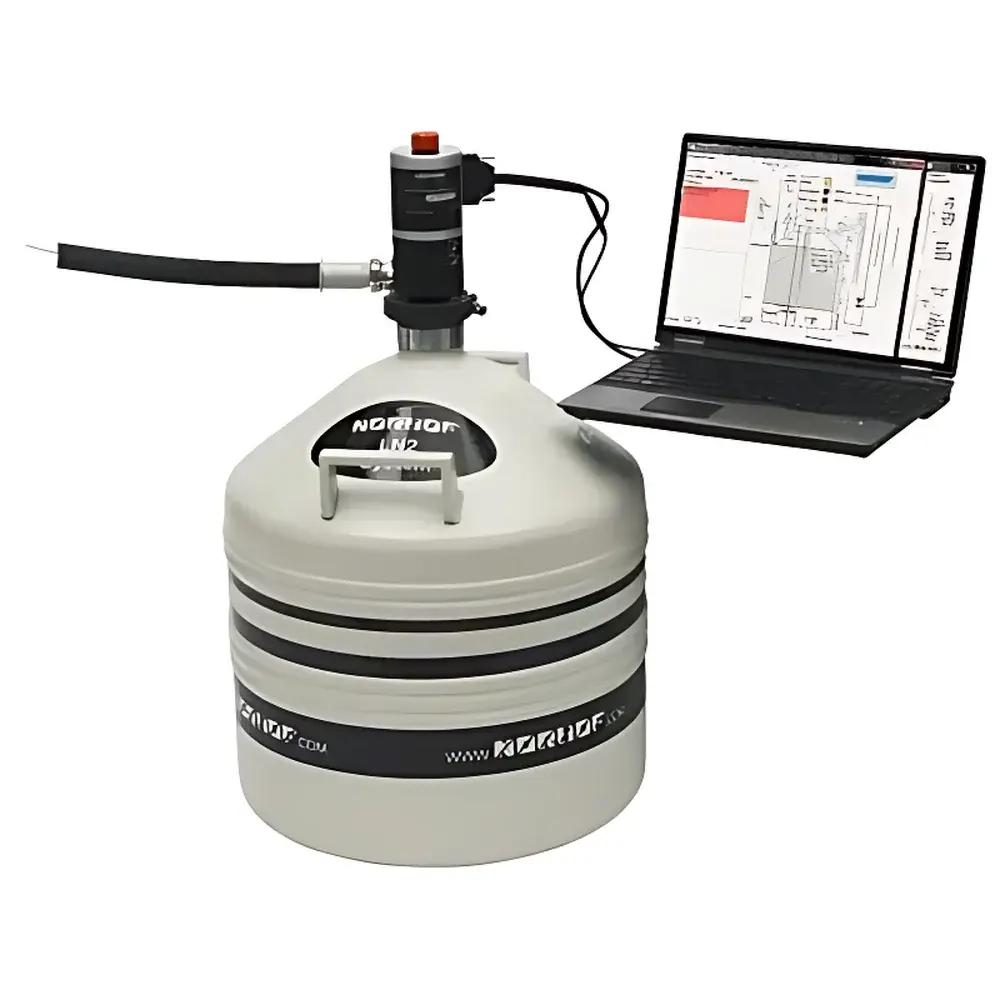
Norhof 900 Series Liquid Nitrogen Micro-Dispensing System
| Brand | Norhof |
|---|---|
| Origin | Netherlands |
| Model | 900 |
| Supply Pressure Range | 0.01–270 mBar (adjustable) |
| Flow Rate | Dropwise to 0.5 L/min |
| Maximum Working Pressure | 300 mBar |
| Static Evaporation Rate | <0.5 L/day |
| LN₂ Lift Height | 5 m |
| Power Supply | 115/230 V AC or 12–24 V AC/DC |
| Average Power Consumption | 5 W (50 W during dispensing) |
| Standard Tubing | 2 m length, 4 mm ID / 6.25 mm OD PTFE, insulated with 32 mm foam jacket |
| Integrated LN₂ Dewar Options | 35 L, 50 L, or 100 L |
| System Includes | Dewar, cryogenic pump, 2 m tubing, phase separator, power supply, cables, level sensor(s), PC software |
Overview
The Norhof 900 Series Liquid Nitrogen Micro-Dispensing System is an engineered solution for precise, low-pressure, and programmable delivery of liquid nitrogen in life science and analytical laboratory environments. Based on controlled-phase displacement and pressure-regulated cryogenic fluid dynamics, the system operates within a safe sub-atmospheric pressure range (≤300 mBar), eliminating risks associated with high-pressure LN₂ transfer—such as splashing, mechanical vibration, acoustic noise, and thermal shock. Its core architecture integrates a hermetically sealed cryogenic pump, a thermally stabilized PTFE delivery line, and a modular control interface capable of executing time-based, level-based, or temperature-driven dispensing protocols. Designed for integration into vacuum cold traps (e.g., freeze dryers, centrifugal concentrators), biological cryo-storage infrastructure, and low-temperature process systems, the 900 Series supports reproducible thermal management down to –196 °C while maintaining compliance with fundamental safety and operational requirements for Class B laboratory equipment under IEC 61010-1.
Key Features
- Programmable micro-dispensing from dropwise delivery up to 0.5 L/min, with pressure regulation across 0.01–270 mBar
- Multi-mode liquid level control: single-sensor time-based, dual-sensor hysteresis (high/low threshold), and PID-regulated feedback loops
- Temperature-controlled operation modes (models 910 & 915), enabling integration with programmable freezing, DSC, GC cryo-focusing, and cryo-microscopy stages
- Low-power design: average 5 W standby consumption; peak 50 W during active dispensing—compatible with uninterruptible power supplies and mobile lab setups
- Integrated mechanical overpressure relief valve and dual-stage alarm system (acoustic + visual) for empty dewar, low-LN₂ (<5 L), sensor failure, and line freeze conditions
- Standard 2 m insulated PTFE tubing (4 mm ID, 32 mm foam jacket) with 5 m vertical lift capacity and ±2 min pre-cooling stabilization time
- Modular hardware configuration: 35 L, 50 L, and 100 L vacuum-insulated dewars with validated static evaporation rates <0.5 L/day
Sample Compatibility & Compliance
The Norhof 900 Series interfaces seamlessly with standard laboratory cryo-devices including lyophilizers, cold traps, cryo-vial storage racks, and thermal analysis platforms. All wetted components—including the pump head, phase separator, and tubing—are constructed from oxygen-compatible, non-reactive materials (PTFE, stainless steel 316L, and electropolished aluminum), ensuring long-term stability in cryogenic service. The system conforms to essential electrical safety standards per IEC 61010-1 for laboratory equipment and meets material compatibility guidelines outlined in ASTM F2626 (Standard Guide for Selection of Materials for Cryogenic Service). While not inherently 21 CFR Part 11 compliant, its PC software supports audit-trail-capable data logging (timestamped flow events, sensor readings, mode transitions), facilitating GLP/GMP-aligned documentation when deployed in regulated biobanking or pharmaceutical development workflows.
Software & Data Management
The included Windows-based monitoring application provides real-time visualization of pump status, pressure transducer output, sensor temperatures, and dispensing cycle logs. Users configure operating modes (e.g., Mode 1–7 for 905; Mode 1–D for 910; Mode 1–F for 915), set custom thresholds, define dwell times, and export CSV-formatted datasets for post-acquisition analysis. The 915 model extends functionality with RS232 command-line interface support, enabling integration into LabVIEW, Python-controlled automation frameworks, or centralized building management systems. All software-generated records include metadata (user ID, system time, firmware version) and are stored locally with optional network share backup—supporting traceability requirements in ISO 17025-accredited laboratories.
Applications
- Maintaining stable liquid nitrogen levels in vacuum cold traps for freeze-drying and solvent removal
- Automated refilling of multi-compartment biological cryo-storage units (e.g., vapor-phase LN₂ tanks, cryobox racks)
- Sequential micro-dosing into small-volume sample containers for controlled cryopreservation protocols
- Time-scheduled or event-triggered LN₂ delivery for thermal cycling in calorimetry and reaction quenching
- Stabilizing sub-zero operating temperatures in gas chromatography cryo-focusing modules and cryo-SEM stages
- Enabling reproducible programmed freezing curves for cell/tissue banking applications per ISO 20387:2018 biobanking standards
FAQ
What is the maximum vertical lift height for liquid nitrogen delivery?
The system supports a verified lift height of 5 meters under nominal operating conditions (270 mBar supply pressure, 2 m standard tubing).
Can the 905 model perform temperature-based control?
No—only models 910 and 915 support temperature feedback loops and PID-based thermal regulation.
Is remote monitoring possible without a PC connection?
Basic status indicators (LEDs) show pump activity and alarm states; full telemetry and parameter adjustment require the PC software or RS232 interface.
What safety certifications does the system carry?
It complies with IEC 61010-1 for electrical safety and incorporates mechanical overpressure protection per EN ISO 4126-1.
How is tubing insulation performance validated?
The 32 mm foam-jacketed PTFE line achieves ≤0.15 W/m·K thermal conductivity, confirmed via steady-state cryogenic heat leak testing at –196 °C.





