
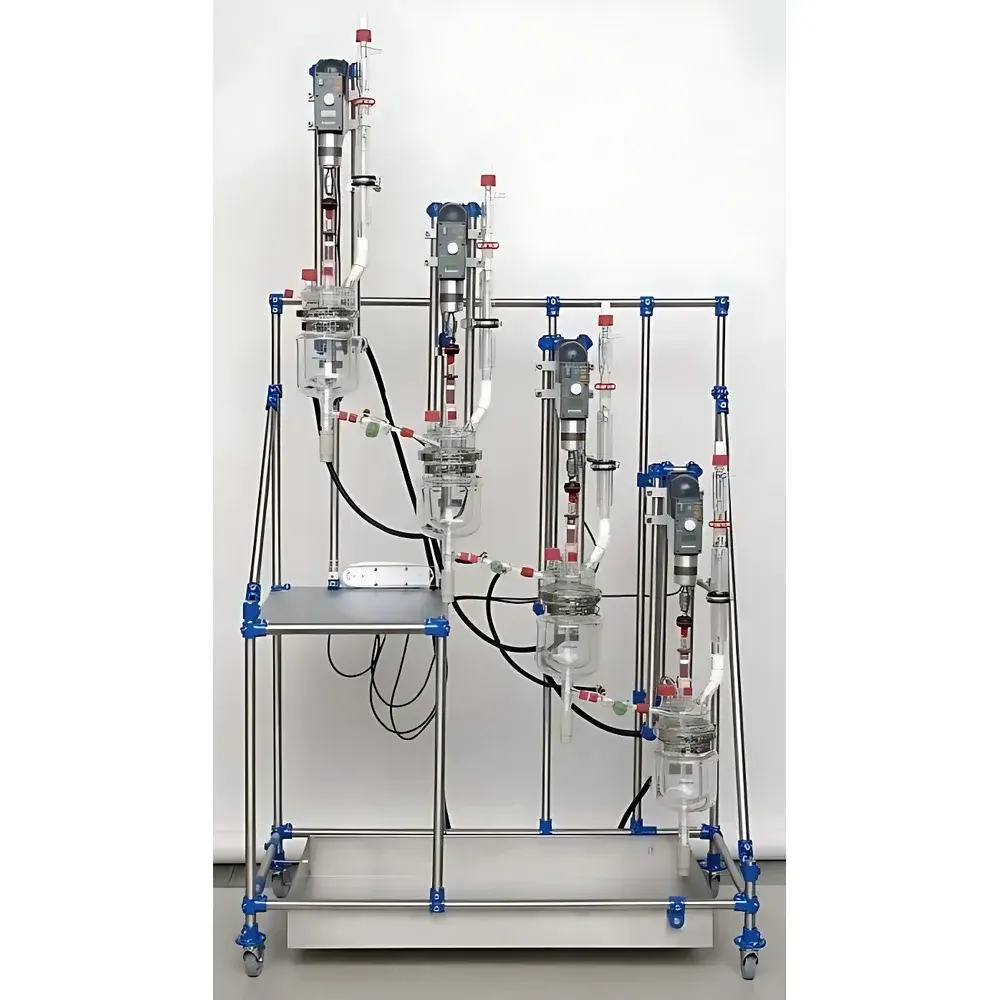
Normag 4-Stage Cascade Synthesis Reactor System
| Brand | NORMAG |
|---|---|
| Origin | Germany |
| Type | Imported Laboratory Cascade Reactor System |
| Model | 4-Stage Cascade Synthesis Reactor |
| Pricing | Available Upon Request |
Overview
The Normag 4-Stage Cascade Synthesis Reactor System is a modular, integrated laboratory-scale platform engineered for continuous or semi-batch multi-step chemical synthesis and in-line separation. Designed in accordance with core principles of process intensification and green chemistry, the system implements a cascade configuration—four independently controlled, thermally and mechanically coupled reaction vessels arranged in series—to enable sequential reactions (e.g., condensation, hydrogenation, hydrolysis, crystallization) without manual intermediate transfer. Each stage features precise temperature control (via jacketed heating/cooling), pressure monitoring (up to 10 bar g), gas dosing capability (N₂, H₂, O₂, inert or reactive), and real-time pH or conductivity feedback integration. The architecture supports both homogeneous and heterogeneous catalysis, enabling kinetic profiling across residence time distributions and facilitating rapid screening of reaction pathways under reproducible, scalable conditions.
Key Features
- Modular reactor blocks: Four stainless-steel (316L) reaction vessels (standard volume options: 0.5 L, 1 L, or 2 L per stage), each equipped with magnetic or overhead stirring, Pt100 temperature sensors, and pressure-rated sight glasses.
- Inter-stage transfer control: Pneumatically actuated diaphragm valves and peristaltic or piston-driven metering pumps ensure accurate, contamination-free liquid/suspension transfer between stages with adjustable residence time (1 min–24 h per stage).
- Integrated separation interface: Optional in-line filtration (sintered metal filters, pore size 1–50 µm), phase separators (gravity or centrifugal), or solvent recovery modules (vacuum distillation traps) can be mounted downstream of Stage 4.
- Process safety compliance: Equipped with rupture discs, pressure relief valves, and redundant temperature limit switches; fully CE-marked per PED 2014/68/EU and ATEX Directive 2014/34/EU for Zone 1/21 operation.
- Control architecture: PLC-based automation with HMI touchscreen interface; supports Modbus TCP and OPC UA protocols for integration into lab-wide SCADA or MES systems.
Sample Compatibility & Compliance
The system accommodates a broad range of chemistries including organometallic catalysis, API intermediate synthesis, polymerization (step-growth and chain-growth), and fine chemical oxidation/reduction. Compatible with corrosive media (e.g., HCl, HF, concentrated H₂SO₄) when configured with Hastelloy C-276 linings or fluoropolymer-coated internals. All wetted materials comply with USP Class VI and FDA 21 CFR Part 211 requirements for pharmaceutical development. Design documentation includes full traceability of material certifications (EN 10204 3.1), weld procedure specifications (WPS), and non-destructive testing (NDT) reports (radiographic + dye penetrant). Validated for GLP and early-phase GMP environments per ICH Q5A and Q7 guidelines.
Software & Data Management
The embedded control software (Normag SynthOS v3.2) provides synchronized logging of >50 process variables at 1 Hz resolution—including torque, jacket temperature, vessel pressure, feed flow rates, and exotherm profiles. Data export formats include CSV, HDF5, and ASTM E2500-compliant XML for direct import into MATLAB, Python (Pandas), or commercial process modeling tools (Aspen Batch, gPROMS). Audit trail functionality meets FDA 21 CFR Part 11 requirements, with user-level access control, electronic signatures, and immutable event logs covering all parameter changes, alarm acknowledgments, and batch start/stop actions. Optional cloud synchronization enables secure remote monitoring via TLS 1.3-encrypted REST API.
Applications
- Rapid optimization of multi-step synthetic routes for active pharmaceutical ingredients (APIs), reducing development timelines from months to weeks.
- Investigation of residence time effects on selectivity and by-product formation in nitration, sulfonation, or Friedel-Crafts acylation sequences.
- Scale-down validation of continuous manufacturing processes prior to pilot-plant implementation (aligned with FDA’s Quality-by-Design framework).
- Development of heterogeneous catalyst deactivation models using real-time activity tracking across four consecutive reaction zones.
- Green process evaluation: Solvent recycling integration, energy balance calculation per stage, and E-factor quantification across the full cascade.
FAQ
Can the system operate under anhydrous or oxygen-sensitive conditions?
Yes—each stage can be purged and maintained under inert atmosphere (N₂ or Ar) with leak-tightness verified to ≤1×10⁻³ mbar·L/s (helium leak test per ISO 15848-1).
Is third-party calibration support available for temperature and pressure sensors?
Certified calibration services (DAkkS-accredited) are provided globally through Normag’s authorized service partners, with full traceability to PTB and NIST standards.
What level of customization is possible for non-standard chemistries (e.g., fluorination or photochemical steps)?
Custom configurations—including UV-transparent quartz reactors, corrosion-resistant Monel components, or integrated LED irradiation modules—are engineered on a project basis with full DQ/IQ/OQ documentation support.
Does the system meet requirements for regulatory submissions to EMA or PMDA?
Yes—system design, validation templates, and raw data handling protocols align with EMA’s Guideline on Investigational Medicinal Products (IMP) and PMDA’s “Guidance for Continuous Manufacturing” (2022 revision).



