
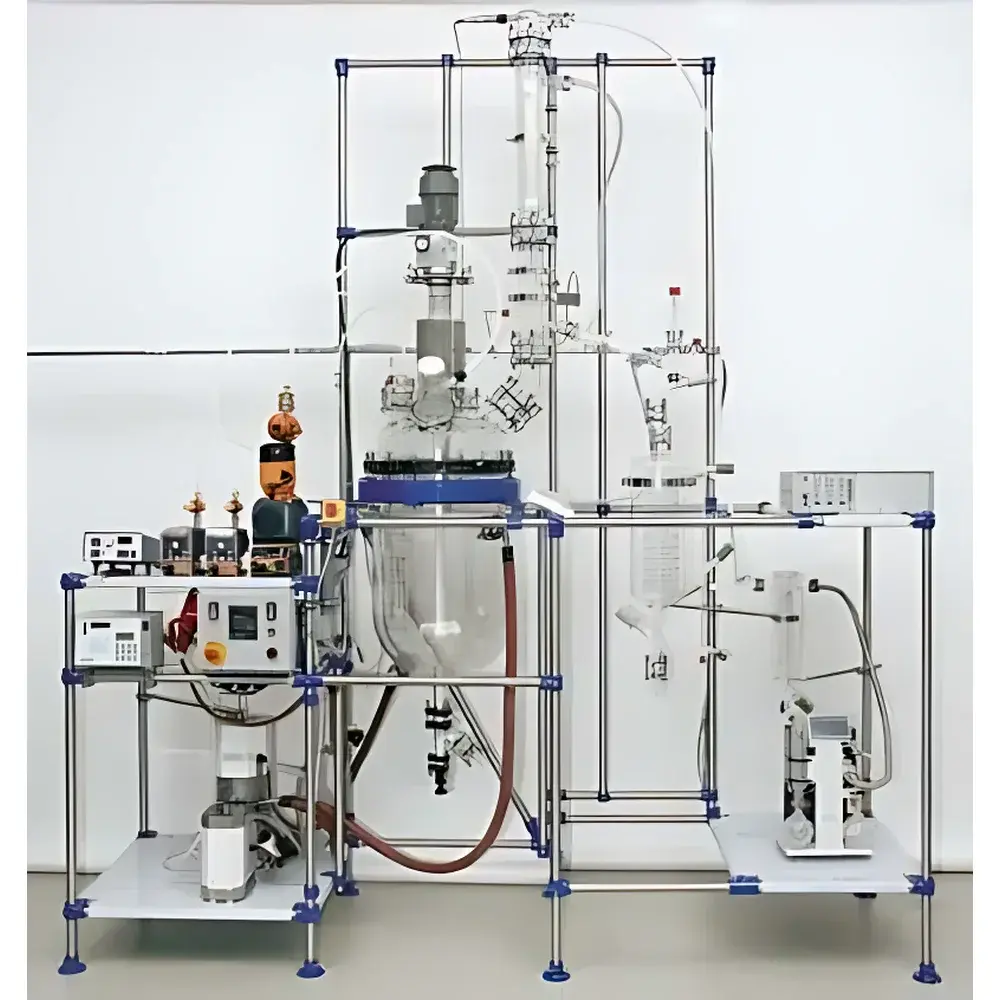
NORMAG 50L Jacketed Glass Reactor with Integrated Distillation System
| Brand | NORMAG |
|---|---|
| Origin | Germany |
| Model | 50L Reactor-Distillation System |
| Construction Material | Borosilicate Glass 3.3 (Duran®) |
| Vessel Volume | 50 L |
| Heating/Cooling | Thermostatic Oil Circulation Bath with Jacket |
| Vacuum Compatibility | High-vacuum capable (≤1 mbar) |
| Bottom Valve | PTFE-sealed pneumatic discharge valve, zero-dead-volume design |
| Sensors | Integrated pH and Pt100 temperature probes |
| Automation | PC-based control unit with real-time data acquisition and process logging |
| Compliance | ISO 719-HGB1, ISO 720-HGA1, ISO 1776, ISO 695-A |
| Modular Interface Standard | DIN 2817 / ISO 2853 flange system |
| Stirring System | Explosion-proof magnetic or overhead drive, variable speed (0–250 rpm) |
| Distillation Assembly | Packed or structured packing column, reflux condenser with phase separation, fraction receiver with automated switching |
Overview
The NORMAG 50L Jacketed Glass Reactor with Integrated Distillation System is a fully modular, laboratory-scale process platform engineered for controlled synthesis, reaction monitoring, and in-line product separation under inert, pressurized, or high-vacuum conditions. Based on the proven principles of jacketed thermal management and continuous vapor–liquid equilibrium separation, this system enables precise execution of multi-step chemical processes—including batch hydrogenation, esterification, solvent exchange, and crystallization-driven distillative purification—within a single, validated hardware architecture. Constructed entirely from borosilicate glass 3.3 (Duran®), the reactor vessel exhibits exceptional thermal shock resistance (ΔT ≤ 120 K), low coefficient of thermal expansion (3.3 × 10⁻⁶ K⁻¹), and broad chemical compatibility with aggressive reagents such as hydrobromic acid, concentrated HCl, and halogenated solvents. Its double-jacketed geometry supports simultaneous heating and cooling via external thermostatic oil circulation, while the integrated distillation train—comprising a packed column, reflux condenser with phase separator, and motorized fraction collector—ensures reproducible separation efficiency across boiling point differentials ≥15 °C.
Key Features
- Zero-dead-volume bottom discharge valve with PTFE sealing, pneumatically actuated and rated for vacuum service down to 0.5 mbar
- Modular DIN 2817/ISO 2853 standardized flange interfaces enabling interchangeability of feed modules (gas/liquid/solid), sensor ports, and distillation components
- Explosion-proof stirring system with torque-controlled overhead drive or magnetic coupling; speed range 0–250 rpm, adjustable in 1-rpm increments
- Integrated Pt100 Class A temperature probe and calibrated pH electrode (glass body, refillable electrolyte) mounted directly into the reactor head
- Automated vacuum control loop interfaced with digital vacuum gauge and two-stage rotary vane pump, including pressure ramping and hold functions
- PC-based control unit compliant with IEC 61131-3 programming standards, supporting recipe-driven operation, alarm logging, and audit-trail-enabled data export (CSV, PDF)
Sample Compatibility & Compliance
The system accommodates heterogeneous reaction mixtures containing suspended solids, viscous slurries, and thermally sensitive intermediates without risk of material degradation or cross-contamination. All wetted parts—including vessel, condenser, column internals, and fraction receivers—are fabricated from borosilicate glass 3.3 conforming to ISO 719-HGB1 (hydrolytic resistance Class 1), ISO 720-HGA1 (alkali resistance Class 1), ISO 1776 (thermal shock), and ISO 695-A (acid resistance). The control software supports 21 CFR Part 11-compliant user authentication, electronic signatures, and immutable process record archiving—making it suitable for GLP and GMP environments where traceability and regulatory readiness are mandatory. Optional ATEX-certified components (e.g., explosion-proof motors, intrinsically safe sensors) are available for Zone 1/21 hazardous area deployment.
Software & Data Management
The embedded control platform runs on a real-time Linux OS and provides dual-mode operation: local HMI touchscreen interface and remote PC supervision via Ethernet TCP/IP. Process parameters—including jacket temperature, internal temperature, pH, stirrer torque, vacuum level, reflux ratio, and fraction collection timing—are sampled at 1 Hz and stored with UTC timestamps. Data export supports CSV for statistical analysis in JMP or Minitab, and PDF reports include operator ID, batch ID, calibration certificates, and deviation flags. Audit trails record all parameter changes, login/logout events, and manual overrides with user attribution and time stamping—fully aligned with ALCOA+ data integrity principles.
Applications
- Process development of API intermediates requiring strict stoichiometric control and inline purity verification
- Kinetic studies of exothermic reactions under controlled heat removal via jacketed cooling
- Solvent recovery and recycling in green chemistry workflows (e.g., ethanol/water azeotrope breaking)
- Multi-stage reactions involving sequential addition, heating, distillation, and quenching without intermediate transfer
- Teaching laboratories demonstrating mass and energy balances in continuous vs. batch distillation configurations
- Material compatibility testing of catalysts or functionalized resins under prolonged reflux conditions
FAQ
Can the system operate under full vacuum (≤0.1 mbar) for heat-sensitive compound isolation?
Yes—the PTFE-sealed bottom valve, glass-to-glass O-ring joints, and vacuum-rated condenser enable stable operation down to 0.05 mbar when paired with a secondary diffusion pump.
Is third-party calibration support available for the pH and temperature sensors?
NORMAG provides NIST-traceable calibration certificates for all factory-installed probes; field recalibration kits and certified service partners are available globally.
What is the maximum allowable operating temperature for the glass vessel during heating cycles?
The borosilicate 3.3 construction permits continuous operation up to 200 °C with thermal oil media; short-term excursions to 250 °C are permissible under controlled ramp rates (<5 K/min).
How is cleaning validation performed between batches?
The smooth, non-porous glass surface allows validated CIP protocols using NaOH/H₂O₂ or citric acid solutions; residue detection limits are verified by TOC or HPLC analysis per ICH Q5C guidelines.
Are custom modifications—such as additional ports or specialized column packings—supported?
All systems are built to order; NORMAG’s engineering team collaborates on bespoke configurations including Hastelloy-lined ports, cryogenic condensers, or reactive gas sparging manifolds.



