
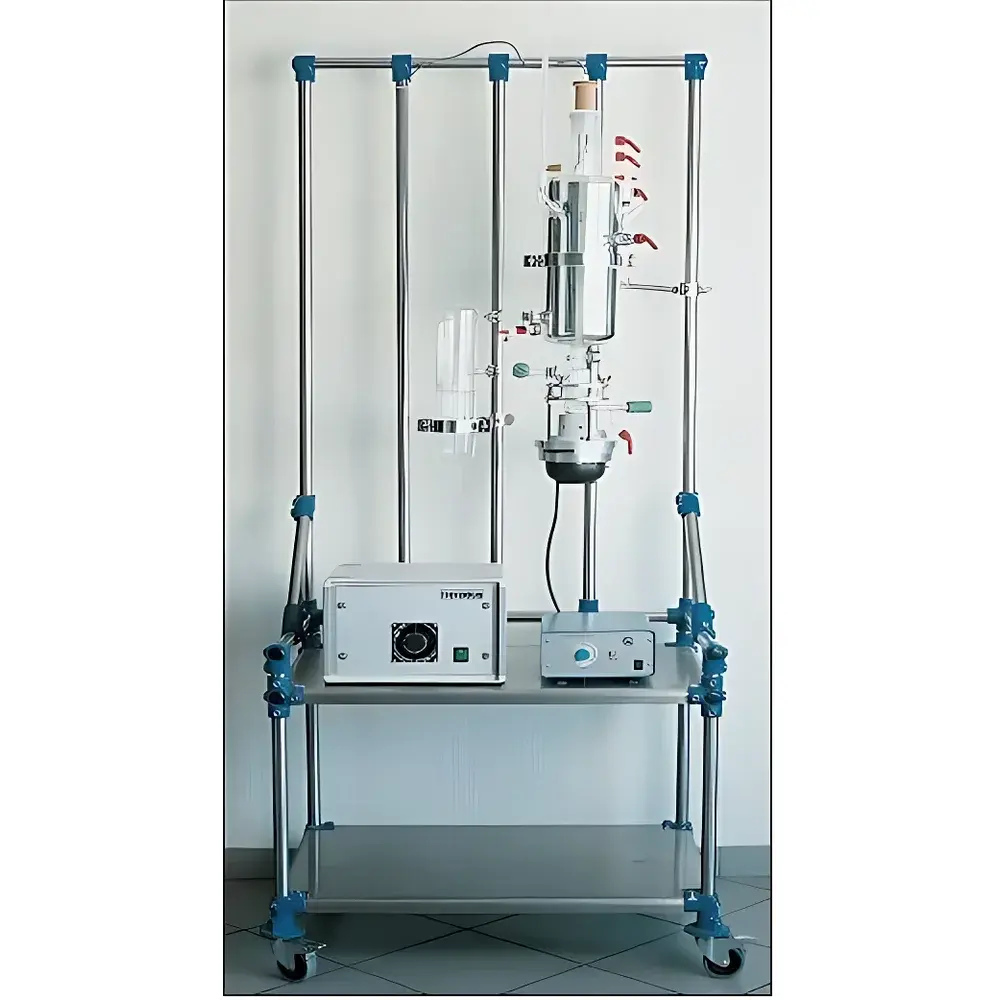
Normag Dual-Jacketed Forced-Circulation Falling-Film Photochemical Reactor
| Brand | NORMAG |
|---|---|
| Origin | Germany |
| Model | Normag |
| Type | Falling-Film Photochemical Reactor with Dual Thermal Management |
| Cooling/Heating Interface | External Circulating Oil Bath (via Inner Jacket) |
| Vacuum Insulation | Silver-Coated High-Vacuum Outer Jacket |
| Light Source Configuration | Central Axial Lamp Assembly |
| Flow Control | Integrated Peristaltic or Diaphragm Circulation Pump |
| Sample Introduction | Modular Inlet with Counter-Current Gas Sparging |
| Compliance | Designed for ISO/IEC 17025-aligned lab environments, compatible with GLP documentation workflows |
Overview
The Normag Dual-Jacketed Forced-Circulation Falling-Film Photochemical Reactor is an engineered solution for controlled, scalable photochemical synthesis under precisely regulated thermal and photonic conditions. Unlike conventional stirred-tank or immersion-lamp reactors, this system operates on the principle of laminar falling-film photolysis: liquid-phase reactants are delivered as a thin, continuous film along the inner wall of a vertically oriented, optically transparent quartz or borosilicate reaction tube—coaxially surrounding a centrally mounted, high-intensity UV or visible light source. This geometry ensures uniform photon flux distribution across the entire reactive interface, minimizing radial light attenuation and eliminating shadow zones common in batch systems. The reactor’s core innovation lies in its dual-jacket architecture: an inner temperature-control jacket interfaces with an external circulating oil bath (−20 °C to +120 °C), while an outer high-vacuum, silver-coated insulation jacket suppresses conductive and radiative heat exchange with ambient surroundings—critical for low-temperature photoreactions and long-duration experiments requiring thermal stability within ±0.3 °C.
Key Features
- Dual-jacket thermal management: Inner jacket enables precise temperature regulation of the photoreactive film; outer high-vacuum silver-coated jacket provides thermal isolation and blocks stray UV emission, enhancing operator safety and experimental reproducibility.
- Falling-film hydrodynamics: Controlled film thickness (typically 0.1–0.5 mm) achieved via calibrated flow rate and surface wetting geometry, ensuring consistent optical path length and photon absorption efficiency across varying viscosities (up to 500 mPa·s).
- Forced recirculation architecture: Integrated circulation pump supports closed-loop operation with external reservoirs (100 mL to 5 L capacity), enabling extended residence time control, multi-pass irradiation, and real-time concentration monitoring without system disassembly.
- Modular gas–liquid interface: Counter-current gas introduction via sintered frit or micro-sparger positioned opposite liquid inflow maximizes interfacial area and mass transfer efficiency—essential for photocatalytic oxidations, hydrogenations, or CO₂ reduction studies.
- Instrument-grade ancillary integration: Standardized ports accommodate Pt100 temperature sensors, inline UV-Vis spectrophotometers (200–800 nm), pressure-rated sampling valves, and digital mass flow controllers (MFCs) for inert or reactive gas dosing.
Sample Compatibility & Compliance
The reactor accommodates organic solvents (e.g., acetonitrile, methanol, THF), aqueous buffers, and heterogeneous suspensions containing supported photocatalysts (e.g., TiO₂, g-C₃N₄, or MOF-based particles ≤50 µm). All wetted parts conform to USP Class VI and FDA-compliant materials (quartz, PTFE, Kalrez®, 316L SS). The system is designed for alignment with ISO 14040 (life cycle assessment of photochemical processes), ASTM E2094 (standard practice for actinometry in photochemistry), and supports audit-ready data capture per FDA 21 CFR Part 11 when paired with validated third-party acquisition software. Vacuum jacket integrity is certified to <1×10⁻³ mbar, verified per ISO 20483.
Software & Data Management
While the base unit operates via analog instrumentation, optional digital integration includes RS485/Modbus RTU connectivity for centralized control through LabVIEW, MATLAB, or Python-based SCADA platforms. Temperature, flow rate, lamp intensity (via calibrated photodiode), and optional in-line absorbance data can be logged at ≥1 Hz resolution. Audit trails—including parameter changes, valve actuations, and calibration events—are timestamped and user-authorized, fulfilling GLP/GMP traceability requirements. Raw datasets export in CSV or HDF5 format, supporting kinetic modeling (e.g., Lambert–Beer–Langmuir analysis) and DOE-driven optimization.
Applications
This reactor is deployed in academic and industrial laboratories for: continuous-flow photocatalytic degradation of micropollutants (e.g., pharmaceuticals in wastewater effluent); asymmetric photoinduced C–C bond formation under chiral sensitizer mediation; solar-driven H₂ evolution using colloidal quantum dot suspensions; photooxidation of lignin model compounds for biorefinery feedstock valorization; and photostability testing of UV-filter actives in cosmetic formulations per ISO 24443. Its scalability—from milligram-scale screening to pilot-level (≥200 g/h throughput)—makes it suitable for technology transfer from discovery to process development.
FAQ
What light sources are compatible with this reactor?
Standard configurations support medium-pressure Hg lamps (365 nm), LED arrays (365–455 nm), and Xe arc lamps (200–700 nm); custom quartz envelopes permit deep-UV (185 nm) or IR-transparent operation.
Can the system operate under inert or pressurized atmospheres?
Yes—rated for up to 6 bar(g) with appropriate pressure relief and sealing; optional explosion-proof electrical enclosures available for Class I, Div 1 environments.
Is cleaning-in-place (CIP) supported?
Fully compatible with automated CIP protocols using solvent flush sequences; all fluid paths are accessible via quick-disconnect fittings and drain ports.
How is photon flux quantified and calibrated?
Integrated silicon photodiode (NIST-traceable) measures irradiance at the film surface; optional chemical actinometry (e.g., potassium ferrioxalate) validates absolute quantum yield calculations.
Does Normag provide validation documentation?
Factory acceptance testing (FAT) reports include thermal uniformity mapping, vacuum decay tests, and optical transmission spectra; IQ/OQ documentation templates are supplied for user-executed qualification.



