
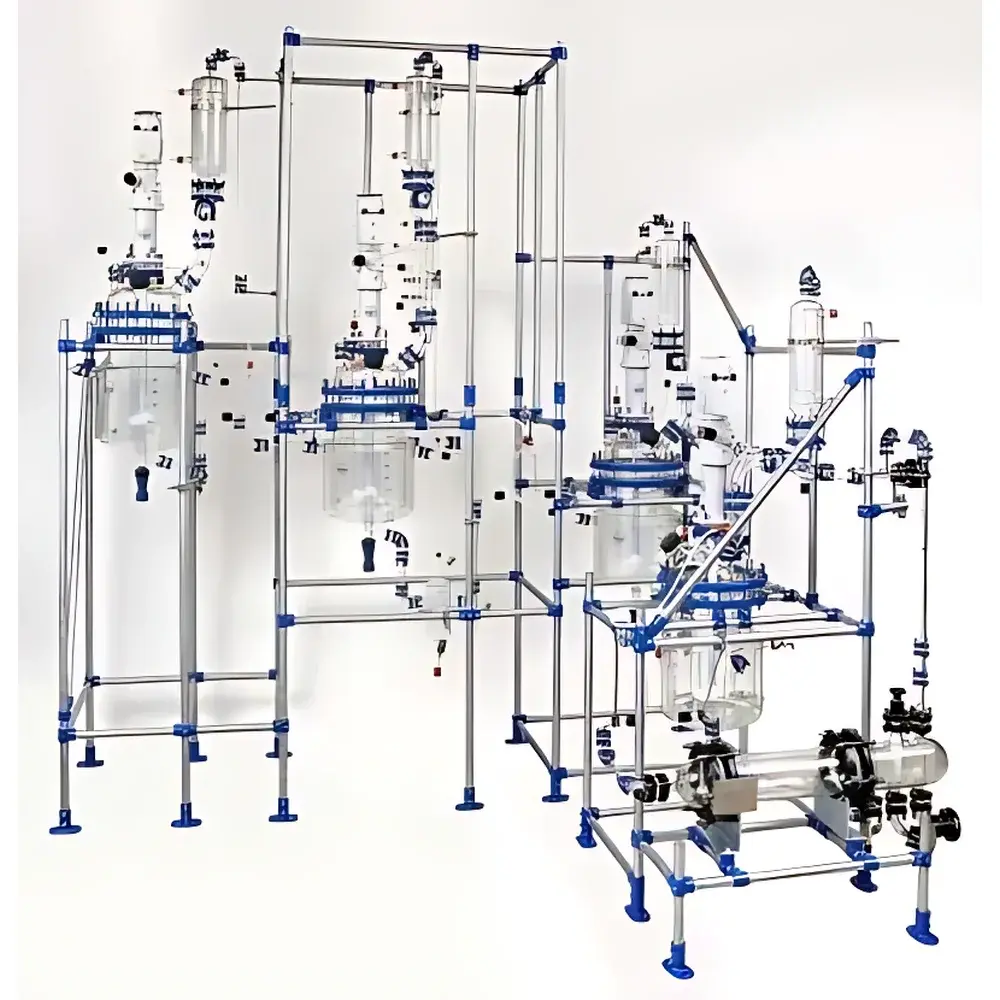
NORMAG Glass Reactor Series (Customizable Lab & Pilot-Scale)
| Brand | NORMAG |
|---|---|
| Origin | Germany |
| Construction Material | Borosilicate Glass 3.3 (DIN ISO 3585) |
| Pressure Rating | Up to 0.5 bar(g) |
| Volume Range | 2 L – 20 L (Standard Configurations) |
| Design Standard | DIN 1561 / DIN 28120 / ASTM E438 Type I, Class A |
| Sealing System | PTFE-Coated Ground Glass Joints (ISO 2768-fine Tolerance) |
| Drive Type | Digital Speed-Controlled DC Motor with Torque Monitoring |
| Temperature Range | –80 °C to +200 °C (with Compatible Circulating Chiller/Heater) |
Overview
The NORMAG Glass Reactor Series represents a benchmark in laboratory- and pilot-scale chemical process development, engineered for precision, transparency, and operational safety under low-pressure conditions. Designed around the principles of jacketed double-wall borosilicate glass (DIN ISO 3585), these reactors enable real-time visual monitoring of reaction progress—including phase separation, crystallization, precipitation, and gas evolution—without compromising structural integrity or chemical resistance. The system operates within a nominal pressure range of up to 0.5 bar(g), making it suitable for atmospheric, slight positive-pressure, or vacuum-assisted processes (e.g., solvent removal, mild catalytic hydrogenations, or low-boiling-point distillations). All wetted parts conform to ISO 2768-fine dimensional tolerances and utilize PTFE-coated ground-glass joints (DIN 1561 compliant), ensuring leak-tight sealing while maintaining ease of assembly and cleaning. The reactor body is supported by a modular stainless-steel frame with integrated load-bearing mounts, compatible with standard lab hoists and overhead stirring systems.
Key Features
- Borosilicate glass 3.3 construction provides exceptional thermal shock resistance (ΔT ≤ 150 °C), hydrolytic stability (Class 1 per ISO 8547), and broad chemical compatibility—from concentrated acids and alkalis to organic solvents and halogenated reagents.
- Modular design allows seamless integration of accessories: reflux condensers, dropping funnels, thermowells, gas inlets/outlets, pH or conductivity probes, and digital temperature sensors with Pt100 calibration traceability.
- Digital DC motor drive delivers precise speed control (0–250 rpm typical, adjustable per impeller configuration) with continuous torque feedback—critical for monitoring viscosity changes during polymerization or emulsion formation.
- Jacketed vessel enables uniform thermal management via external circulators; standard jacket volume supports ΔT control within ±0.5 °C over full operating range (–80 °C to +200 °C).
- Compliant with mechanical design references DIN 28120 (glass apparatus) and ASTM E438 Type I, Class A for volumetric accuracy—ensuring reproducibility across scale-up batches from lab to pilot plant.
Sample Compatibility & Compliance
NORMAG glass reactors accommodate heterogeneous, multiphase, and exothermic reactions involving solids, liquids, and gases—common in pharmaceutical intermediate synthesis, agrochemical formulation, and specialty polymer R&D. The inert glass surface eliminates catalytic interference or metal leaching, supporting USP extractables profiling and ICH Q5C stability studies. Systems are routinely validated under GLP and GMP-aligned workflows, with documentation packages supporting FDA 21 CFR Part 11-compliant electronic records when paired with NORMAG’s optional data acquisition interface. Pressure relief is achieved via calibrated rupture discs or spring-loaded safety valves (optional), meeting PED 2014/68/EU requirements for Category I equipment.
Software & Data Management
While the base reactor operates as a stand-alone mechanical unit, NORMAG offers optional digital integration through its ReactoLink™ interface module. This hardware bridge connects analog sensor outputs (temperature, pH, pressure, torque) to PC-based acquisition software compliant with ASTM E2500-13 (Verification and Validation of Pharmaceutical Manufacturing Systems). Raw data logs are timestamped, encrypted, and exportable in CSV or ASTM E1394-97 format—enabling traceability for internal audits or regulatory submissions. Audit trails record user actions, parameter modifications, and calibration events, satisfying ALCOA+ principles for data integrity.
Applications
- Process optimization of Grignard, Suzuki, or Heck couplings under inert atmosphere (N₂/Ar purging via side ports).
- Kinetic studies of enzymatic hydrolysis or microbial fermentation using inline optical density or dissolved oxygen monitoring.
- Development of continuous-flow photochemical reactions when coupled with NORMAG’s UV-transparent quartz photoreactor modules.
- Solvent-free esterification or transesterification under vacuum-assisted stripping conditions.
- Scale-down modeling of industrial extraction columns using segmented glass towers mounted on shared support frames.
FAQ
What certifications accompany standard NORMAG glass reactors?**
Each unit ships with a Manufacturer’s Declaration of Conformity referencing DIN 28120, ISO 3585, and PED 2014/68/EU Annex II for glass components. CE marking applies to electrical drive units and control panels.
Can the reactor be used under vacuum?**
Yes—rated for continuous operation at absolute pressures down to 10 mbar; optional vacuum-rated PTFE seals and reinforced glass thicknesses available for sub-mbar applications.
Is custom geometry or port configuration supported?**
NORMAG provides engineering consultation and CAD-supported customization—including non-standard neck angles, extended jackets, or integrated sight glasses—for process-specific validation protocols.
How is cleaning and maintenance performed?**
All glass components are autoclavable (121 °C, 2 bar) and compatible with ultrasonic baths; joint surfaces require periodic inspection for micro-scratches per DIN 12574 guidelines.
Does NORMAG support IQ/OQ documentation?**
Yes—factory-issued Installation Qualification (IQ) templates and Operational Qualification (OQ) test protocols are provided upon request, aligned with ISO/IEC 17025 and EU GMP Annex 15 frameworks.



