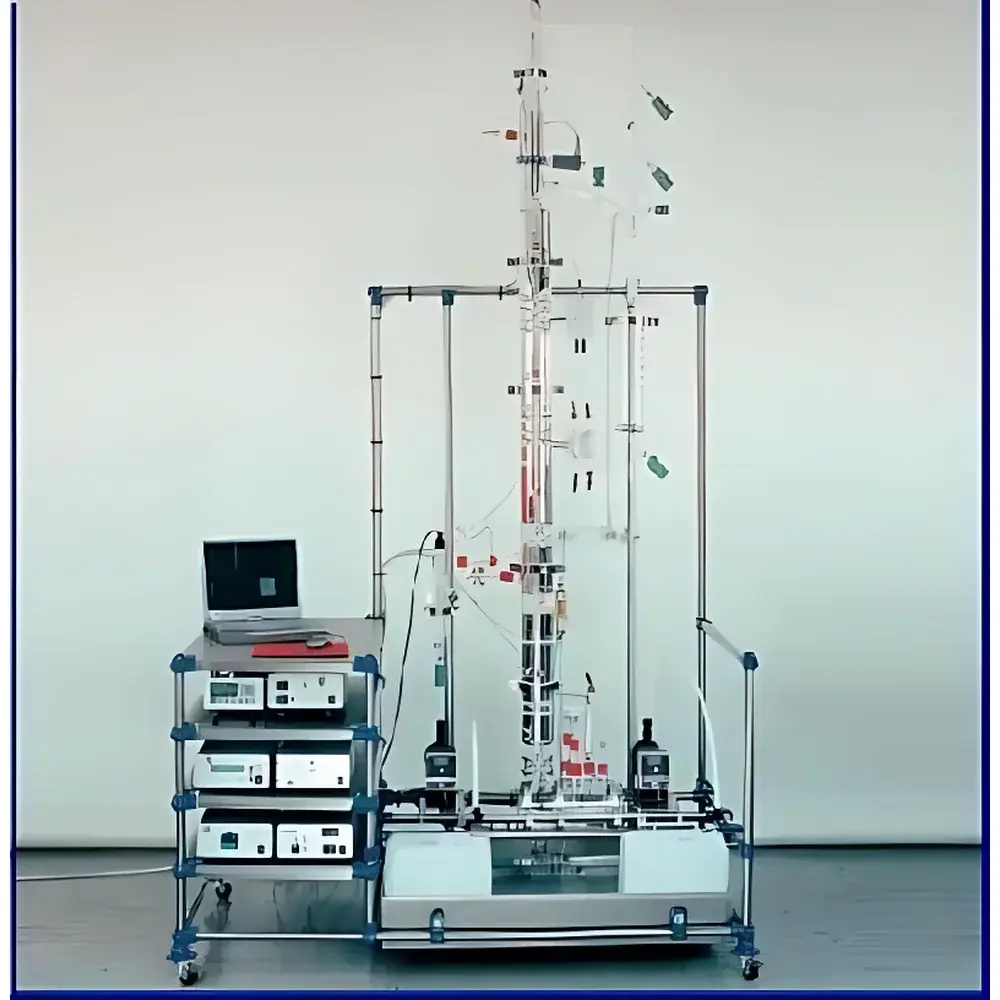
Normag Normag Continuous Laboratory Distillation Apparatus
| Brand | NORMAG |
|---|---|
| Origin | Germany |
| Model | Normag |
| Operating Pressure | Atmospheric and Vacuum (up to 0.1 mbar) |
| Temperature Range | Up to 200 °C |
| Reflux Ratio Control | Manual and Automated |
| Condensate Flow Monitoring | Yes, with automatic shutoff safety interlock |
| Feed/Collection | Continuous inlet and outlet |
| Construction Materials | Borosilicate glass (DIN ISO 3585) and PTFE-sealed piston valves |
| Joint Standards | NS-ground, spherical ground, and flange connections |
| Safety Certification | Non-explosion-proof (suitable for standard laboratory environments per EN 61000-6-3 and EN 61000-6-4) |
Overview
The Normag Continuous Laboratory Distillation Apparatus is an engineered solution for precise, scalable separation of liquid mixtures under controlled atmospheric or reduced-pressure conditions. Designed in accordance with fundamental principles of fractional distillation—governed by relative volatility, vapor–liquid equilibrium, and mass transfer kinetics—the system enables reproducible operation across research, process development, and quality control workflows. Unlike batch distillation units, this apparatus supports uninterrupted feed introduction and fraction collection, facilitating steady-state operation critical for kinetic studies, solvent recovery optimization, and pilot-scale feasibility assessment. Its modular architecture integrates seamlessly into existing lab infrastructure while maintaining full traceability of thermal, pressure, and flow parameters—essential for method validation in regulated environments.
Key Features
- Flexible operational mode: Configurable for atmospheric distillation, vacuum distillation (down to 0.1 mbar), or intermediate pressure regimes via integrated vacuum controller and pressure transducer
- Dual-mode reflux management: Precision-adjustable reflux ratio via manual micrometer valve or programmable PID-controlled solenoid actuator—enabling both exploratory screening and validated protocol execution
- Integrated condensate safety monitoring: Real-time detection of coolant flow interruption triggers immediate heating cutoff and audible/visual alarm per IEC 61508 SIL 1 functional safety requirements
- Chemically inert wetted path: All fluid-contact components fabricated from high-purity borosilicate glass (Class B, DIN ISO 3585) and PTFE-sealed piston valves rated for continuous service up to 200 °C and resistant to halogenated solvents, strong acids, and bases
- Standardized mechanical interfacing: NS-ground (NS 14/23, NS 29/32), spherical ground (e.g., 24/29, 29/32), and clamp-flange connections ensure interchangeability with common labware and compatibility with third-party condensers, receivers, and feed reservoirs
- Modular instrumentation architecture: Independent mounting of temperature sensors (Pt100 Class A), pressure transducers, and level switches permits configuration alignment with internal SOPs or external LIMS integration
Sample Compatibility & Compliance
The apparatus accommodates a broad spectrum of organic and inorganic liquid mixtures—including hydrocarbon fractions, reaction crude streams, pharmaceutical intermediates, agrochemical formulations, and bio-derived solvents—without degradation of separation fidelity. Its construction complies with DIN 12574 (laboratory glassware), ASTM D86/D1078 (petroleum distillation standards), and ISO 9001-aligned manufacturing protocols. While not intrinsically explosion-proof, the unit meets electromagnetic compatibility (EMC) requirements per EN 61000-6-3 (emission) and EN 61000-6-4 (immunity), and may be deployed in non-hazardous zones under local occupational safety regulations (e.g., OSHA 29 CFR 1910.1200). Documentation packages include material declarations (RoHS/REACH), calibration certificates for embedded sensors, and installation qualification (IQ) templates.
Software & Data Management
The system operates without proprietary firmware; analog outputs (4–20 mA, 0–10 V) and digital interfaces (RS485 Modbus RTU) allow connection to third-party SCADA, PLC, or laboratory information management systems (LIMS). Optional data acquisition modules support time-stamped logging of temperature gradients across column sections, reflux ratio history, and vacuum stability profiles—structured to meet ALCOA+ data integrity principles. Audit trails, user access levels, and electronic signature capability can be implemented via externally hosted software compliant with FDA 21 CFR Part 11 when paired with validated IT infrastructure.
Applications
- Process intensification studies in fine chemical synthesis, including azeotrope breaking and heat-integrated column design
- Crude oil fractionation simulation for API gravity and distillation curve generation (ASTM D1160, D2892)
- Solvent recycling validation in GMP-compliant pharmaceutical manufacturing environments
- Thermal stability assessment of biobased platform chemicals under controlled residence time distributions
- Method development for regulatory submissions requiring documented distillation efficiency (e.g., ICH Q5C, USP )
- Educational use in chemical engineering laboratories for teaching McCabe–Thiele analysis and column hydraulics
FAQ
Is the Normag continuous distillation apparatus suitable for hazardous solvent handling?
Yes—provided appropriate engineering controls (e.g., fume hood ventilation, secondary containment) are in place. The PTFE/glass construction ensures compatibility with chlorinated, nitrated, and sulfonated compounds; however, user-defined risk assessments must precede operation with peroxides or thermally unstable species.
Can the system be validated for GLP or GMP compliance?
Absolutely. With optional IQ/OQ documentation kits, calibrated sensor records, and configurable data logging, the apparatus supports full validation lifecycle management per Annex 15 and ASTM E2500.
What is the maximum allowable column height for custom configurations?
Standard configurations support up to 1.2 m effective column length; extended assemblies require structural anchoring and are subject to local static load regulations.
Does Normag provide application support for method transfer?
Yes—application engineers offer remote assistance for parameter mapping (e.g., reflux ratio ↔ theoretical plates), scaling correlations, and troubleshooting distillation inefficiencies using industry-standard HETP and Murphree efficiency models.