
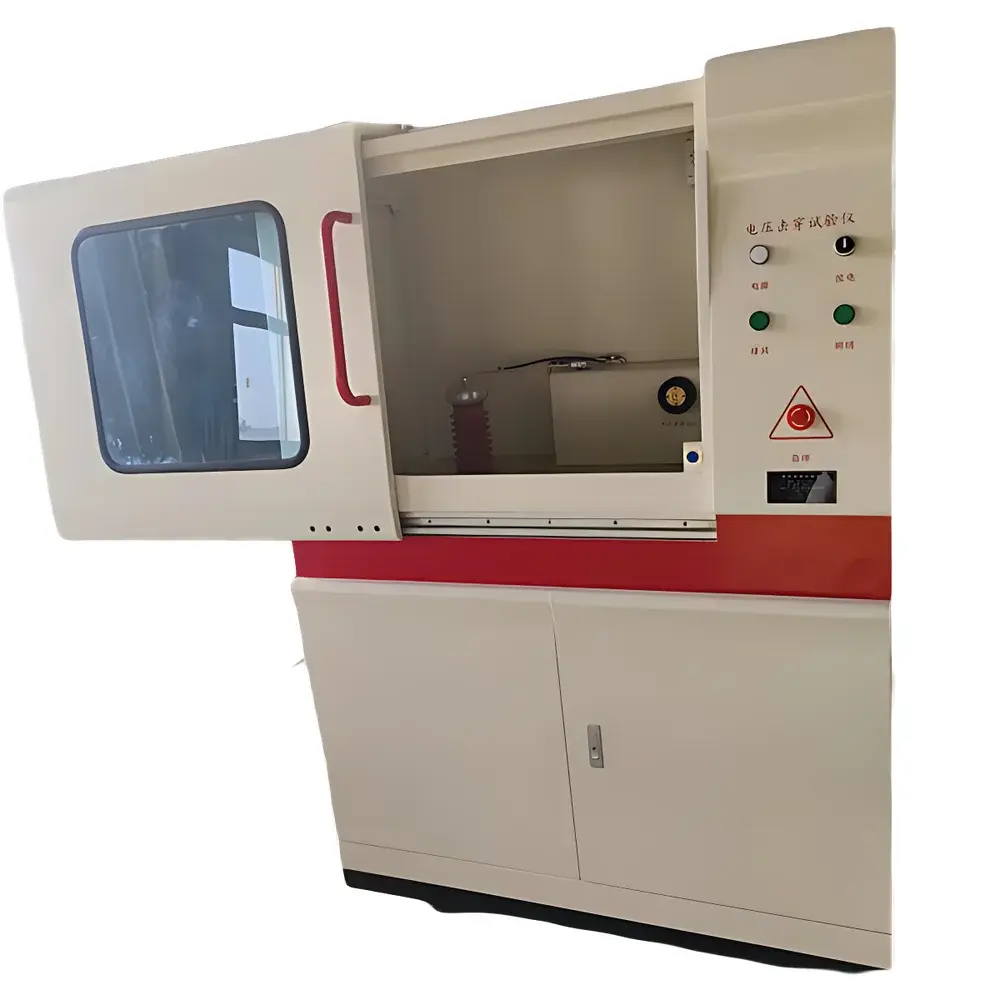
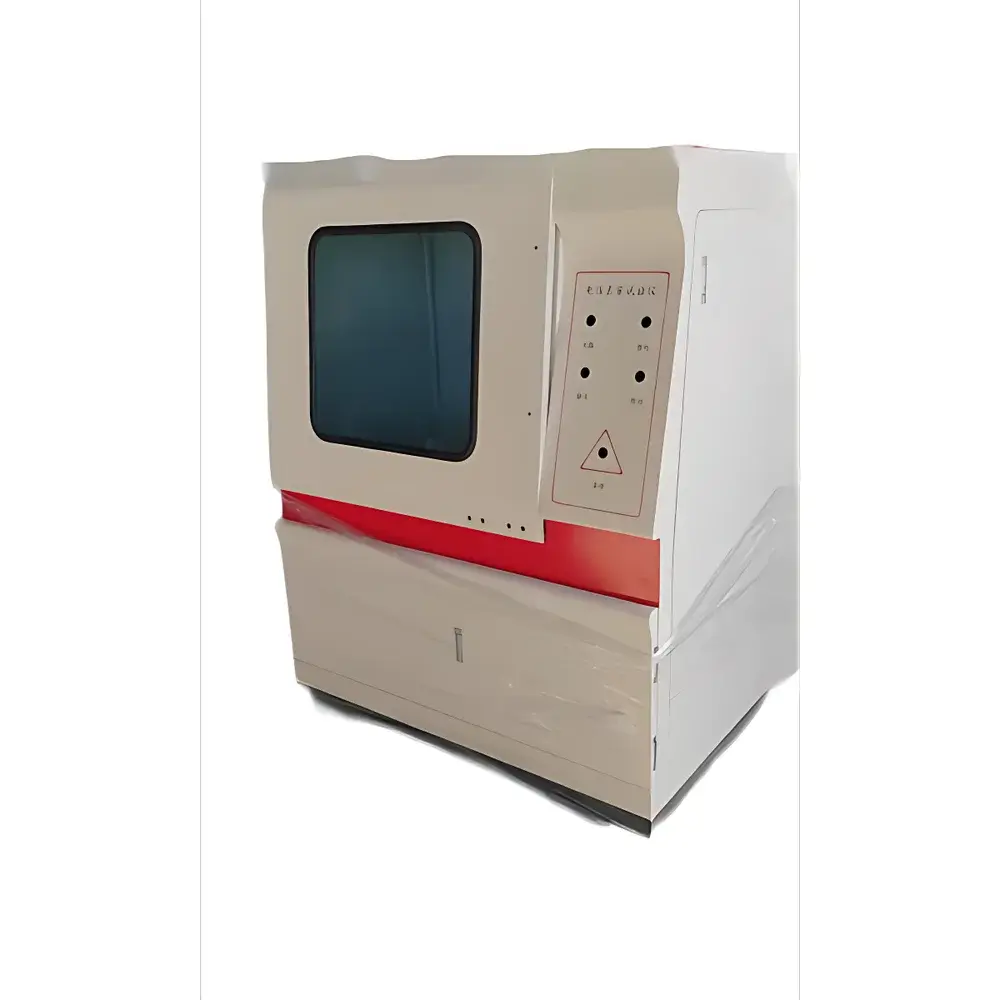
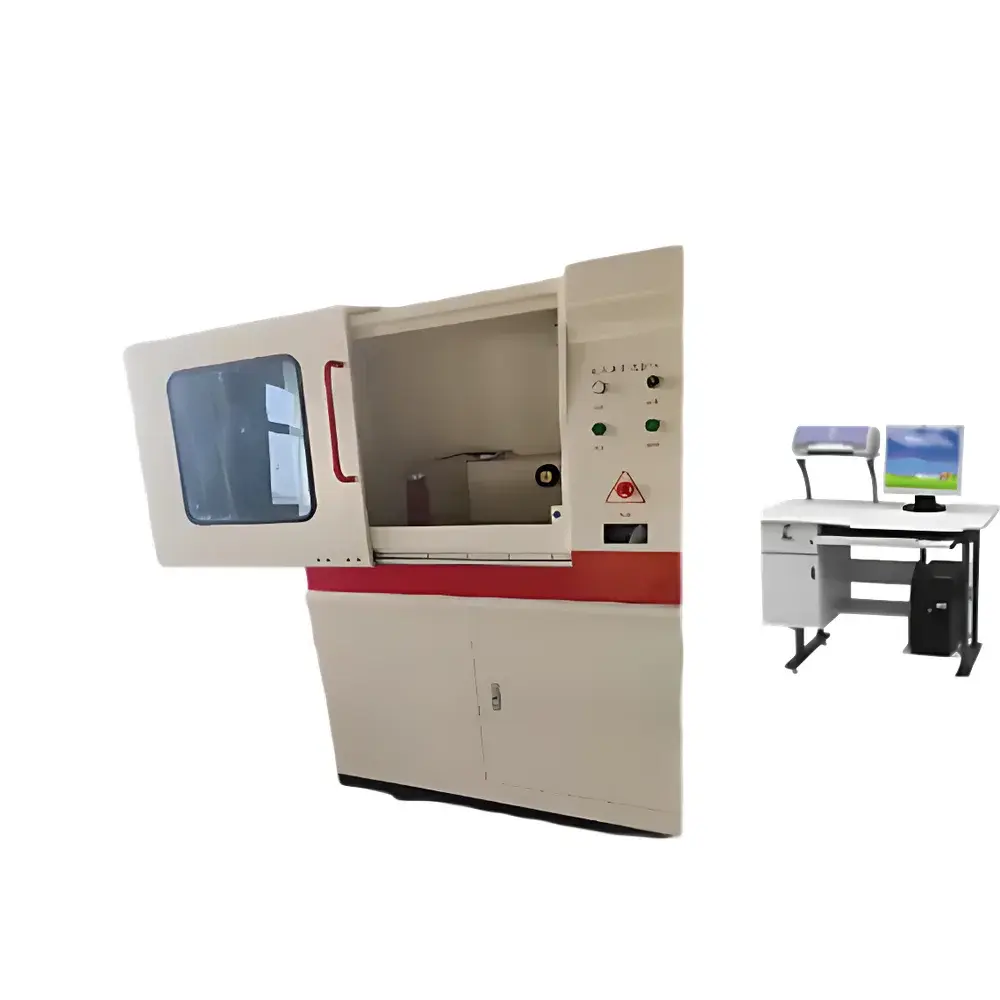
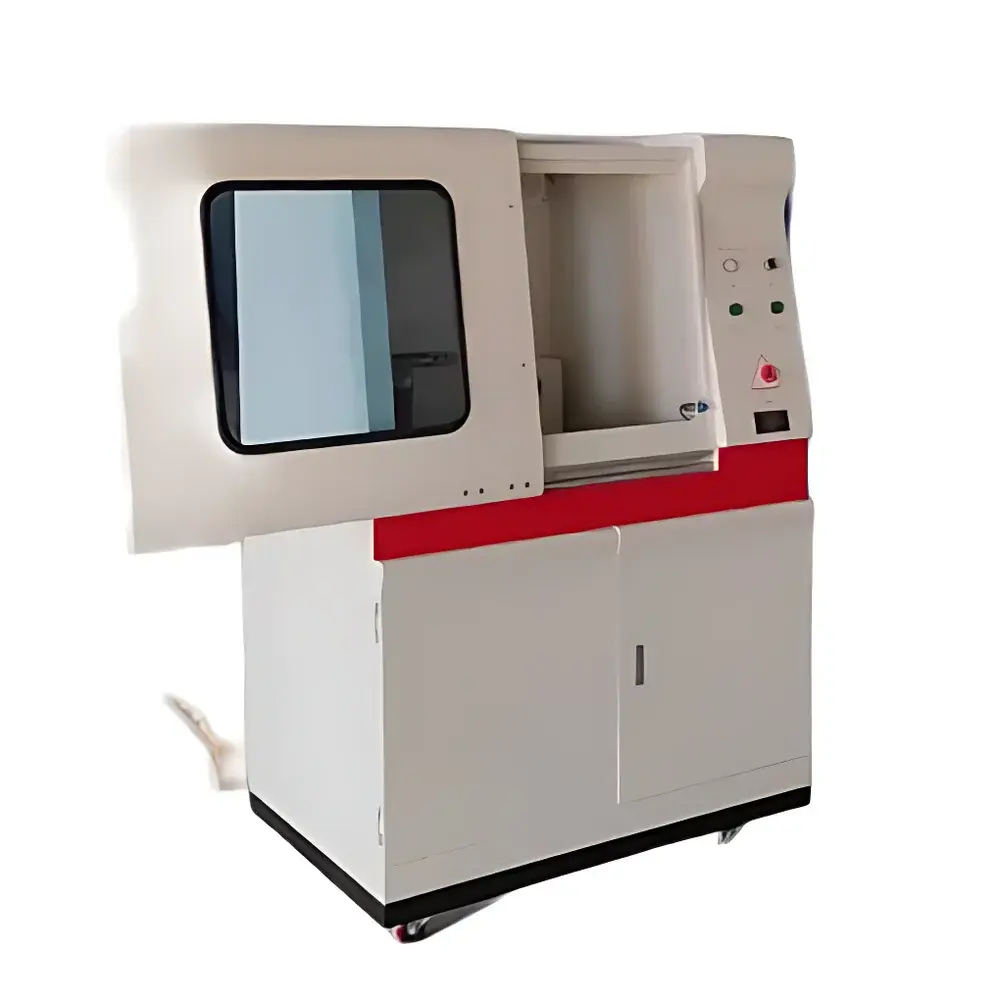
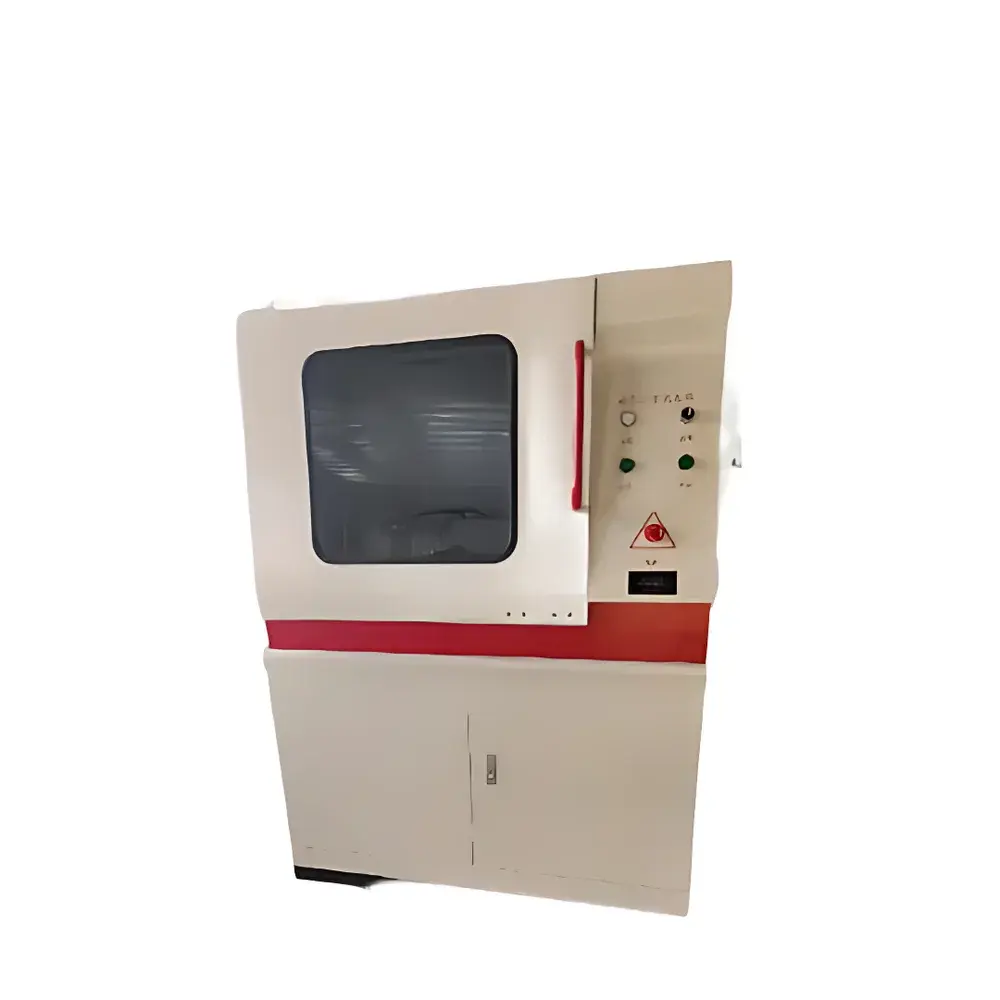
North Guang Precision BDJC-50K Dielectric Breakdown Strength Tester
| Brand | North Guang Precision Instrument |
|---|---|
| Origin | Beijing, China |
| Manufacturer Type | OEM Manufacturer |
| Model | BDJC-50K |
| Input Voltage | AC 220 V ±10%, 50 Hz ±1% |
| Output Voltage | AC/DC 0–50 kV (continuously adjustable) |
| Electrical Capacity | 10 kVA |
| Voltage Accuracy | ≤1% |
| Rise Rate | 0.1–5.0 kV/s (user-selectable) |
| Protection | Overvoltage, overcurrent, short-circuit, leakage, door interlock, zero-voltage reset, grounding, post-test discharge, fault alarm |
| Electrodes | Two Φ25 mm × 25 mm disc electrodes |
| Test Media | Air or transformer oil |
| Dielectric Test Modes | AC/DC ramp-up, step-up, and withstand testing |
| Withstand Time | 0–6 h (software-controlled) |
| Data Acquisition | Real-time voltage/current (mA resolution), automated breakpoint detection |
| Compliance | GB/T 1408.1–2006, GB/T 1695–2005, GB/T 3333–1982, HG/T 3330–2003, GB 12656–1990, ASTM D149–2022 |
Overview
The North Guang Precision BDJC-50K Dielectric Breakdown Strength Tester is a fully integrated, microprocessor-controlled high-voltage test system engineered for precise determination of the dielectric strength of solid and liquid insulating materials under standardized AC and DC conditions. It operates on the fundamental principle of controlled voltage escalation until electrical breakdown occurs—defined as the irreversible loss of insulating integrity due to ionization, thermal runaway, or electrochemical degradation across the test specimen. Designed in strict alignment with IEC 60243-1, ASTM D149, and GB/T 1408.1–2006, the instrument delivers traceable, repeatable measurements essential for quality assurance in polymer compounding, cable insulation R&D, capacitor dielectric qualification, and aerospace-grade composite validation. Its dual-mode architecture supports both sinusoidal AC (50 Hz) and pulsating DC outputs—achieved via internal high-voltage silicon stack switching—enabling direct comparison of material behavior under alternating versus unidirectional stress, critical for evaluating space charge accumulation and partial discharge susceptibility.
Key Features
- True dual-mode output: Seamless AC/DC switching via mechanical shorting rod manipulation inside the high-voltage insulation column—no external rectifier modules required.
- Advanced non-contact voltage regulation: Solid-state, contactless step-up control eliminates mechanical wear and ensures linear, jitter-free voltage ramping from 0.1 to 5.0 kV/s with <1% linearity deviation.
- Comprehensive multi-layer safety architecture: Interlocked test chamber with grounded stainless-steel (SUS304) enclosure; automatic zero-reset upon trip; active arc-quenching circuitry; real-time mA-level current monitoring with 50 ms cutoff response.
- Modular electrode system: Supplied with three standardized electrodes per GB/T 1408.1–2006—two Φ25 mm discs and one Φ75 mm disc—enabling comparative testing across thickness and area variables.
- Flexible operational topology: Supports local PC control (USB/RS-232), Bluetooth-enabled remote operation, and optional networked multi-user access—ideal for centralized lab management and GLP-compliant audit trails.
- Integrated oil bath assembly: Removable transformer oil immersion tank with temperature-stable mounting interface for liquid dielectric evaluation per ASTM D877 and IEC 60156.
Sample Compatibility & Compliance
The BDJC-50K accommodates rigid solids (e.g., epoxy laminates, polyimide films, ceramic substrates), flexible sheets (PVC, silicone rubber), molded components (insulator housings, bushings), and liquid dielectrics (mineral oil, synthetic esters, silicone fluids). Specimen thickness range: 0.1–10 mm (solid); volume: ≥100 mL (liquid). All test configurations comply with mandatory requirements for electrode geometry, edge guarding, and environmental conditioning specified in GB/T 1408.1–2006 (equivalent to IEC 60243-1), ASTM D149–2022, and ISO 60243-1. The system meets Class II electrical safety standards per GB/T 38031–2019 and incorporates grounding continuity verification per IEC 61010-1. Optional NIST-traceable calibration certificates are available through CNAS-accredited third-party metrology laboratories.
Software & Data Management
The proprietary NGP-TestSuite v4.2 software provides full IEC 61508 SIL2-aligned control, data acquisition, and reporting. It logs time-stamped voltage, current, ramp rate, breakdown location (1–5 mm precision), and ambient temperature/humidity (via optional sensor input). All user actions—including parameter changes, test initiation, and emergency stops—are recorded with timestamped operator ID and IP address for 21 CFR Part 11 compliance. Export formats include CSV, PDF (with digital signature), and XML for LIMS integration. Audit trail retention exceeds 10 years; data encryption follows AES-256 standards. Software supports automated report generation compliant with ISO/IEC 17025:2017 clause 7.8.2 for accredited testing laboratories.
Applications
- Quality control of insulating varnishes, encapsulants, and potting compounds in electronics manufacturing.
- Evaluation of aging effects on polymeric insulation after thermal, UV, or humidity exposure per IEC 60216.
- Validation of high-voltage transformer oil dielectric stability per ASTM D877 and D1816.
- R&D screening of nanocomposite dielectrics for electric vehicle battery separators and solid-state capacitors.
- Third-party certification testing for UL 746C, IEC 60674-2, and GB/T 507–2002 compliance.
FAQ
How does the BDJC-50K ensure measurement traceability?
All high-voltage sensors are calibrated against primary standards maintained by CNAS-accredited national metrology institutes. Calibration certificates include uncertainty budgets per ISO/IEC 17025 and are valid for 12 months.
Can the system perform step-voltage withstand tests per IEC 60270?
Yes—the software supports programmable hold steps at user-defined voltages for durations up to 6 hours, with automatic pass/fail classification based on leakage current thresholds.
Is remote operation secure for regulated environments?
Bluetooth and Ethernet interfaces implement TLS 1.2 encryption and role-based access control (RBAC), satisfying FDA 21 CFR Part 11 electronic record requirements.
What maintenance is required for long-term accuracy?
Annual verification of electrode flatness (≤0.005 mm deviation), HV bushing insulation resistance (>1012 Ω), and grounding bond integrity (<0.1 Ω) is recommended.
Does the system support custom waveform testing (e.g., lightning impulse)?
No—the BDJC-50K is optimized for power-frequency AC and steady-state DC. Impulse testing requires dedicated surge generators compliant with IEC 60060-1.



