
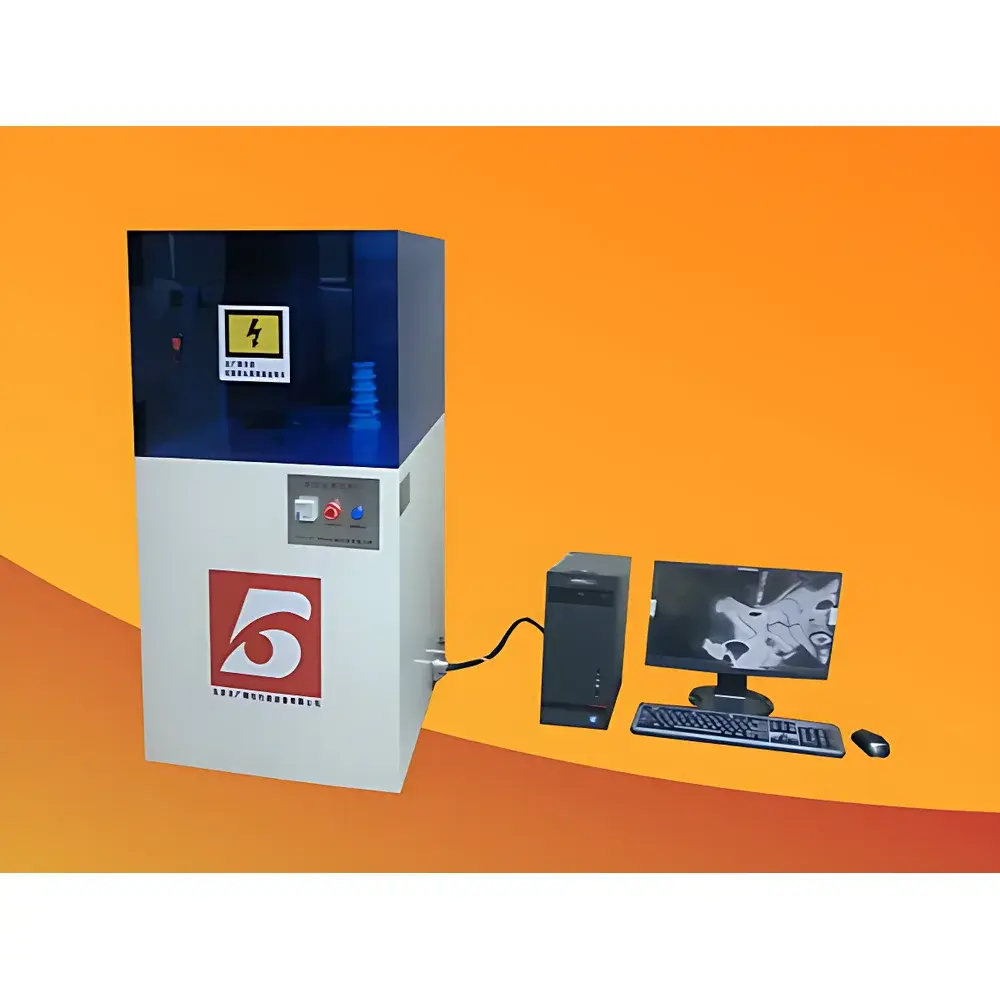
North Guang Precision BDJC-50KV Organic Silicon Voltage Breakdown Tester
| Brand | North Guang Precision / All Precision Instrument |
|---|---|
| Origin | Beijing, China |
| Manufacturer Type | Direct Manufacturer |
| Country of Origin | China |
| Model | BDJC-50KV |
| Breakdown Voltage Range | 0–50 kV AC/DC |
| Input Voltage | AC 220 V |
| Power Capacity | 3–10 kVA |
| Voltage Accuracy | ≤ ±1% |
| Ramp Rate | 0.01–5 kV/s (adjustable) |
| Test Modes | Stepwise ramp, Constant-rate ramp, Hold-at-voltage (0–7 h) |
| Test Medium | Air |
| Sample Types | Solid and liquid insulating materials |
| Environmental Conditions | 23 ± 2 °C, 50 ± 5 % RH |
| Compliance | ASTM D149, IEC 60243-1, GB/T 1408.1, ISO 60243-1 |
Overview
The North Guang Precision BDJC-50KV Organic Silicon Voltage Breakdown Tester is an engineered high-voltage dielectric strength testing system designed for precise determination of the electrical breakdown voltage and dielectric strength of organic silicon-based insulating materials—including silicone elastomers, silicone resins, RTV rubbers, and filled silicone compounds—as well as broader classes of solid and liquid dielectrics. Operating on the principle of controlled voltage escalation under standardized test conditions, the instrument applies either AC or DC voltage across a defined electrode geometry until electrical failure (i.e., disruptive discharge or current surge beyond threshold) occurs. The system complies with fundamental dielectric testing standards including ASTM D149 (Standard Test Method for Dielectric Breakdown Voltage of Solid Electrical Insulating Materials at Commercial Power Frequencies), IEC 60243-1, and GB/T 1408.1, ensuring traceable, repeatable, and internationally recognized measurement outcomes. Its 50 kV maximum output capacity enables reliable evaluation of medium-thickness insulation specimens—typically 2–3 mm—for applications in R&D labs, quality control departments, and certification testing facilities serving the electrical insulation, aerospace, automotive, and power transmission sectors.
Key Features
- True dual-mode operation: selectable AC or DC high-voltage output with independent calibration paths and waveform fidelity verification.
- Microprocessor-controlled voltage ramping: adjustable rate from 0.01 to 5 kV/s via digital setpoint, eliminating mechanical variac drift and enabling reproducible stress profiles.
- Multi-criteria breakdown detection: simultaneous monitoring of voltage collapse and leakage current threshold (programmable mA limit) ensures robust failure identification across material types.
- Wireless Bluetooth safety interlock system: remote emergency shutdown and real-time status feedback minimize operator exposure during high-voltage operation.
- Modular high-voltage generator architecture: scalable power capacity options (3/5/10 kVA) accommodate varying load impedance and test duration requirements without compromising regulation stability.
- Integrated environmental monitoring: built-in temperature and humidity sensors log ambient conditions per test cycle to support GLP-compliant reporting and data correlation.
Sample Compatibility & Compliance
The BDJC-50KV supports standardized electrode configurations per ASTM D149 (e.g., cylindrical brass electrodes, 6.4 mm diameter, 25.4 mm spacing) and accommodates both solid slabs (2–3 mm thickness recommended for silicone elastomers and ceramic composites) and liquid samples in sealed, grounded test cells. It is routinely employed for evaluating silicone encapsulants, high-temperature RTV gels, silicone-coated fiberglass tapes, and silicone-filled potting compounds. Regulatory alignment includes full support for test documentation required under ISO/IEC 17025-accredited laboratories; audit trails, user authentication, and electronic signature capability meet FDA 21 CFR Part 11 and EU Annex 11 expectations when configured with validated software modules. All electrical safety design conforms to IEC 61010-1:2010 for measurement, control, and laboratory equipment.
Software & Data Management
The Windows-based control platform provides full test lifecycle management: real-time voltage-current curve visualization, dynamic pass/fail flagging, and automatic timestamped data capture. Each test record stores raw acquisition points (voltage, current, time, ramp rate, ambient T/RH), operator ID, sample ID, electrode configuration, and selected standard. Export functionality supports direct CSV and Excel (.xlsx) generation with customizable field mapping. Report templates adhere to ASTM and IEC formatting conventions—including calculated dielectric strength (kV/mm), statistical summaries across batches, and deviation flags against historical baselines. Role-based access control enforces separation of duties: administrators configure methods and calibrations; technicians execute tests; QA reviewers approve final reports. All software modifications are version-logged and subject to change control procedures compliant with ISO 9001 Clause 8.5.5.
Applications
This tester serves critical functions across multiple domains: validation of silicone-based high-voltage cable terminations and bushings; qualification of silicone gel dielectric fillers in LED driver modules; screening of silicone pressure-sensitive adhesives for HV battery module insulation; comparative assessment of siloxane-modified epoxy vs. pure silicone systems in aerospace wire coatings; and routine QC of silicone rubber gaskets used in medical imaging equipment housings. In academic research, it supports structure-property studies linking siloxane backbone length, filler dispersion homogeneity, and crosslink density to macroscopic dielectric performance. Its ability to perform hold-at-voltage tests up to 7 hours also enables accelerated aging simulations under sustained electrical stress.
FAQ
What electrode configurations are supported for silicone elastomer testing?
Standard ASTM D149 cylindrical electrodes (6.4 mm diameter, 25.4 mm gap) are supplied; custom electrodes—including needle-plane and spherical geometries—can be integrated upon request for non-standard evaluations.
Is the system compatible with third-party LIMS or ELN platforms?
Yes—via RS-232, USB, or TCP/IP interface, raw data and metadata can be exported in structured ASCII or XML format for ingestion into enterprise laboratory informatics systems.
How is calibration traceability maintained?
High-voltage output is calibrated annually using NIST-traceable reference dividers (e.g., Fluke 80K-40); calibration certificates include uncertainty budgets and are stored within the software audit trail.
Can the system perform pre-conditioning cycles before breakdown testing?
Yes—programmable pre-stress sequences (e.g., 10 min at 75% of target voltage) are available to simulate service history prior to final ramp-to-failure.
Does the software support multi-sample batch testing with auto-indexing?
Yes—up to 99 specimens per session; each receives unique identifiers, sequential test sequencing, and consolidated summary statistics upon completion.



