
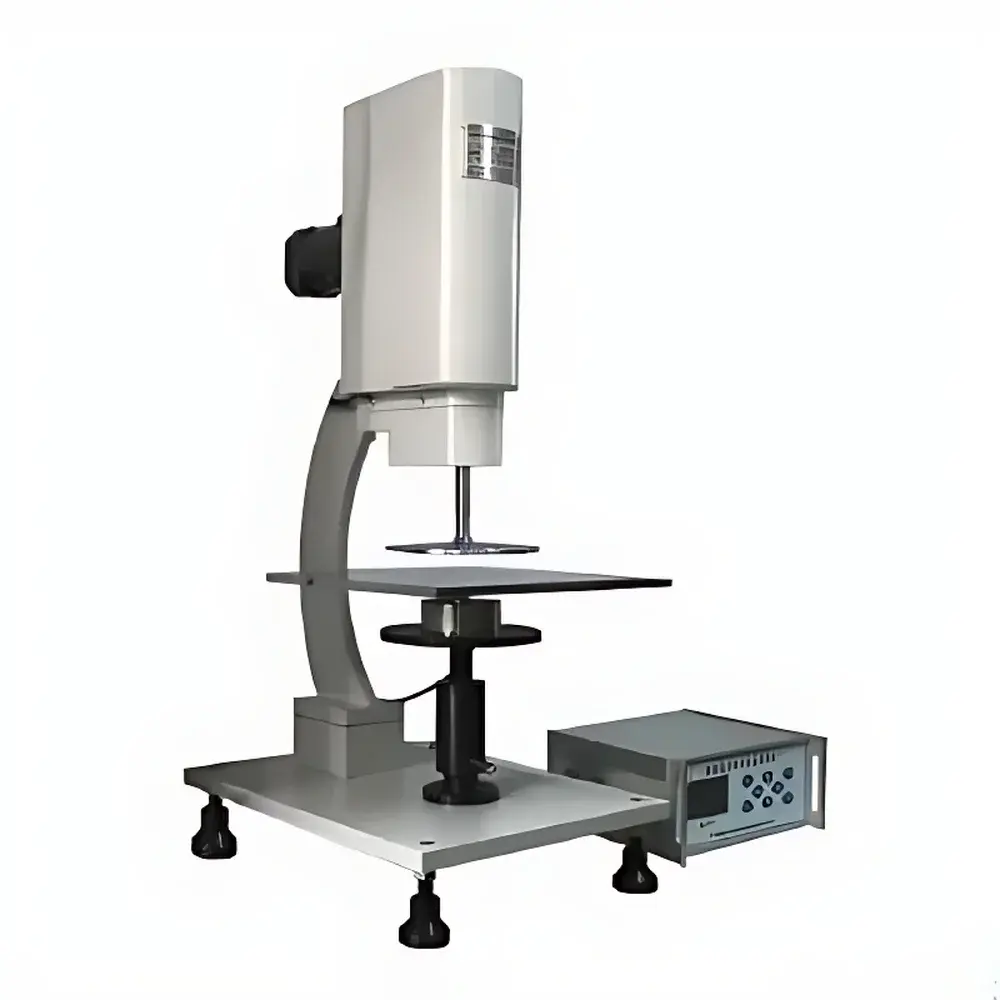
North Guang Precision HMPL-2000 Fixed-Load Impact Fatigue Tester for Flexible Polymeric Foams
| Brand | North Guang Precision Instrument |
|---|---|
| Origin | Beijing, China |
| Manufacturer Type | Direct Manufacturer |
| Model | HMPL-2000 |
| Max Test Force | 2000 N |
| Stroke Range | 0–100 mm |
| Compression Frequency | 20–120 cycles/min |
| Platen Diameter | Ø250 mm |
| Specimen Dimensions | (380±20) mm × (380±20) mm × (50±2) mm |
| Load Accuracy | ±20 N (at 750 N setpoint) |
| Display | LCD with Chinese UI |
| Compliance | GB/T 18941, ISO 3385, QC/T 56-93, JASO B408-84 |
Overview
The North Guang Precision HMPL-2000 Fixed-Load Impact Fatigue Tester is an electromechanically controlled testing system engineered for the standardized evaluation of dynamic mechanical degradation in flexible polymeric foams—particularly polyurethane, latex, and viscoelastic foams used in automotive seating, furniture, bedding, and packaging applications. It operates on the principle of controlled cyclic compression under constant load, simulating real-world repetitive loading conditions such as occupant weight cycling on seat cushions or mattress support layers. The instrument implements the fixed-load impact method defined in ISO 3385 and GB/T 18941, wherein a rigid circular platen applies a preselected static force to a foam specimen at a regulated frequency and stroke depth. The primary output metrics are residual thickness loss (expressed as % permanent deformation) and hardness reduction after a specified number of cycles—quantitative indicators of fatigue-induced structural breakdown, cell wall collapse, and viscoelastic recovery decay.
Key Features
- Microprocessor-based closed-loop load control system maintains constant applied force (range: 0–2000 N) throughout each cycle, with automatic compensation for load drift due to foam creep or thermal relaxation.
- Adjustable compression frequency (20–120 cycles/min) and stroke depth (0–100 mm), enabling protocol customization per material stiffness and application requirements.
- Large-format test platens (Ø250 mm upper platen; 30 × 30 cm lower support surface) accommodate standard ISO/GB specimens up to 380 × 380 × 50 mm, minimizing edge effects and ensuring uniform stress distribution.
- High-precision load cell (spindle-mounted, S-type, 0.5% full-scale accuracy) integrated with real-time digital feedback ensures traceable force delivery and repeatability across laboratories.
- LCD interface with bilingual menu navigation (Chinese default, firmware-upgradable to English) supports intuitive parameter entry, cycle counting (0–9999), and immediate post-test display of cumulative deformation trends.
- Robust cast-iron frame with linear guide rails and precision timing belt drive delivers low-vibration operation, minimal maintenance, and long-term dimensional stability—critical for multi-day fatigue runs.
Sample Compatibility & Compliance
The HMPL-2000 is validated for use with open-cell and semi-closed-cell flexible foams having initial thickness ≥20 mm and nominal density between 15–120 kg/m³. Specimens must be conditioned per ISO 293 and ASTM D3574 prior to testing. The system fully complies with the procedural and metrological requirements of ISO 3385:2014 (“Flexible cellular polymeric materials — Determination of fatigue by the constant-load method”) and its national equivalents, including GB/T 18941–2003. It also satisfies functional criteria outlined in QC/T 56–1993 (“Test methods for cushioning materials in automobile seats”) and JASO B408–1984 (“Testing method for seat cushion materials”), making it suitable for Tier-1 automotive supplier qualification and OEM audit readiness. All mechanical components—including platen geometry (R25 lower-edge radius), platen parallelism (<0.1 mm deviation over 300 mm), and displacement resolution (0.01 mm)—are verified against calibration protocols traceable to CNAS-accredited standards.
Software & Data Management
While the base HMPL-2000 operates via embedded firmware without PC connectivity, optional RS-232 or USB-to-serial interface modules enable data export to external acquisition software (e.g., LabVIEW, MATLAB, or custom CSV loggers). Raw outputs include timestamped cycle count, instantaneous load (N), vertical displacement (mm), and elapsed time. For GLP/GMP-regulated environments, the optional Data Logging Kit provides audit-trail-enabled recording compliant with FDA 21 CFR Part 11 requirements—including user authentication, electronic signatures, and immutable event logs. Calibration certificates, maintenance records, and test reports generated from exported datasets meet ISO/IEC 17025 documentation expectations for accredited testing laboratories.
Applications
- Quantifying fatigue resistance of automotive seat foams during durability validation (e.g., 50,000–100,000 cycles at 750 N, 70 cpm).
- Evaluating long-term support retention in mattress core layers under simulated body pressure profiles.
- Comparative benchmarking of bio-based or recycled-content foams versus conventional petrochemical formulations.
- Supporting material development R&D by correlating fatigue performance with chemical crosslink density, blowing agent type, and filler dispersion homogeneity.
- Verifying conformance to procurement specifications issued by global OEMs requiring ISO 3385-compliant fatigue data packages.
FAQ
What standards does the HMPL-2000 directly support?
ISO 3385:2014, GB/T 18941–2003, QC/T 56–1993, and JASO B408–1984.
Can the instrument perform variable-load fatigue tests?
No—the HMPL-2000 is designed exclusively for fixed-load impact testing per ISO 3385. For programmable load profiles, consider the NGP-FAT series with servo-hydraulic actuation.
Is specimen conditioning required before testing?
Yes. Specimens must be equilibrated at 23 ± 2 °C and 50 ± 5% RH for ≥16 hours per ISO 293 and ASTM D3574.
How is force calibration performed and how often is it recommended?
Calibration uses traceable dead-weight standards or certified reference load cells. Annual recalibration is recommended; quarterly verification is advised for high-throughput labs.
Does the system include test report generation capability?
The base unit displays real-time cycle count and final deformation but does not auto-generate PDF reports. Exported CSV data can be formatted into compliant reports using third-party tools or optional NGP-ReportSuite software.



