
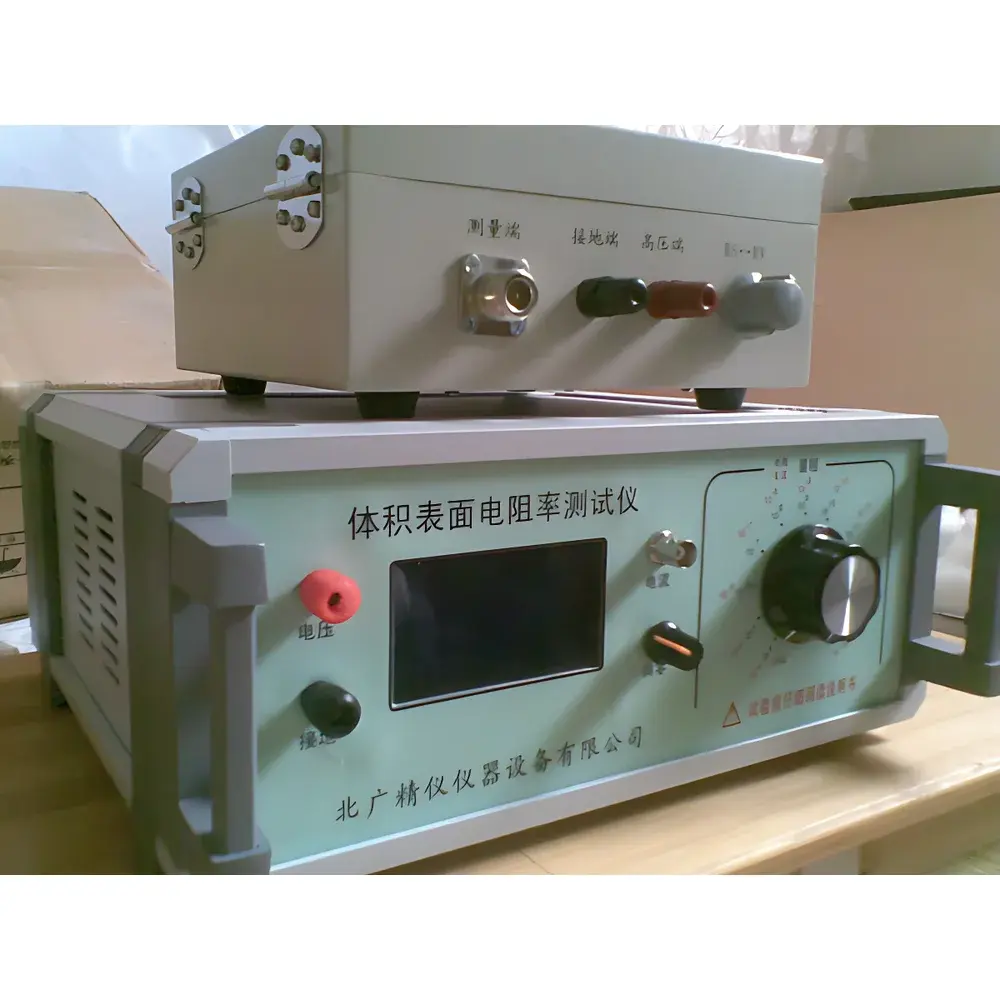
North Guang Precision Instrument EST-121 High-Resistance Meter for Volume and Surface Resistivity of Rubber and Polymeric Insulating Materials
| Brand | North Guang Precision Instrument / All Precision Instrument |
|---|---|
| Origin | Beijing, China |
| Manufacturer Type | Direct Manufacturer |
| Country of Origin | China |
| Model | EST-121 |
| Pricing | Upon Request |
| Test Voltages | DC 10 V, 50 V, 100 V, 500 V, 1000 V |
| Resistance Range | 1×10⁴ Ω to 1×10¹⁸ Ω |
| Current Range | 2×10⁻⁴ A to 1×10⁻¹⁶ A |
| Input Impedance | >10¹⁵ Ω |
| Power Supply | AC 220 V ±10%, 50 Hz |
| Operating Temperature | 0–40 °C |
| Relative Humidity | ≤70% RH |
| Dimensions (L×W×D) | 355 mm × 320 mm × 145 mm |
| Weight | ~6 kg |
| Power Consumption | ~10 W |
| Continuous Operation | Up to 8 hours |
Overview
The North Guang Precision Instrument EST-121 High-Resistance Meter is a precision laboratory instrument engineered for the quantitative determination of volume resistivity (ρv) and surface resistivity (ρs) in solid insulating materials—particularly elastomers, vulcanized rubber, thermoplastic polymers, coatings, and dielectric films. It operates on the principle of direct-current (DC) high-voltage resistance measurement, utilizing a high-input-impedance electrometer amplifier (>10¹⁵ Ω) to accurately resolve ultra-low conduction currents across electrically insulating specimens. The instrument complies with internationally recognized test standards including GB/T 1410–2006, ASTM D257–99, GB/T 1692–2008, GB/T 2439–2001, and GB/T 10064–2006—ensuring data integrity for quality control, R&D validation, and regulatory submission in electrical insulation qualification workflows.
Key Features
- Five selectable DC test voltages (10 V, 50 V, 100 V, 500 V, and 1000 V) enable compliance with material-specific test protocols and voltage-dependent resistivity evaluation.
- Direct-read resistance display eliminates manual range-factor multiplication—improving measurement reproducibility and reducing operator error during high-resistance testing (up to 1×10¹⁸ Ω).
- Dual-parameter readout: simultaneous digital display of resistance value (Ω) and leakage current (A), supporting real-time assessment of conduction behavior.
- Guard terminal (G-terminal) configuration mitigates surface leakage errors—critical when measuring coaxial cables, laminated composites, or specimens with heterogeneous surface contamination.
- Robust front-panel interface with intuitive voltage selection and range switching; no external software or PC required for basic operation.
- Compact benchtop design (355 × 320 × 145 mm) and low power consumption (~10 W) support integration into constrained lab environments and long-duration stability tests.
Sample Compatibility & Compliance
The EST-121 is validated for use with standardized electrode configurations per IEC 62631-3-1 and ASTM D257—including guarded two-electrode and three-electrode setups for volume and surface resistivity separation. It accommodates rigid sheets (e.g., silicone rubber slabs), flexible films (e.g., EPDM insulation wraps), molded elastomer components, and extruded polymer profiles. When paired with a thermostatically controlled water bath (not included), the system supports temperature-dependent resistivity profiling per GB/T 10581–2006 and ASTM D1711, enabling characterization from ambient up to 85 °C. All measurements adhere to Good Laboratory Practice (GLP) documentation requirements, with traceable voltage calibration and stable bias sourcing suitable for internal audit and ISO/IEC 17025-accredited laboratories.
Software & Data Management
While the EST-121 operates as a stand-alone analog-digital hybrid instrument, its output signals (voltage, current, resistance) are compatible with optional analog-to-digital acquisition modules for time-series logging. For regulated environments requiring electronic records, users may integrate the unit with validated third-party DAQ systems compliant with FDA 21 CFR Part 11—supporting audit trails, user access controls, and electronic signatures. Raw measurement data aligns with ASTM E178 statistical guidelines for outlier detection and repeatability assessment. No proprietary firmware or cloud dependency is involved; all calibration constants and test parameters remain under full user control.
Applications
- Quality assurance of rubber-based cable jacketing, automotive gaskets, and aerospace sealing compounds.
- Development and screening of antistatic additives in polyolefin blends and conductive elastomer composites.
- Validation of insulation integrity in medical device housings (e.g., ultrasound probe casings) per IEC 60601-1 leakage current limits.
- Research into humidity- and temperature-induced resistivity drift in silicone elastomers used in high-voltage bushings.
- Conformance testing of textile substrates for electrostatic dissipative (ESD) workwear per GB/T 12703.4–2010.
- Baseline resistivity mapping prior to accelerated aging (thermal, UV, ozone) per ASTM D573 and ISO 188.
FAQ
What safety precautions are required when operating the EST-121 at 1000 V DC?
Operators must use insulated gloves rated for ≥1.5 kV, ensure proper grounding of the instrument chassis, and never touch exposed terminals during measurement. The guard terminal must be connected when evaluating multi-layer or shielded samples to prevent erroneous surface conduction readings.
Can the EST-121 measure resistivity of liquid or paste-like insulators?
No—the instrument is designed exclusively for solid, self-supporting specimens. Liquid or semi-solid materials require dedicated conductivity cells and alternative instrumentation (e.g., four-point probe or impedance spectroscopy systems).
Is calibration traceable to national standards?
Yes. The high-voltage source and current-sensing circuitry are factory-calibrated against NIM (National Institute of Metrology, China)-certified reference resistors and standard cells. Users receive a calibration certificate with uncertainty budget per ISO/IEC 17025.
How does the guard terminal reduce measurement error?
The G-terminal diverts surface leakage current away from the main measurement path, effectively isolating bulk conduction. This is essential for accurate volume resistivity when testing specimens with hygroscopic surfaces or contaminated electrodes.
Does the EST-121 support automated temperature ramping?
Not natively—but it interfaces seamlessly with external programmable environmental chambers and calibrated immersion baths. Resistance vs. temperature datasets can be compiled manually or via third-party LabVIEW/Python scripts using analog outputs.



