
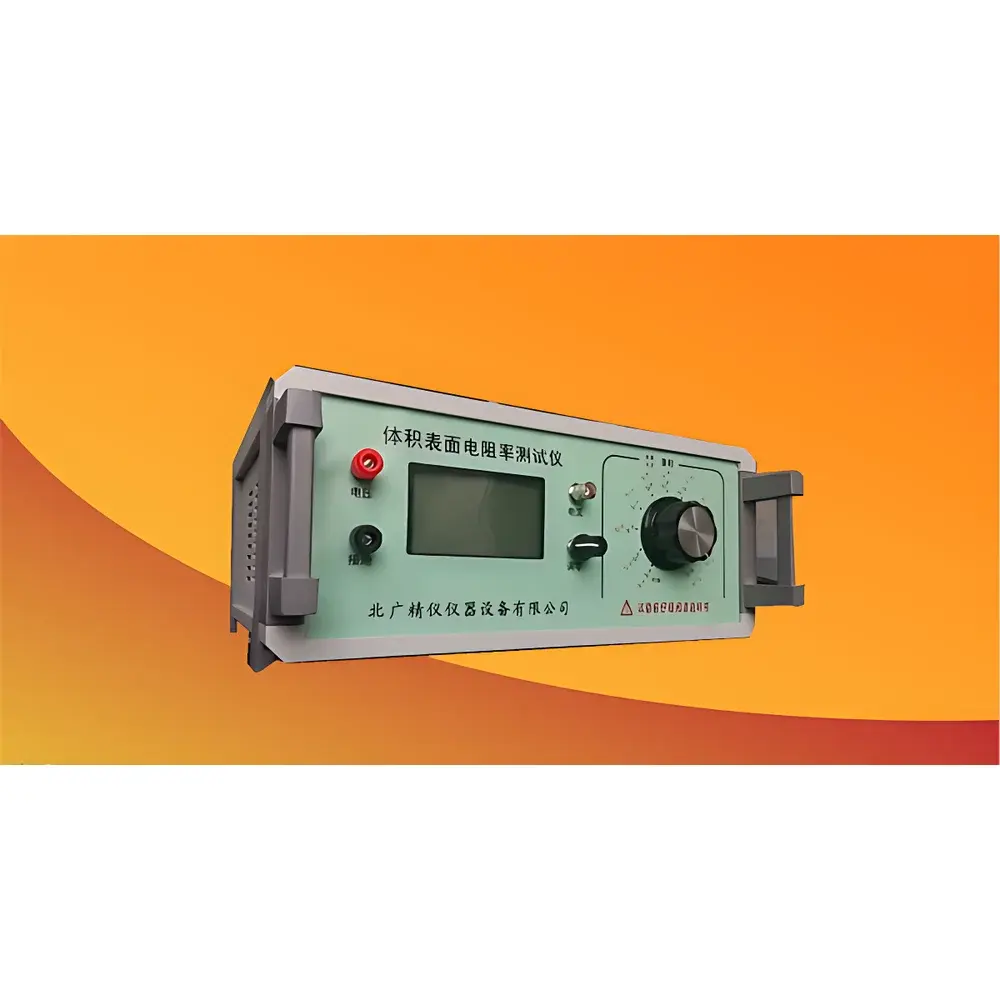
North Guangjing B121 Ultra-High Resistance Volume & Surface Resistivity Tester
| Brand | All Precision Instrument |
|---|---|
| Origin | Beijing, China |
| Manufacturer Type | Direct Manufacturer |
| Country of Origin | China |
| Model | B121 |
| Price | USD 1,200 (FOB Beijing) |
| Compliance | GB/T 1410–2006 / IEC 60093:1980 |
| Measurement Principle | Guarded Three-Electrode Ring Method |
| Resistance Range | 1.0×10³ – 2.0×10¹² Ω |
| Resistivity Range | 1.0×10³ – 2.0×10¹² Ω·m |
| Sheet Resistance Range | 1.0×10⁴ – 2.0×10¹² Ω/□ |
| Resolution | 0.1×10³ – 0.1×10¹² Ω (auto-ranging) |
| Power Supply | 220 V ±10%, 50 Hz ±4%, ≤20 W |
| Dimensions (W×H×L) | 280 × 90 × 275 mm |
| Net Weight | ≤3.0 kg |
| Standard Electrode | Triple-ring coaxial electrode (center cylinder Ø50 mm × 40 mm h |
Overview
The North Guangjing B121 Ultra-High Resistance Volume & Surface Resistivity Tester is a precision metrology instrument engineered for quantitative characterization of electrical insulation performance in solid dielectric materials. It operates on the guarded three-electrode ring method—standardized in GB/T 1410–2006 and its international counterpart IEC 60093:1980—to independently isolate and quantify volume resistivity (ρv) and surface resistivity (ρs). This methodology eliminates parasitic leakage paths by actively shielding the measurement electrode with a concentric guard ring held at the same potential, thereby ensuring that only current flowing through the designated bulk or surface region contributes to the reading. The instrument integrates a stabilized high-voltage DC source (up to 1,000 V), a sub-picoampere microcurrent detection circuit (<1 fA resolution), and an embedded microcontroller system with digital keypad interface. All operational parameters—including test voltage selection, range switching (manual or auto), zero/full-scale calibration, and data display—are managed via firmware-controlled digital inputs. Its compact benchtop form factor (280 × 90 × 275 mm, ≤3.0 kg) supports integration into QC laboratories, R&D cleanrooms, and production-line verification stations.
Key Features
- Triple-ring coaxial electrode system compliant with IEC 60093 geometry specifications: center electrode (Ø50 mm × 40 mm), guard ring (ID 60 mm / OD 80 mm × 40 mm), and grounded base plate (Ø100 mm × 10 mm)
- Ultra-wide resistance measurement range: 1.0×10³ Ω to 2.0×10¹² Ω, with selectable test voltages (10 V, 100 V, 500 V, 1,000 V) and automatic range scaling
- Dual-mode output: direct digital readout of resistance (Ω), volume resistivity (Ω·m), and sheet resistance (Ω/□); all derived in real time using geometric correction factors stored in firmware
- Integrated electrostatic discharge (ESD) mitigation: built-in shorting relay for sample pre-discharge and guard-driven leakage compensation circuitry
- Low-power architecture (≤20 W), CE-marked power supply, and EMI-filtered analog front-end to minimize noise-induced uncertainty in sub-nA current measurements
- Firmware-upgradable platform supporting future calibration traceability enhancements and expanded compliance protocols (e.g., ASTM D257, ISO 3915)
Sample Compatibility & Compliance
The B121 is validated for use with rigid and semi-rigid insulating solids including thermoplastics (e.g., PE, PP, PTFE), elastomers (silicone rubber, EPDM), laminates, ceramics, and coated substrates. Sample thickness must exceed electrode height (≥40 mm recommended) to ensure field uniformity; flatness tolerance: ≤0.1 mm over electrode contact area. The instrument satisfies national and international requirements for resistivity testing under controlled environmental conditions (23 °C ±2 °C, 50 % RH ±5 % RH per GB/T 10580). Its design incorporates provisions for conditioning sample humidity per IEC 60243-1—users may integrate optional glycerol-water saturated chambers prior to measurement. All electrical safety circuits conform to IEC 61010-1:2010 for measurement category CAT II 1000 V. Data acquisition complies with GLP audit-trail requirements when used with optional PC interface (RS-232), enabling timestamped result logging and operator ID tagging.
Software & Data Management
While the B121 operates as a stand-alone instrument with local digital display, it supports optional RS-232 serial communication for external data capture. When connected to host software (provided free of charge), users can configure automated test sequences—including variable dwell times (1 s to 9,999 s), multi-voltage sweeps, and pass/fail thresholds based on material specification limits (e.g., ANSI/ESD S20.20 for static-dissipative flooring). Raw current vs. time datasets are exportable in CSV format for post-processing in MATLAB®, Python (NumPy/Pandas), or Excel®. Firmware logs include calibration history, last zero/full-scale adjustment timestamps, and internal temperature monitoring—critical for ISO/IEC 17025 accredited labs maintaining technical records for ≥5 years. No proprietary drivers required; standard CDC ACM class enumeration ensures plug-and-play compatibility with Windows, macOS, and Linux systems.
Applications
- Quality control of ESD-safe components: antistatic footwear, conductive floor tiles, packaging foams, and polymer-based gaskets per ANSI/ESD STM97.1 and IEC 61340-2-3
- R&D evaluation of novel dielectrics: nanocomposite fillers (carbon black, graphene), ion-conductive polymers, and high-k ceramic coatings
- Failure analysis in electronics manufacturing: delamination detection via localized ρs mapping (using custom electrode fixtures)
- Regulatory testing for medical device housings (IEC 60601-1), aerospace composites (SAE AMS3675), and automotive interior trim (ISO 10993-10)
- Low-current physics experiments: dark current characterization of photodiodes, thermopiles, and bolometric sensors
FAQ
What standards does the B121 comply with for volume and surface resistivity measurement?
It fully implements GB/T 1410–2006 and IEC 60093:1980. Optional firmware updates extend support to ASTM D257 (2022) and ISO 3915 (2021).
Can the instrument measure materials with resistivity below 10³ Ω·m?
No—the B121 is optimized for insulators and static-dissipative materials (ρ ≥ 10³ Ω·m). For conductors or semiconductors, a four-point probe system is recommended.
Is electrode customization supported?
Yes. Users may substitute the standard ring electrode with custom geometries (e.g., parallel plate, concentric ring variants) provided dimensional tolerances adhere to IEC 60093 Annex A.
How is measurement uncertainty minimized in high-humidity environments?
The guard electrode topology inherently suppresses surface leakage; additionally, the instrument includes a “guard bias stabilization” mode that dynamically adjusts guard potential to match measurement electrode drift during extended dwell tests.
Does the device meet FDA 21 CFR Part 11 requirements for electronic records?
When operated with the optional PC software and networked authentication server, full Part 11 compliance—including electronic signatures, audit trails, and role-based access control—is achievable.





