
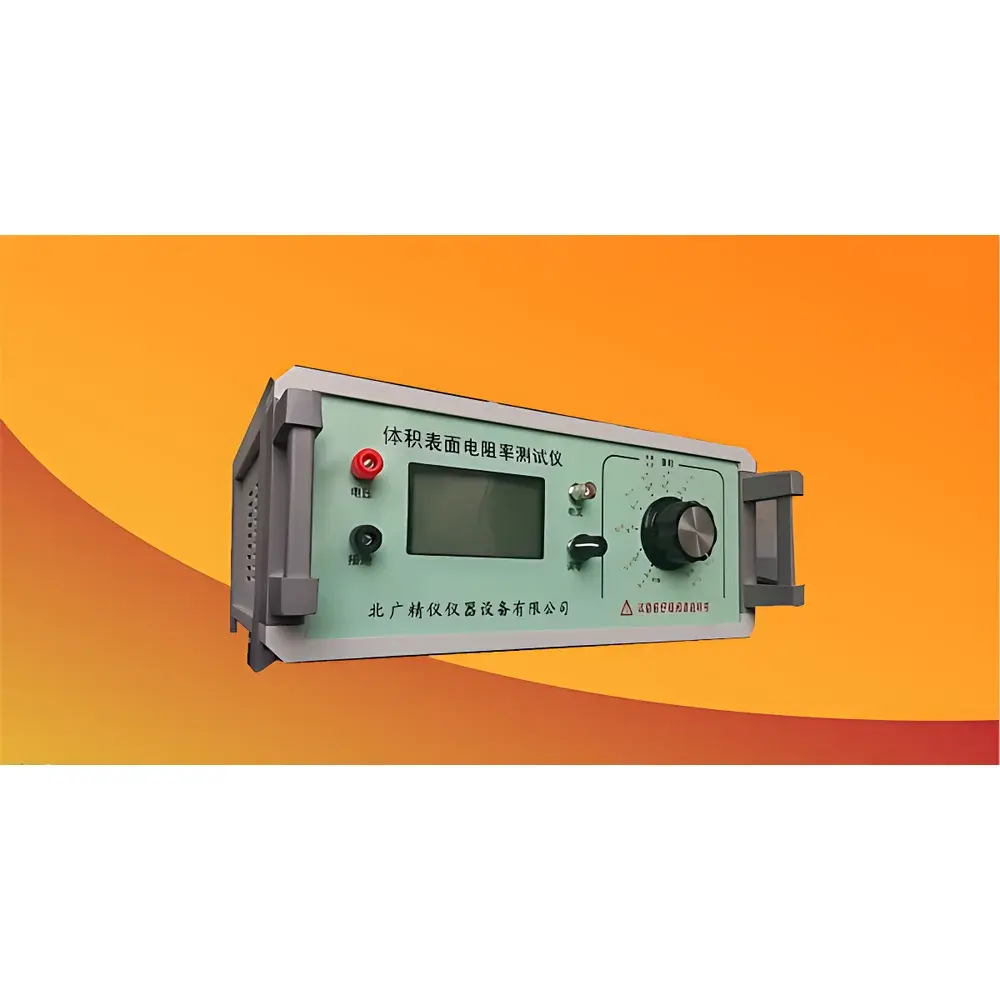
North Guangjingyi BEST-121 High-Resistance Meter for Volume & Surface Resistivity Measurement
| Brand | North Guangjingyi / All Precision Instrument |
|---|---|
| Origin | Beijing, China |
| Manufacturer Type | OEM Manufacturer |
| Regional Category | Domestic (China) |
| Model | BEST-121 |
| Measurement Range | 1×10⁴ Ω to 1×10¹⁸ Ω |
| Current Range | 2×10⁻⁴ A to 1×10⁻¹⁶ A |
| Test Voltages | DC 10 V, 50 V, 100 V, 250 V, 500 V, 1000 V |
| Accuracy Class | Compliant with Q/TPGG 7–2008 |
| Standard Compliance | GB/T 1410–2006, GB/T 1692–2008, GB/T 20991–2007, GB/T 12703.6–2010, ASTM D257, IEC 62631-3-1 |
| Operating Temperature | 0–40 °C |
| Relative Humidity | ≤70 % RH |
| Power Supply | AC 220 V ±10 %, 50 Hz |
| Power Consumption | ~10 W |
| Dimensions (L×W×D) | 355 mm × 320 mm × 145 mm |
| Weight | ~6 kg |
| Electrode System | Standard Triple-Ring Electrode (Guarded Electrode Configuration) |
| Display | Dual Digital Readout (Resistance + Current) |
| Auto/Manual Range Selection | Yes |
| Zero & Full-Scale Calibration | Built-in |
| Continuous Operation Time | Up to 8 h |
Overview
The North Guangjingyi BEST-121 High-Resistance Meter is a precision instrument engineered for the quantitative determination of volume resistivity (ρv) and surface resistivity (ρs) of solid and liquid insulating materials under controlled DC electric fields. It operates on the principle of guarded two-terminal (or three-terminal) ohmmetry, where a stable, low-noise high-voltage source applies a defined test potential across a standardized electrode configuration, while a high-sensitivity electrometer measures the resulting leakage current. The instrument’s design adheres to the fundamental physics of charge transport in dielectrics—namely, Ohm’s law extended to volumetric conduction (J = σE), where conductivity σ is the reciprocal of resistivity ρ. With a maximum measurable resistance of 1×10¹⁸ Ω at 1000 V DC, the BEST-121 supports characterization of ultra-high-resistivity polymers, ceramics, elastomers, coatings, and antistatic composites used in aerospace, semiconductor packaging, medical devices, and high-voltage insulation systems.
Key Features
- Ultra-wide resistance measurement range: 1×10⁴ Ω to 1×10¹⁸ Ω, enabling evaluation of both conductive additives and highly insulating bulk matrices.
- Simultaneous dual digital display of resistance value and corresponding current magnitude—critical for diagnosing non-ohmic behavior, polarization effects, or leakage path anomalies.
- Programmable DC test voltages (10 V, 50 V, 100 V, 250 V, 500 V, 1000 V) to comply with material-specific test protocols and avoid field-induced conduction artifacts.
- Integrated triple-ring guarded electrode system conforming to GB/T 1410–2006 and ASTM D257, ensuring accurate separation of volume and surface conduction paths via guard ring current shunting.
- Embedded microcontroller architecture with digital keypad input, automatic/manual range switching, and internal zero/full-scale calibration routines—eliminating analog drift and enhancing long-term measurement reproducibility.
- Low power consumption (~10 W) and compact footprint (355 × 320 × 145 mm) facilitate integration into QC labs, cleanrooms, and university teaching laboratories without dedicated HVAC or grounding infrastructure.
Sample Compatibility & Compliance
The BEST-121 is validated for use with rigid and flexible dielectric specimens including thermoplastics (e.g., PE, PP, PTFE), thermosets (epoxies, phenolics), elastomers (silicone, nitrile), fiber-reinforced composites, ceramic substrates, antistatic flooring materials, ESD-safe textiles, and liquid plasticizers. Its electrode configuration supports flat, sheet-like, and molded samples per GB/T 1410–2006 and IEC 62631-3-1. The instrument meets national and international standards for electrical safety and metrological traceability, including compliance with GB/T 1692–2008 (rubber resistivity), GB/T 20991–2007 (protective footwear), and GB/T 12703.6–2010 (textile electrostatic performance). For regulated environments—including GMP-compliant manufacturing facilities and GLP-certified testing labs—the system supports documented calibration records and operator-accessible parameter logs, though native 21 CFR Part 11 audit trail functionality requires external LIMS integration.
Software & Data Management
While the BEST-121 operates as a standalone benchtop meter with real-time front-panel readouts, its analog output port (0–2 V proportional to log10R) enables connection to external data acquisition systems (e.g., LabVIEW, MATLAB, or custom SCADA platforms) for time-resolved resistivity monitoring during thermal aging, humidity cycling, or voltage ramping tests. All measurement parameters—including applied voltage, selected range, elapsed charging time, and ambient temperature/humidity (when externally logged)—are manually recorded per test report templates aligned with ISO/IEC 17025 requirements. The absence of proprietary firmware or cloud connectivity ensures full data sovereignty and simplifies validation in regulated settings where cybersecurity controls restrict networked instrumentation.
Applications
- Quality control of insulating components in power transmission equipment (e.g., bushings, spacers, cable jackets) per GB 4385–1995 and DL/T 620–1997.
- Development and qualification of antistatic packaging films, conductive polymer blends, and carbon-black-filled composites per GB/T 15738–2008 and ASTM F1812.
- Research on moisture diffusion kinetics in polymeric dielectrics via temperature- and humidity-dependent ρv profiling.
- Evaluation of surface contamination levels on cleanroom-compatible materials using standardized 60-second electrification per GB/T 18044–2008.
- Verification of electrostatic dissipation (ESD) performance in work surfaces, garments, and footwear per ANSI/ESD S20.20 and IEC 61340-5-1.
- Fundamental studies of charge trapping and detrapping mechanisms in organic semiconductors and ferroelectric thin films via transient current analysis.
FAQ
What is the difference between volume resistivity and surface resistivity?
Volume resistivity (ρv, unit: Ω·m) quantifies bulk conduction through the material thickness, whereas surface resistivity (ρs, unit: Ω/sq) characterizes lateral current flow along the specimen’s top layer—primarily sensitive to adsorbed moisture, ionic contaminants, or surface oxidation.
Why is guard electrode configuration essential for accurate volume resistivity measurement?
The guard ring diverts surface leakage current away from the measuring circuit, preventing it from contributing to the measured current—and thus isolating true bulk conduction per IEC 62631-3-1 Clause 6.2.
How does environmental humidity affect resistivity measurements?
Relative humidity >50% RH significantly reduces ρv in hygroscopic polymers (e.g., nylon, PET) due to water-assisted ion mobility; therefore, GB/T 10580 mandates strict environmental conditioning prior to testing.
Can the BEST-121 measure resistivity of liquids?
Yes—when used with appropriate liquid cells compliant with GB/T 1672–1988 (liquid plasticizer resistivity), provided electrodes are chemically inert and cell geometry satisfies the standard’s aspect ratio requirements.
Is calibration traceable to national standards?
The instrument supports external calibration using NIST-traceable high-value resistors (e.g., 10¹² Ω to 10¹⁶ Ω); factory calibration certificates reference China National Institute of Metrology (CNIM) standards.



