
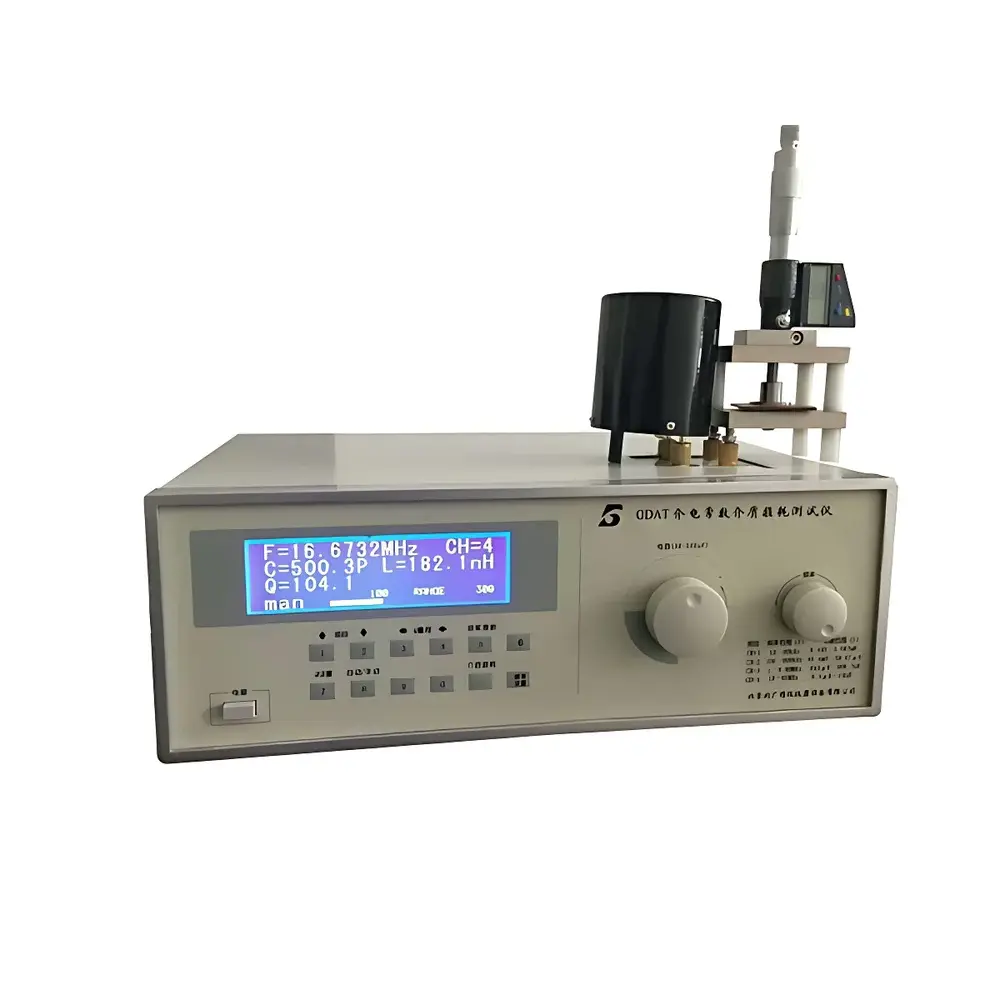
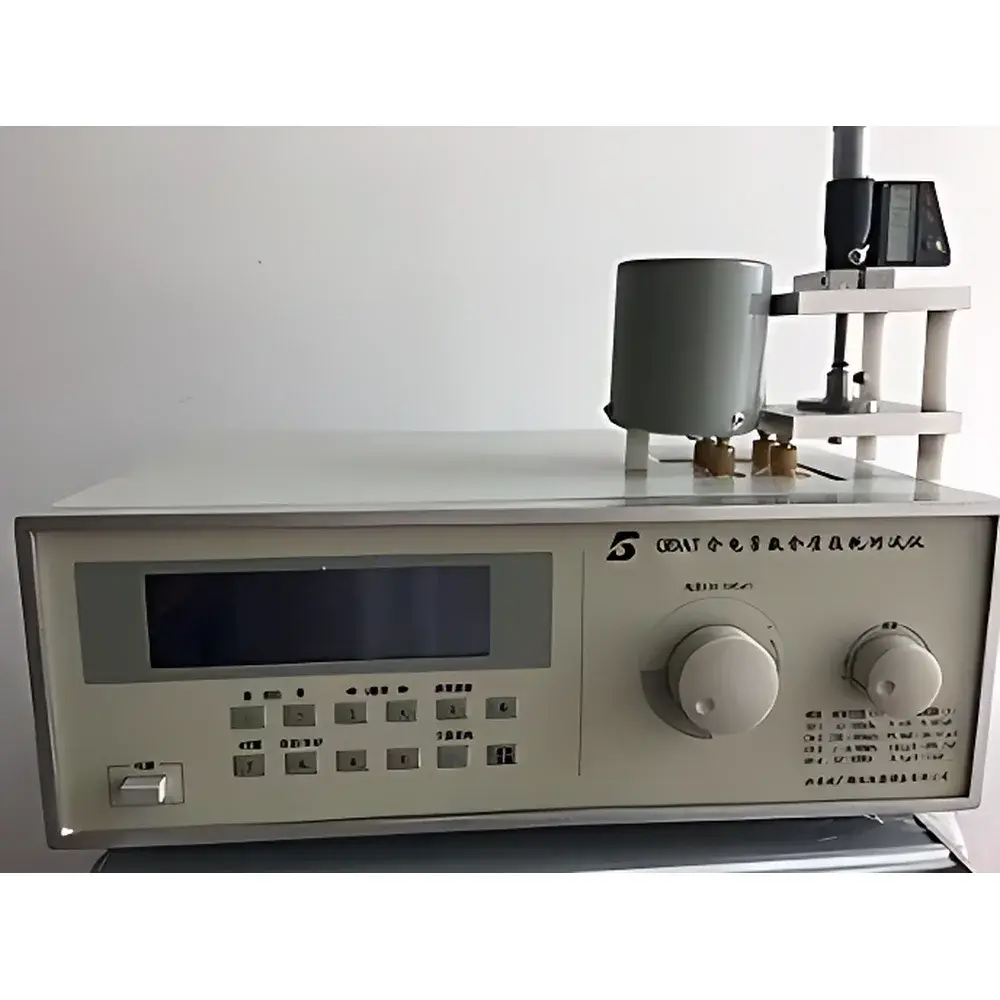
North Guangjingyi GDAT-A High-Frequency Dielectric Constant and Dissipation Factor Analyzer (70 MHz)
| Brand | North Guangjingyi / All Precision Instrument |
|---|---|
| Origin | Beijing, China |
| Manufacturer Type | Manufacturer |
| Model | GDAT-A (10 kHz – 70 MHz) |
| Frequency Range | 10 kHz to 70 MHz |
| Q Factor Measurement Range | 2–1023 |
| Capacitance Measurement Range | 1–460 pF |
| Main Tuning Capacitor Range | 30–500 pF |
| Capacitance Accuracy | ±1.5 pF (≤150 pF) |
| Inductance Measurement Range | 4.5 nH–100 mH (with residual inductance compensation) |
| Parallel-Plate Electrode Diameter Options | Ø25.4 mm or Ø50 mm |
| Electrode Spacing Adjustment Range | ≥10 mm, Resolution: ±0.01 mm |
| Cylindrical Capacitor Linearity | 0.33 pF/mm ±0.05 pF |
| Cylindrical Capacitor Travel Range | 0–20 mm, Resolution: ±0.01 mm |
| Fixture Loss Tangent (tanδ) | ≤4×10⁻⁴ at 1 MHz |
| Operating Temperature | 0–40 °C |
| Relative Humidity | <80% RH |
| Power Supply | 220 V ±22 V, 50 Hz ±2.5 Hz |
| Power Consumption | ~25 W |
| Net Weight | ~7 kg |
| Dimensions (L×W×H) | 380×132×280 mm |
Overview
The North Guangjingyi GDAT-A High-Frequency Dielectric Constant and Dissipation Factor Analyzer is a precision impedance measurement system engineered for the quantitative characterization of dielectric properties in solid insulating materials—particularly electrical insulation papers, ceramics, polymer composites, and advanced dielectrics used in high-voltage and high-frequency applications. It operates on the principle of high-frequency resonant cavity perturbation using a calibrated parallel-plate or cylindrical capacitor configuration coupled with a digitally stabilized Q-meter architecture. By measuring the shift in resonant frequency and Q-factor (quality factor) of a high-stability LC tank circuit upon insertion of a dielectric sample, the instrument determines both the complex permittivity ε* = ε′ − jε″ and the loss tangent tanδ = ε″/ε′. This method conforms to fundamental electromagnetic theory under quasi-static conditions and aligns with standardized test practices described in ASTM D150, IEC 60250, and GB/T 1409—providing traceable, repeatable data essential for material qualification, process control, and R&D validation.
Key Features
- High-resolution dual-capacitor test fixture: Includes interchangeable parallel-plate electrodes (Ø25.4 mm and Ø50 mm) with micrometer-driven spacing adjustment (≥10 mm range, ±0.01 mm resolution) for controlled sample thickness evaluation.
- Linear cylindrical tuning capacitor (0–20 mm travel, ±0.01 mm resolution, 0.33 pF/mm linearity ±0.05 pF) serving as a calibrated reference for precise tanδ calculation via Q-value perturbation.
- Digital frequency synthesis with automatic resonance search and frequency-locking (10 kHz–70 MHz, ±1×10⁻⁶ accuracy), eliminating drift and enabling stable multi-point spectral scanning.
- Auto-ranging Q measurement (2–1023) with five manual or auto-switched ranges (30, 100, 300, 1000) and built-in residual inductance compensation for accurate L/C extraction.
- Integrated microprocessor control with real-time numeric display of Q, C, L, f₀, tanδ, and ε′—eliminating analog interpolation errors and enabling direct readout without external calibration curves.
- Low-loss fixture design with verified tanδ ≤ 4×10⁻⁴ at 1 MHz, ensuring measurement uncertainty remains dominated by sample properties—not instrumentation artifacts.
Sample Compatibility & Compliance
The GDAT-A supports rigid, flat, low-conductivity dielectric specimens—including cellulose-based insulation paperboards, epoxy-glass laminates, alumina ceramics, polyimide films, and silicone rubber sheets—provided they meet dimensional constraints (max Ø50 mm × 5 mm thick) and surface flatness requirements (<0.02 mm electrode parallelism tolerance). Sample mounting follows standardized procedures outlined in ASTM D150 Annex A3 (parallel-plate method) and IEC 60250 Clause 6. The system’s mechanical stability, thermal drift control (operating range 0–40 °C), and humidity-resistant construction (<80% RH) support GLP-compliant laboratory workflows. While not inherently 21 CFR Part 11–compliant, raw measurement data (Q, f₀, C) are fully exportable for integration into validated LIMS or ELN platforms supporting audit-trail requirements.
Software & Data Management
The GDAT-A operates as a stand-alone hardware platform with embedded firmware—no proprietary PC software is required for basic operation. All measured parameters (Q, frequency, capacitance, tanδ, ε′) are displayed numerically on a high-contrast LCD interface. For extended data logging, users may connect a digital multimeter or oscilloscope via analog outputs (0–5 V DC proportional to Q or C), or integrate the instrument into automated test benches using its TTL-compatible trigger and status I/O lines. Raw values can be manually recorded or captured via RS-232 (optional module) into spreadsheet or statistical analysis tools. Calibration records—including main capacitor verification (±1 pF or 1%), electrode parallelism checks, and cylindrical capacitor linearity mapping—are maintained per ISO/IEC 17025 documentation guidelines.
Applications
- Quality assurance of transformer insulation paperboards (e.g., kraft, thermally upgraded, or nano-filled cellulose) across frequency sweeps from power-frequency harmonics (50/60 Hz equivalents) up to RF bands (up to 70 MHz).
- Development and screening of high-dielectric-strength polymer composites for aerospace encapsulation and EV battery module insulation.
- Correlation of moisture absorption, aging, and thermal degradation in dielectrics through systematic tanδ vs. temperature/frequency profiling.
- Validation of ceramic capacitor dielectrics (e.g., X7R, C0G) for high-Q RF filter design where ε′ stability and loss minimization are critical.
- Academic research in solid-state physics and materials science involving dipole relaxation mechanisms, interfacial polarization, and space charge dynamics in heterogeneous media.
FAQ
What measurement principle does the GDAT-A employ?
It uses high-frequency resonant perturbation of a tunable LC circuit, where changes in Q-factor and resonant frequency induced by sample insertion are used to calculate ε′ and tanδ.
Can the GDAT-A measure liquids or powders?
No—it is designed exclusively for solid, self-supporting, planar dielectric samples compatible with parallel-plate clamping geometry.
Is the instrument compliant with international standards?
Yes—its methodology and uncertainty budget align with ASTM D150, IEC 60250, and GB/T 1409; however, final compliance depends on lab-specific calibration and procedural validation.
Does it support automated frequency sweeps?
While it lacks built-in sweep sequencing, the digital frequency lock and auto-resonance search enable rapid point-by-point acquisition across discrete frequencies within its 10 kHz–70 MHz range.
How often does the fixture require recalibration?
Mechanical alignment (electrode parallelism, cylindrical capacitor linearity) should be verified annually or after physical impact, using traceable metrology tools (e.g., dial indicators, precision capacitance bridges with ±0.01 pF resolution).



