
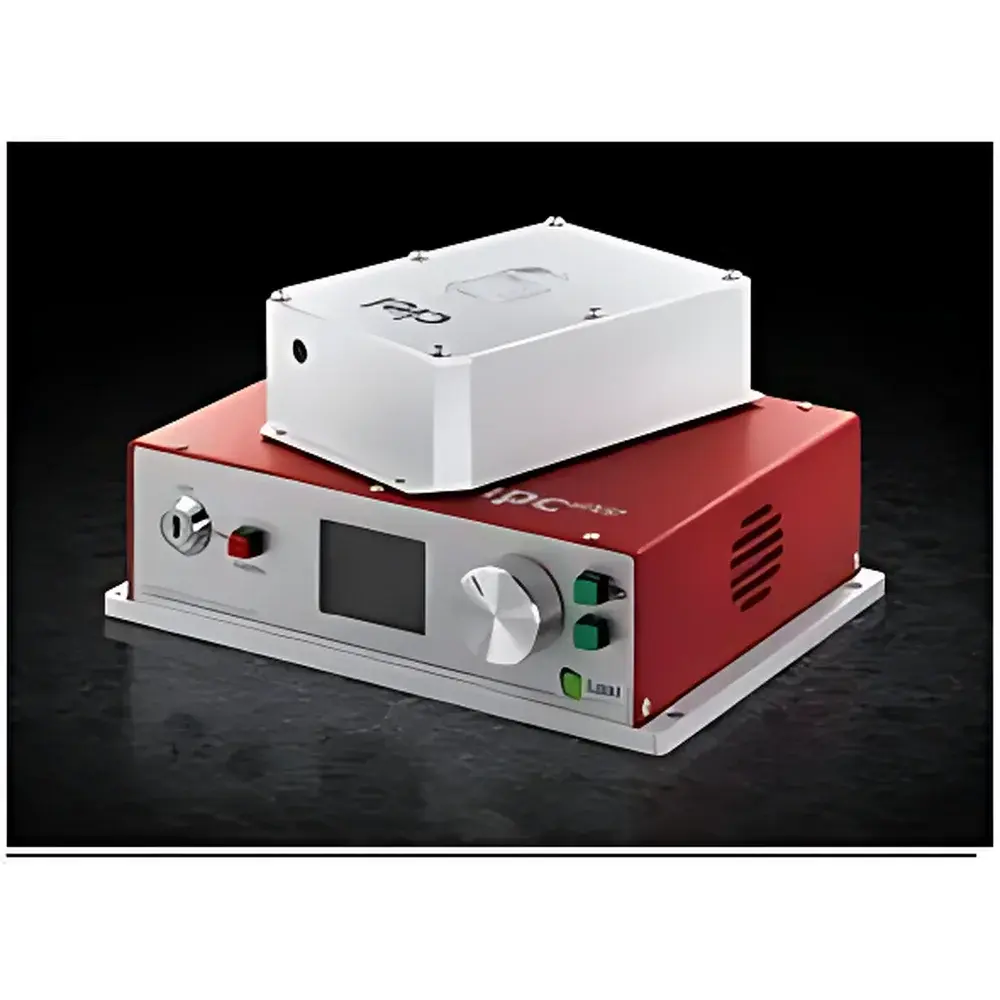
Quantum Tau Continuous-Wave Solid-State Laser System
| Origin | UK |
|---|---|
| Manufacturer Type | Authorized Distributor |
| Origin Category | Imported |
| Model | Tau |
| Core Technology | Diode-Pumped Solid-State (DPSS) CW Laser |
| Wavelength Options | 473 nm, 532 nm, 561 nm, 660 nm, 671 nm, 1064 nm |
| Output Power Range | 30 mW – 1.5 W (model-dependent) |
| Beam Quality | TEM₀₀ (M² < 1.2) |
| Power Stability | < 0.5–1.0% RMS |
| Polarization Ratio | >100:1 |
| Coherence Length | 3 mm – >100 m |
| MTTF | 400,000 hours |
| Environmental Rating | IP54-equivalent sealed enclosure |
| Compliance | IEC 60825-1:2014 (Class IV), FDA 21 CFR Part 1040.10/1040.11, RoHS, CE |
Overview
The Quantum Tau series represents a family of high-performance, diode-pumped solid-state (DPSS) continuous-wave (CW) lasers engineered for demanding scientific and industrial applications requiring exceptional spectral purity, long-term power stability, and robust mechanical integrity. Designed and manufactured in the United Kingdom, each Tau laser operates at precisely stabilized wavelengths—473 nm, 532 nm, 561 nm, 660 nm, 671 nm, and 1064 nm—with wavelength selection determined by nonlinear crystal configuration and cavity design. The 660 nm and 671 nm red-emitting variants are particularly optimized for fluorescence excitation, super-resolution microscopy (e.g., STED, PALM), Raman spectroscopy, DNA sequencing platforms, and optogenetic stimulation, where deep tissue penetration, reduced autofluorescence, and compatibility with red-shifted fluorophores (e.g., Alexa Fluor 647, Cy5, mCherry) are critical. All models employ monolithic resonator architectures with active thermal management, ensuring sub-microradian pointing stability and low-noise output across ambient temperature fluctuations (10–40 °C). The Tau platform is not a generic OEM module but a fully integrated, turnkey laser system—including driver electronics, thermal control, safety interlocks, and beam delivery interface—validated to meet ISO 9001 manufacturing protocols and traceable calibration standards.
Key Features
- PowerLoQ™ real-time power stabilization circuitry delivering <0.5% RMS power drift over 8 hours (Ventus 660/671) and <1.0% RMS (Gem, Opus, Torus variants)
- Ultra-high reliability architecture with 400,000-hour mean time to failure (MTTF), validated via accelerated life testing per MIL-STD-810G
- Hermetically sealed, dust- and moisture-resistant housing rated to IP54-equivalent environmental protection
- Vertical or horizontal linear polarization options, with polarization extinction ratio >100:1 (standard horizontal; vertical available on Torus-660)
- Fiber-coupled output capability (FC/PC or FC/APC) with low insertion loss (<0.3 dB) and modal fidelity preservation
- Analog and TTL modulation inputs (up to 50 kHz bandwidth on Ventus; DC–100 MHz on Torus-660) supporting external triggering and intensity control
- Comprehensive remote interface via USB 2.0, RS-232, and Ethernet (TCP/IP), compatible with LabVIEW, MATLAB, Python, and EPICS control frameworks
- Pre-certified Class IV laser safety compliance per IEC 60825-1:2014, including integrated key switch, emission indicator, and interlock loop support
- 1200g shock resistance rating (per IEC 60068-2-27) and vibration tolerance up to 5 g RMS (10–500 Hz)
Sample Compatibility & Compliance
The Quantum Tau laser systems are routinely deployed in GLP- and GMP-regulated environments, including clinical diagnostics laboratories, pharmaceutical QC facilities, and academic core imaging centers. Their optical performance parameters—including power stability, beam pointing reproducibility, and spectral linewidth—are documented per ISO/IEC 17025-accredited test reports. All units ship with full traceable calibration certificates (NIST-traceable photodiode reference) and comply with FDA 21 CFR Part 1040.10/1040.11 for laser product safety. For regulated data acquisition workflows, optional audit-trail-enabled firmware supports 21 CFR Part 11-compliant electronic records when integrated with validated LIMS or instrument control software. The Tau series meets essential requirements of ASTM E2919 (Standard Practice for Laser-Based Diagnostic Instrumentation) and ISO 13694 (Laser beam parameters — Determination of beam diameter).
Software & Data Management
Quantum provides the TauControl Suite—a cross-platform (Windows/macOS/Linux), digitally signed application enabling real-time monitoring of laser current, head temperature, output power, and fault logs. The suite supports automated power ramping profiles, scheduled on/off cycles, and CSV-exportable time-series datasets with microsecond timestamp resolution. API libraries (DLL, .so, .dylib) allow integration into custom automation pipelines. All firmware updates are cryptographically signed and delivered via secure HTTPS; rollback functionality ensures version consistency during validation maintenance. Configuration files are stored in human-readable JSON format, facilitating version control and audit readiness. Optional add-ons include SCPI command emulation mode for legacy system compatibility and OPC UA server support for Industry 4.0 integration.
Applications
- Super-resolution Microscopy: STED, RESOLFT, and single-molecule localization microscopy (SMLM) benefit from the Tau’s diffraction-limited beam quality (M² < 1.2), low pointing drift (100 m on Torus-660)
- Flow Cytometry & DNA Sequencing: Stable 660/671 nm excitation enables uniform fluorophore activation across high-throughput cell sorting and next-generation sequencing platforms (e.g., Illumina SBS chemistry)
- Raman Spectroscopy: Narrow linewidth (<1 MHz on Torus) and low amplitude noise (<0.5% RMS) minimize spectral broadening and improve signal-to-noise ratio in confocal and fiber-coupled Raman systems
- Optogenetics: Precise power control and fast analog modulation support millisecond-scale neuronal activation protocols using ChrimsonR, ReaChR, and other red-shifted opsins
- Industrial Metrology: Used in interferometric alignment, holographic recording, and photolithography mask inspection where beam pointing stability and coherence length are performance-critical
FAQ
What is the difference between the Gem, Ventus, Torus, and Opus Tau models?
The Gem series prioritizes compactness and cost-efficiency for benchtop fluorescence setups; Ventus emphasizes ultra-low noise and high-speed modulation for dynamic imaging; Torus delivers narrowest linewidth and longest coherence for interferometry; Opus offers highest CW power (up to 1.5 W) for photochemical activation.
Is fiber coupling standard or optional?
Fiber coupling is an optional configuration selected at order time. All Tau models support FC/PC or FC/APC termination with guaranteed modal content preservation and minimal back-reflection (<−40 dB).
Do Tau lasers support analog modulation down to DC?
Yes—Ventus and Opus models support 0–50 kHz analog modulation; Torus-660 extends this to DC–100 MHz for RF-driven applications such as AOM seeding.
What documentation is provided for regulatory validation?
Each unit ships with a Certificate of Conformance, NIST-traceable calibration report, IEC 60825-1 test summary, and full electrical safety certification (CE, UKCA). Optional IQ/OQ/PQ protocol templates are available upon request.
Can multiple Tau lasers be synchronized for multi-wavelength experiments?
Yes—via external TTL trigger input and programmable delay generators, Tau systems achieve sub-100 ns timing jitter across wavelength channels when controlled through TauControl Suite or third-party timing hardware.



