
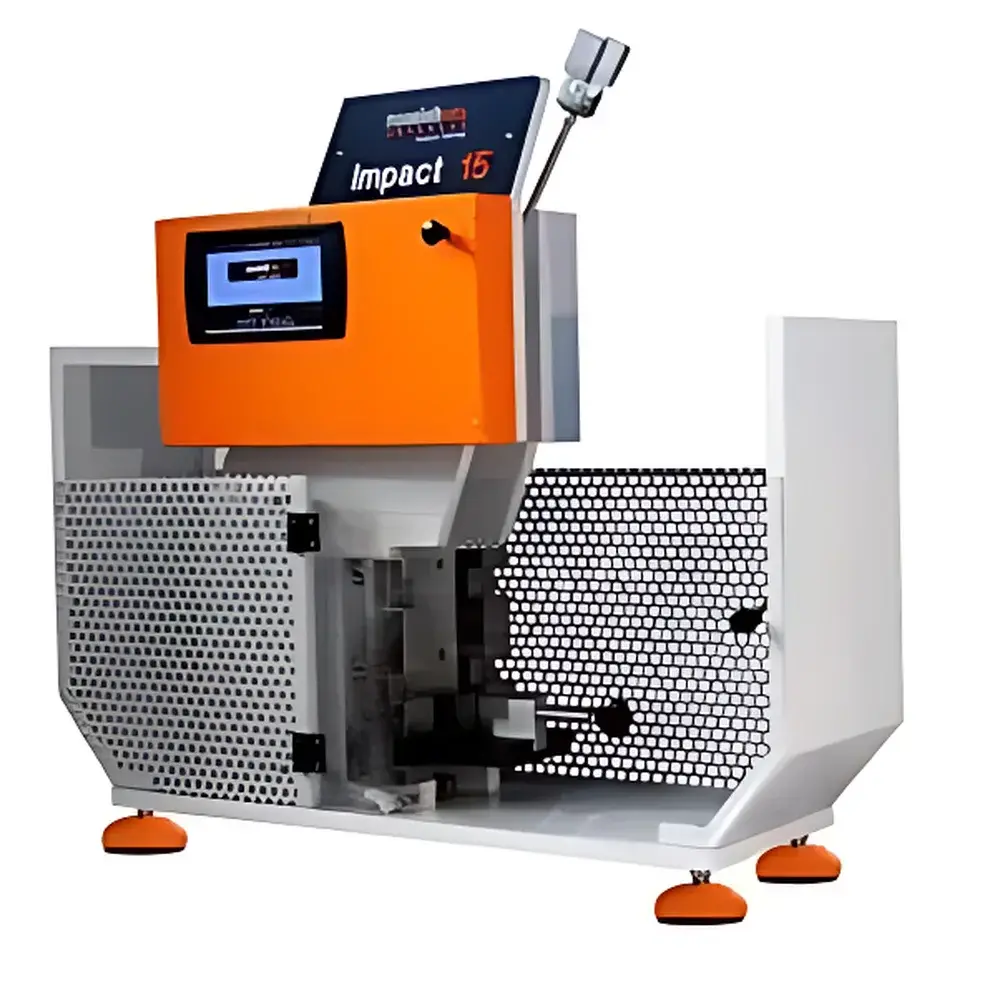
NOSELAB ATS IMPats 15/25/50 Pendulum Impact Tester
| Brand | NOSELAB ATS |
|---|---|
| Origin | Italy |
| Model | IMPats 15/25/50 |
| Impact Energy Range | 0–15 J, 0–25 J, 0–50 J |
| Impact Velocity | 2.9 m/s, 3.46 m/s, 3.8 m/s (model-dependent) |
| Pendulum Moment (Impact Constant) | Calibrated per energy range |
| Load Cell Range | Matched to nominal impact energy (0–15 J / 0–25 J / 0–50 J) |
| Maximum Lifting Height | Compliant with ISO 179, ISO 180, ASTM D256, ASTM E23, DIN 53438, UNI EN ISO 13802 |
Overview
The NOSELAB ATS IMPats 15/25/50 Pendulum Impact Tester is a precision-engineered mechanical impact testing system designed for standardized Charpy, Izod, tensile impact, and Dynstat testing of rigid and semi-crystalline polymeric materials, metals, composites, and thermosets. Based on classical pendulum impact mechanics—where gravitational potential energy is converted into kinetic energy upon release—the instrument delivers repeatable, traceable impact energy transfer to standardized specimens under strictly controlled boundary conditions. Its modular energy configuration (15 J, 25 J, or 50 J) enables compliance with international test standards including ISO 179 (Charpy), ISO 180 (Izod), ASTM D256 (Izod & Tensile Impact), ASTM E23 (Metallic Materials), DIN 53438 (Fire Behavior Screening), and UNI EN ISO 13802 (Verification of Impact Machines). The system operates without external PC dependency, integrating real-time kinematic measurement, automatic calibration verification, and full audit-ready data capture within its embedded architecture.
Key Features
- Integrated 7-inch full-color capacitive touchscreen interface with intuitive six-module menu navigation: Calibration, Test, Configuration, Results, Transfer, and Settings—enabling complete standalone operation.
- Real-time dynamic display of pre-impact parameters: release angle, theoretical impact velocity, stored potential energy, and pendulum moment—verified prior to each test cycle.
- Embedded electronic leveling system with continuous LED status feedback; instrument halts test initiation if out-of-level condition exceeds ±0.2° tolerance.
- Automated self-diagnostic startup sequence: validates sensor linearity, encoder resolution, brake response time, and safety interlock integrity—faults reported via standardized error codes.
- Patented quick-change specimen alignment system for Charpy and Izod configurations, featuring built-in shear-beam centering guides and adjustable clamping jaws for standard (e.g., 80 × 10 × 4 mm, 63.5 × 12.7 × 3.2 mm) and non-standard geometries.
- Dual-mode braking: mechanical emergency stop (EN 89/392/EEC compliant) plus programmable post-impact electromagnetic deceleration ensuring consistent pendulum arrest within <150 ms.
- Epoxy-polyester powder-coated structural frame providing corrosion resistance in laboratory and QC environments with humidity up to 80% RH.
- Onboard data storage capacity: ≥1,000 individual test records across up to 20 user-defined batches, with statistical evaluation (mean, SD, CV%, min/max) and comparative overlay functionality.
Sample Compatibility & Compliance
The IMPats series accommodates standardized notched and unnotched specimens per ISO 179-1, ISO 180-1, ASTM D256 Type A/B/C, and ASTM E23 Method A/B. Specimen thicknesses from 2 mm to 12.7 mm are supported via interchangeable anvil sets and support span adapters. All configurations maintain strict adherence to support span tolerances (±0.1 mm), notch geometry (depth, radius, symmetry), and impact edge alignment per ISO 13802 Annex B. The system includes certified reference pendulums traceable to national metrology institutes (e.g., INRIM, PTB), and supports third-party verification reports compliant with ISO/IEC 17025 requirements. Safety design conforms to EU Machinery Directive 2006/42/EC and EN ISO 12100, with interlocked polycarbonate guarding, dual-hand activation, and fail-safe emergency brake engagement.
Software & Data Management
Data acquisition and reporting are fully embedded—no external software license or installation required. Each test record stores timestamp, operator ID, specimen ID, method standard, energy absorption (J), calculated toughness (kJ/m²), fracture type (ductile/brittle/transitional), and raw encoder trajectory data. Reports are exportable via USB 2.0 to CSV or PDF format, with customizable templates supporting alphanumeric headers, lab-specific footers, and ISO-compliant uncertainty statements. Audit trail functionality logs all parameter modifications, calibration events, and user logins with timestamps—meeting GLP and FDA 21 CFR Part 11 requirements when deployed with networked identity management. Optional Ethernet module enables integration into LIMS environments via TCP/IP-based command protocol.
Applications
This instrument serves quality control laboratories in polymer compounding, automotive plastics, aerospace composites, medical device manufacturing, and metal casting foundries. Typical use cases include: qualification of impact-modified PP/ABS blends; validation of heat-aging effects on PVC toughness; comparative assessment of bio-based polymer brittleness; incoming inspection of forged aluminum alloys per AMS 2301; and failure analysis of brittle fracture in fiber-reinforced thermosets. Its high reproducibility (coefficient of variation ≤2.1% for certified reference materials) makes it suitable for round-robin interlaboratory studies coordinated under ASTM WK or ISO TC61 frameworks.
FAQ
Does the IMPats require external calibration certification to comply with ISO/IEC 17025?
Yes—while the system includes onboard calibration verification tools, formal accreditation requires annual verification by an ILAC-recognized calibration laboratory using traceable reference pendulums and certified reference materials.
Can the same base unit be upgraded from 15 J to 50 J capacity post-purchase?
No—energy modules (pendulum mass, bearing assembly, and impact anvil geometry) are mechanically and dynamically optimized per model; upgrades require replacement of the core pendulum assembly and recalibration.
Is tensile impact testing supported without additional hardware?
Yes—the IMPats platform includes dedicated tensile impact fixtures compliant with ISO 8256 and ASTM D1822, requiring only fixture swap and parameter reconfiguration in the Settings menu.
How is data integrity ensured during power interruption?
All test data is written to non-volatile flash memory in real time; unsaved configurations are retained in battery-backed RAM, and the system resumes operation at last valid state after reboot.
What maintenance intervals are recommended for long-term accuracy?
Biannual verification of encoder linearity, annual load cell recalibration, and quarterly inspection of bearing preload and brake pad wear—documented in the embedded maintenance log with reminder alerts.



