
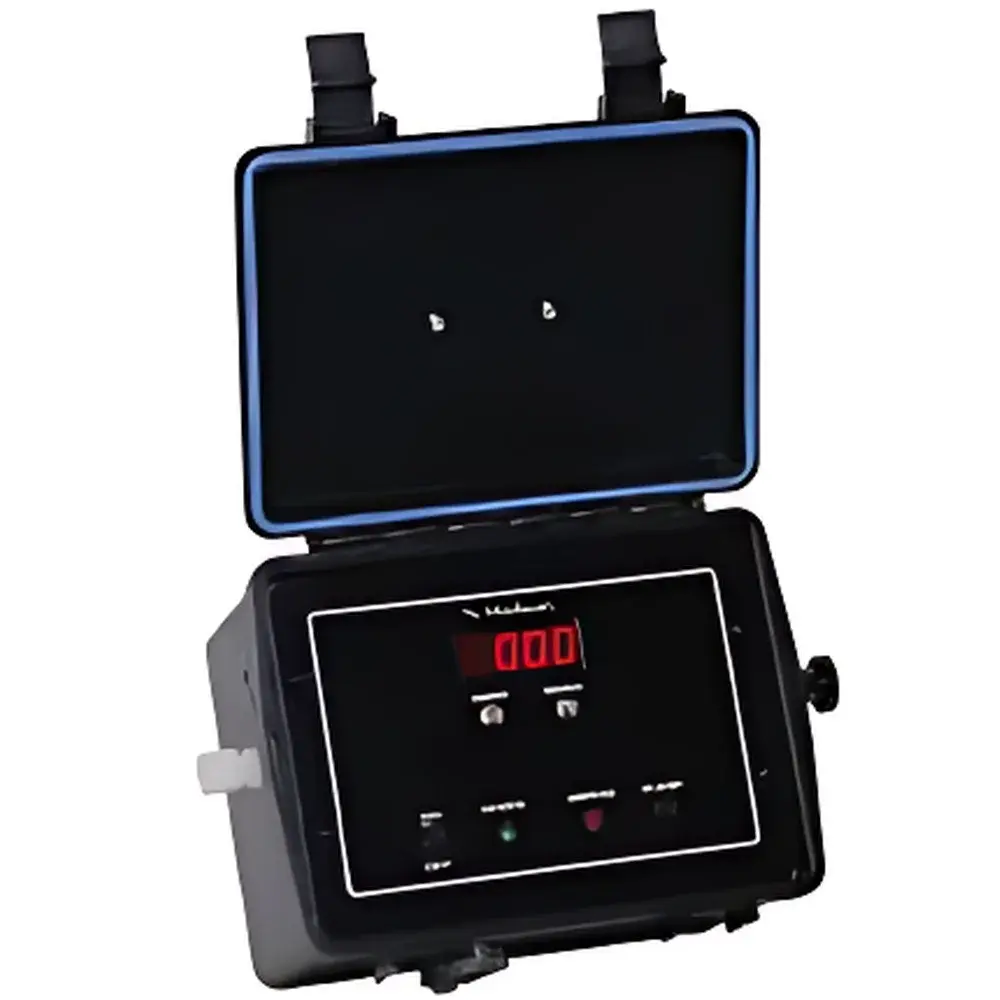
Nova 339 Portable Methane Leak Detector
| Brand | Nova |
|---|---|
| Origin | Canada |
| Model | 339 |
| Detection Principle | Non-dispersive Infrared (NDIR) |
| Gas Range | 0–100% LEL (Methane, Natural Gas, Propane) |
| Resolution | 0.1% LEL |
| Accuracy & Repeatability | ±1% of full scale |
| Drift | ±1% of full scale per week |
| Response Time (T90) | 8–10 s |
| Operating Temperature | 12–50 °C |
| Linearity | ±2% of full scale |
| Dimensions (WP Type) | 25.5 × 19 × 16.5 cm |
| Weight | 3.6 kg |
| Power | Rechargeable sealed-gel battery |
| Output Options | 4–20 mA or 0–1 VDC |
| Alarm | Audible buzzer + visual LED indicator with field-adjustable setpoint |
| Enclosure Rating | WP-rated housing with transparent Lexan cover |
| Integrated Components | Built-in sample pump, sampling hose, probe, flow indicator, backlighted digital display |
Overview
The Nova 339 Portable Methane Leak Detector is an intrinsically safe, field-deployable instrument engineered for rapid, selective, and quantitative detection of methane (CH₄), natural gas, and propane in ambient air. Utilizing non-dispersive infrared (NDIR) spectroscopy, the device measures gas concentration based on characteristic absorption bands in the mid-infrared region—specifically targeting the 3.3 µm C–H stretch fundamental of hydrocarbons. Unlike catalytic bead (pellistor) or semiconductor sensors, the NDIR optical path is unaffected by oxygen deficiency, sensor poisoning, or cross-sensitivity to hydrogen, CO, or VOCs. This eliminates false positives from background gases and ensures stable baseline performance without flame-based combustion or consumable reagents. Designed for pipeline integrity verification, compressor station surveys, LNG facility perimeter monitoring, and utility distribution network audits, the 339 delivers real-time, maintenance-free quantification across the full 0–100% Lower Explosive Limit (LEL) range.
Key Features
- True NDIR optical sensing architecture—no catalytic oxidation, no calibration drift from high-concentration exposure (“sensor poisoning”)
- Integrated sample pump with flow indicator and flexible sampling probe for targeted point-source interrogation (e.g., valve stems, flange joints, regulator housings)
- Backlit digital LCD display with 0.1% LEL resolution and auto-ranging capability
- Rechargeable sealed-gel lead-acid battery supporting >8 hours of continuous operation; LED status indicators for charging, low-battery, and alarm activation
- Field-adjustable audible/visual alarm threshold with latching or non-latching configuration
- IP65-rated WP enclosure with impact-resistant transparent Lexan viewing window and corrosion-resistant aluminum chassis
- Standard analog output (4–20 mA or 0–1 VDC) for integration into SCADA, DCS, or data logging systems
- No warm-up time required—operational immediately upon power-on due to passive thermal stabilization of the optical cell
Sample Compatibility & Compliance
The Nova 339 is validated for use in Class I, Division 1 hazardous locations per CSA C22.2 No. 152 and UL 913 (for intrinsic safety compliance when used with approved barriers). It meets EN 61000-6-2 (immunity) and EN 61000-6-4 (emissions) standards. While not certified to ATEX or IECEx out-of-the-box, its NDIR design inherently avoids ignition sources—making it suitable for pre-entry screening and leak localization in potentially explosive atmospheres. The detector exhibits negligible interference from common industrial gases including CO₂ (up to 5%), humidity (10–95% RH non-condensing), and ambient CO, H₂S, or SO₂ at typical environmental concentrations. Calibration is traceable to NIST-certified methane reference standards; recommended interval is every 6 months or after exposure to >500% LEL gas events.
Software & Data Management
The 339 operates as a standalone field instrument with no embedded firmware requiring PC-based configuration. All operational parameters—including alarm setpoint, display brightness, and output scaling—are adjusted via intuitive front-panel push-button interface. Analog outputs support direct connection to third-party dataloggers compliant with IEEE 1451.2 or Modbus RTU gateways. For auditability, the device logs timestamped peak-hold values and alarm event counters (non-volatile memory, 1000-event capacity). When deployed in regulated environments (e.g., EPA OOOOa compliance programs or EU MRV reporting), users may pair the unit with external GPS-enabled tablets running ISO/IEC 17025-aligned QA/QC workflows. Though the 339 itself does not provide electronic records meeting FDA 21 CFR Part 11 requirements, its analog output can feed into validated data acquisition systems that do.
Applications
- Preventive maintenance inspections of natural gas distribution mains, metering stations, and pressure regulation skids
- Post-excavation leak verification following pipeline repair or replacement
- Compliance monitoring under U.S. EPA Subpart OOOOa (Quad O) and Canadian ECCC Methane Regulations
- Landfill gas migration studies and biogas upgrading facility safety sweeps
- Offshore platform perimeter surveillance and flare stack emissions verification
- Academic and industrial research on fugitive emission quantification methodologies
FAQ
Does the Nova 339 require periodic calibration gas?
Yes—annual calibration using certified 50% LEL methane in air is recommended; field zeroing with ambient air is permissible between calibrations.
Can the unit detect ethane or butane?
It responds to all C₁–C₄ alkanes with sensitivity proportional to C–H bond density; however, factory calibration is optimized for methane. Cross-sensitivity to ethane is ~85%, to propane ~92%.
Is the built-in pump flow rate adjustable?
No—the fixed-flow pump delivers 0.5 L/min nominal, optimized for NDIR cell residence time and signal-to-noise ratio.
What is the expected service life of the infrared source and detector?
The dual-beam pyroelectric detector and tungsten-filament IR source are rated for >5 years of continuous operation under specified temperature and humidity conditions.
Can the 339 be used in sub-zero ambient temperatures?
Operation below 12°C is not recommended; condensation risk and reduced battery capacity may affect accuracy and runtime. Optional heated probe accessories are available for cold-climate deployment.







