
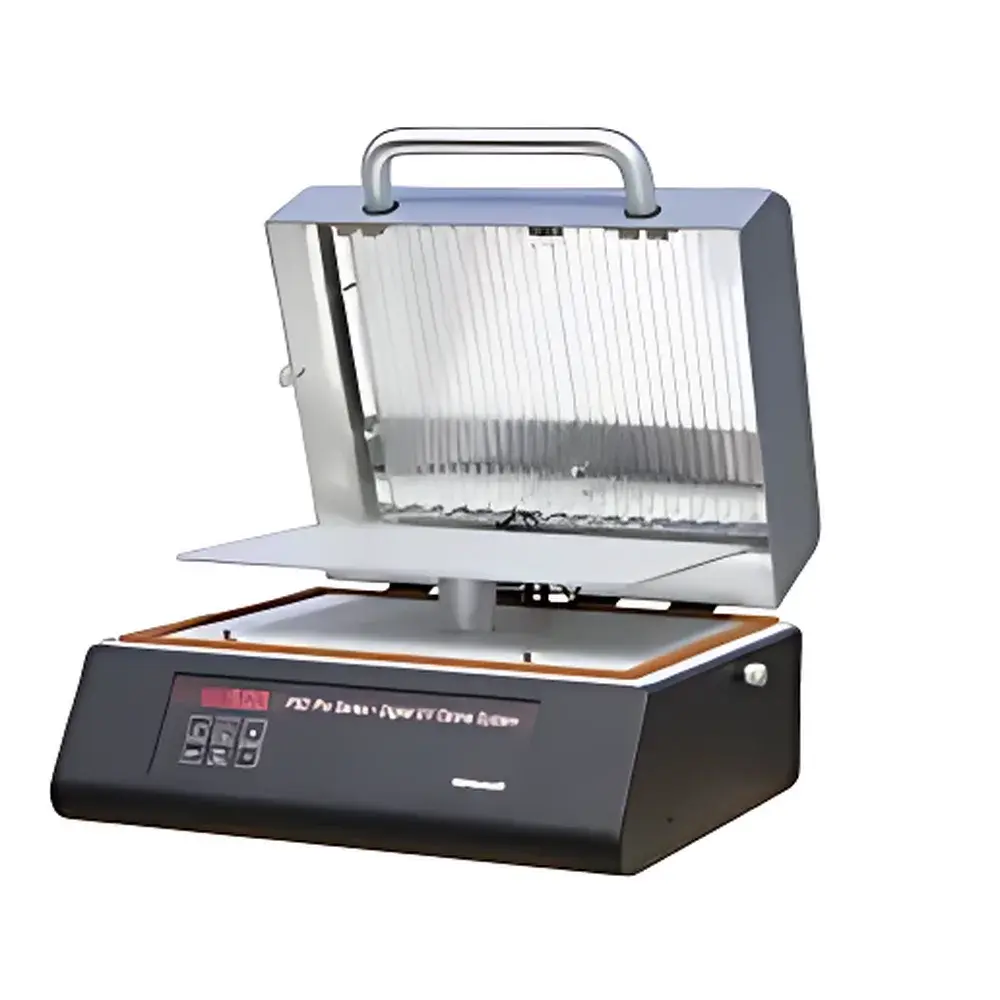
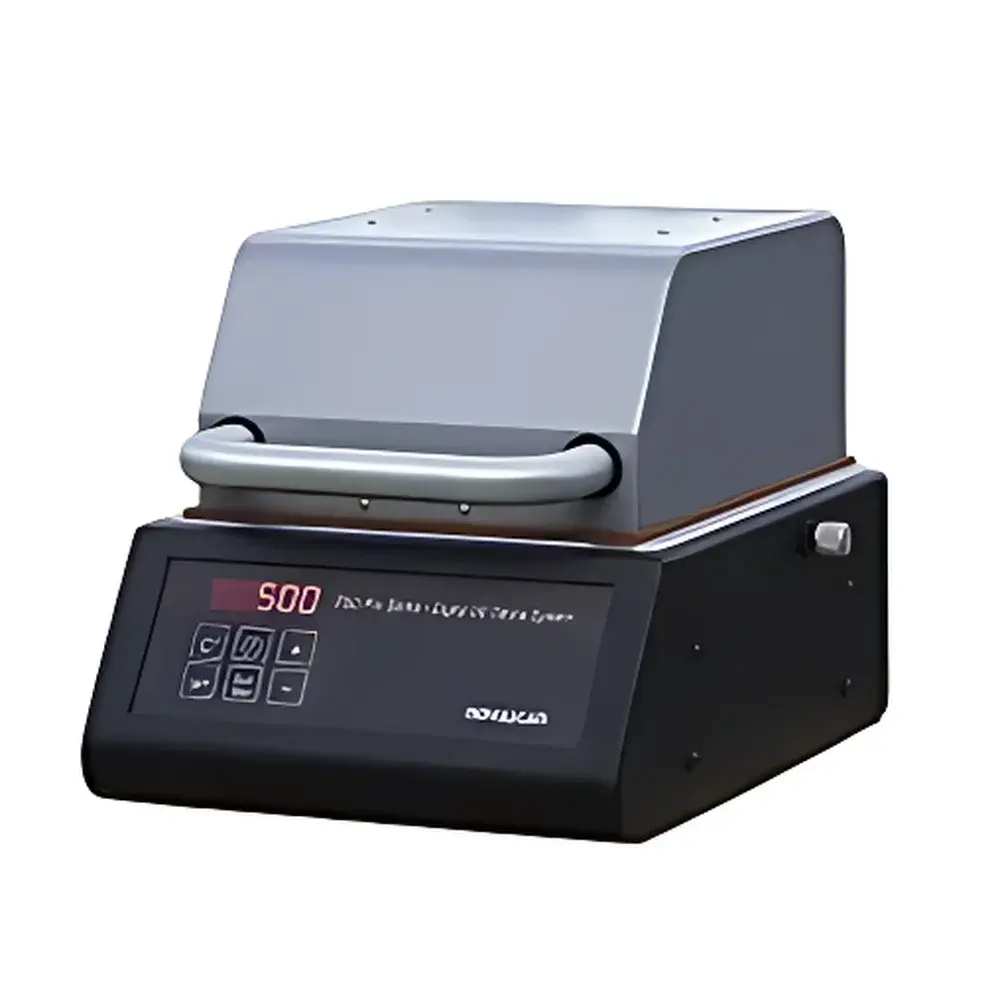
Novascan PSDP-UVT Series Heated UV-Ozone Cleaner
| Brand | Novascan |
|---|---|
| Origin | USA |
| Model | PSDP-UVT |
| Lamp Type | Low-Pressure Mercury Grid Lamp (185 nm / 254 nm) |
| Adjustable Sample Stage Height | Yes |
| Heating Capability | PID-Controlled, Up to 150 °C (200 °C Optional) |
| Dual Gas Inlet/Outlet Ports | Standard |
| Safety Interlock | Automatic UV Shutoff Upon Chamber Opening |
| Ozone Destruction System | Integrated Catalytic Neutralizer + Exhaust Pump |
| Chamber Construction | Aluminum or Optional Quartz |
| Lamp Lifetime | ~5,000 hours |
| UV Reflector Margin | +2.54 cm Beyond Lamp Dimensions |
| Sample Loading | Top-Access, 360° Placement |
| Compliance | CE, RoHS, FDA 21 CFR Part 11 Ready (via optional audit trail software module) |
Overview
The Novascan PSDP-UVT Series Heated UV-Ozone Cleaner is an engineered solution for high-efficiency surface decontamination and organic residue removal in research, microfabrication, and analytical laboratories. It operates on the well-established principle of ultraviolet photochemical oxidation: short-wavelength UV-C radiation (185 nm) dissociates molecular oxygen (O2) in ambient air or supplemental O2 to generate atomic oxygen (O), which rapidly combines with O2 to form ozone (O3). Simultaneously, 254 nm UV photons directly cleave C–C, C–H, and C–O bonds in hydrocarbons and other organic contaminants. The integrated heated sample stage (PID-controlled, up to 150 °C standard, 200 °C optional) thermally accelerates oxidative reaction kinetics, enabling complete mineralization of recalcitrant organics—including photoresist residues, lubricants, adhesives, and biological films—into CO2, H2O, and volatile oxides. Unlike plasma-based systems, this method requires no vacuum infrastructure, operates at atmospheric pressure, and leaves no conductive or particulate residue.
Key Features
- Programmable digital controller with real-time display of elapsed time, set temperature, and lamp status
- PID-regulated heating stage with ±1 °C thermal stability across full range (150 °C standard; 200 °C available as factory option)
- High-output low-pressure mercury grid lamp emitting dual-band UV (185 nm for ozone generation; 254 nm for direct photolysis)
- UV-reflective aluminum housing extending 2.54 cm beyond lamp dimensions to maximize irradiance uniformity
- Vertically adjustable sample stage (height lockable) for precise source-to-sample distance optimization (critical for dose control per ISO 14644-1 cleanroom surface conditioning protocols)
- Dual standardized gas ports (¼” NPT) supporting ambient-air operation or controlled O2 enrichment to boost ozone concentration up to 3× baseline
- Interlocked safety system: UV emission ceases instantly upon chamber lid opening, complying with IEC 60825-1 Class 3B laser safety logic architecture
- Integrated catalytic ozone neutralizer and exhaust pump enable benchtop use without fume hood integration—validated per ANSI Z9.5 laboratory ventilation guidelines
- Top-access configuration supports rapid loading/unloading of wafers (up to 200 mm), TEM grids, optical components, MEMS devices, and irregularly shaped substrates
Sample Compatibility & Compliance
The PSDP-UVT accommodates substrates ranging from silicon wafers and fused silica optics to polymer films, metal foils, and ceramic sensors. Its non-contact, dry-process methodology preserves delicate surface topographies and avoids solvent-induced swelling or leaching. All models meet CE marking requirements for electromagnetic compatibility (EN 61326-1) and low-voltage safety (EN 61010-1). Optional firmware enables 21 CFR Part 11-compliant electronic records, including timestamped parameter logs, user authentication, and immutable audit trails—essential for GLP/GMP-regulated QC environments. Lamp spectral output is traceable to NIST-calibrated radiometers, and ozone generation efficiency conforms to ASTM D5157-22 (Standard Guide for Ozone Generation Testing).
Software & Data Management
The embedded controller stores up to 20 user-defined cleaning protocols, each configurable with independent time, temperature, gas mode (air/O2), and ramp/soak profiles. An optional USB data logger exports CSV-formatted session records (start/end timestamps, actual vs. setpoint temperature, cumulative UV exposure minutes) for LIMS integration. Remote monitoring via RS-232 or Ethernet (with add-on module) supports centralized lab equipment management platforms. Firmware updates are performed via secure signed binaries, ensuring integrity during field upgrades.
Applications
- Pre-bonding surface activation of silicon, glass, and PDMS for microfluidic device assembly
- Removal of organic contamination from AFM cantilevers, SEM stubs, and XRD sample holders
- Trace hydrocarbon elimination from ultra-high vacuum (UHV) chamber components prior to bake-out
- Decontamination of reusable biosensor surfaces between assay cycles (validated per ISO 15197:2013 Annex D)
- Photomask cleaning in semiconductor R&D labs without risk of chrome layer oxidation
- Surface preparation of perovskite solar cell substrates to improve interfacial charge transfer
- Restoration of anti-reflective coatings on telescope optics by eliminating sub-monolayer carbonaceous films
FAQ
What is the maximum recommended operating temperature for the heated stage?
The standard PSDP-UVT model is rated for continuous operation up to 150 °C. A 200 °C high-temp option is available with upgraded thermal insulation and platinum RTD sensing.
Can the system operate without external gas supply?
Yes—ambient air is sufficient for most applications. Supplemental O2 increases ozone yield and reduces treatment time for heavily contaminated samples.
How often must the UV lamp be replaced?
Lamp lifetime is rated at ≥5,000 hours under normal duty cycles. Output decay is monitored via integrated photodiode feedback; replacement is recommended when irradiance drops below 85% of initial specification.
Is ozone exposure hazardous during routine operation?
No—integrated catalytic neutralization and forced-air exhaust maintain ambient ozone concentrations below 0.05 ppm (OSHA PEL), verified by third-party industrial hygiene testing.
Does the system support validation documentation for regulated labs?
Yes—IQ/OQ documentation packages, calibration certificates (NIST-traceable radiometer), and 21 CFR Part 11 readiness kits are available upon request.



