
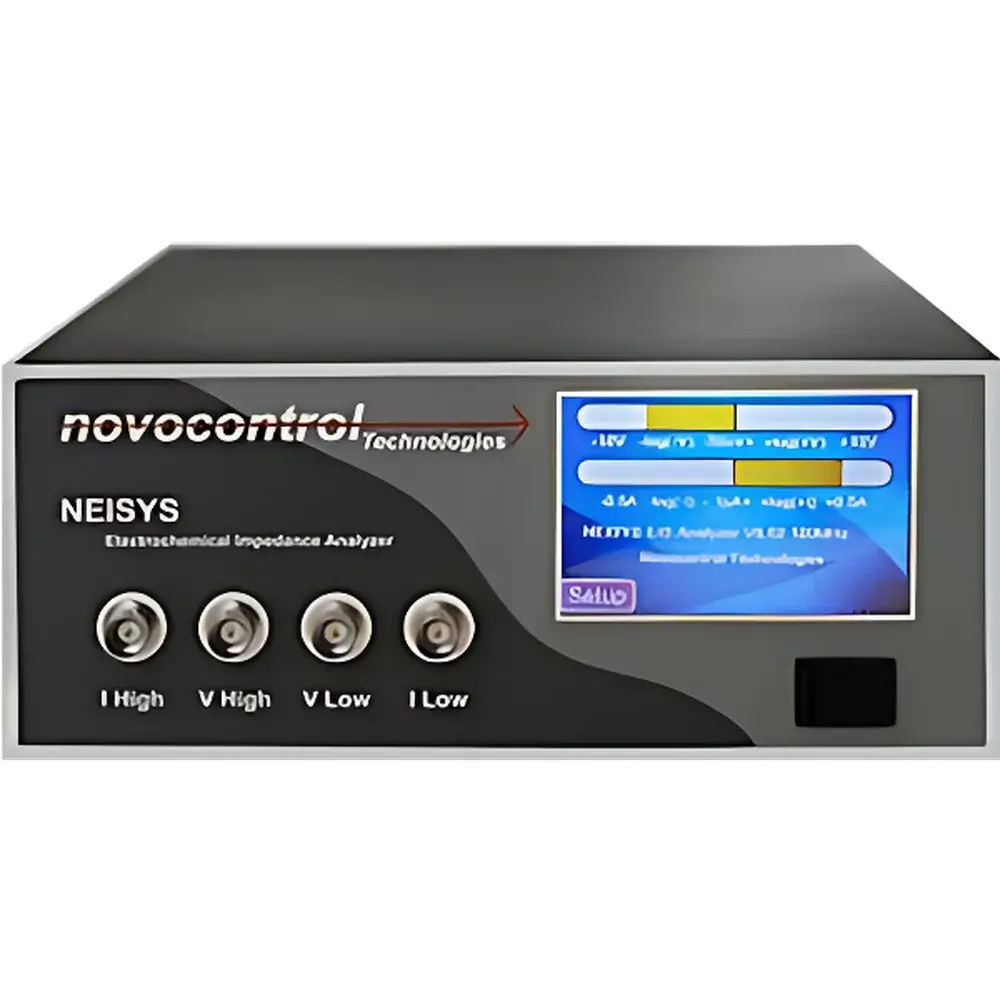
Novocontrol NEISYS Electrochemical Impedance and Dielectric Spectrometer
| Brand | Novocontrol Technologies |
|---|---|
| Origin | Germany |
| Model | NEISYS |
| Frequency Range | 3 µHz – 100 MHz |
| Sampling Rate | 10⁷ points/sec |
| Impedance Range | 10⁻⁴ Ω – 1 TΩ |
| Loss Factor Accuracy | ±1×10⁻⁴ |
| Architecture | Four-Electrode, Separated Current/Voltage Signal Paths |
| Thermal Expansion Option | Yes |
| Operating Modes | Frequency-Domain (EIS, Dielectric, Conductivity, Loss Tangent) & Time-Domain (CV, LSV, SWV, CA, CP, Galvanostatic/Potentiostatic Cycling, Battery Charge/Discharge, Capacitor Charging/Discharging) |
| Compliance Support | ASTM D257, ISO 60270, IEC 60601-2-60 (for dielectric safety), GLP/GMP-ready data audit trail |
Overview
The Novocontrol NEISYS Electrochemical Impedance and Dielectric Spectrometer is a high-performance, modular instrumentation platform engineered for precision broadband characterization of electrical transport, interfacial kinetics, and polarization dynamics in solid, liquid, and soft-matter systems. Built upon Novocontrol Technologies’ decades-long expertise in impedance metrology, the NEISYS integrates a digitally controlled potentiostat/galvanostat with a wideband frequency-domain analyzer (3 µHz to 100 MHz) into a single compact chassis. Its core architecture employs fully isolated current and voltage signal paths combined with a true four-electrode (Kelvin) configuration—minimizing parasitic inductance and stray capacitance to ensure sub-degree phase resolution and loss factor reproducibility down to 1×10⁻⁴. Unlike conventional electrochemical workstations optimized for low-frequency battery or corrosion studies, the NEISYS bridges the gap between electrochemical impedance spectroscopy (EIS), dielectric relaxation spectroscopy (DRS), and time-domain electroanalytical techniques—enabling seamless correlation between bulk conduction, interfacial charge transfer, dipolar relaxation, and electrode kinetics across seven decades of frequency.
Key Features
- Ultra-broad frequency coverage from 3 µHz to 100 MHz—supporting both low-frequency electrochemical processes (e.g., diffusion-limited reactions) and high-frequency dielectric relaxations (e.g., segmental motion in polymers or ion hopping in solid electrolytes)
- Real-time sampling at up to 10⁷ data points per second—enabling high-fidelity transient capture during pulsed or stepped excitation protocols
- Four-terminal sensing architecture with guarded voltage measurement—eliminating lead impedance errors and ensuring accurate phase determination even below 0.1°
- Modular thermal integration—compatible with Novocontrol’s QSG series temperature controllers and cryogenic or furnace-based sample stages for variable-temperature EIS/DRS (–160 °C to +400 °C)
- Dual-domain operation: simultaneous support for frequency-sweep (AC impedance, permittivity, conductivity, loss tangent) and time-domain methods (cyclic voltammetry, chronoamperometry, galvanostatic intermittent titration, battery cycling)
- Embedded digital signal processing with hardware-level lock-in detection—delivering robust noise rejection and stable baseline performance under electromagnetic interference
Sample Compatibility & Compliance
The NEISYS accommodates diverse sample geometries—including two- and three-electrode electrochemical cells, parallel-plate and coaxial dielectric fixtures, interdigitated electrodes (IDEs), and custom-designed microfluidic or thin-film holders. Its flexible input impedance (>10¹⁵ Ω) and low-noise current amplifier (fA resolution) enable reliable measurements on insulating polymers, ionic liquids, ceramic electrolytes, and biological membranes. The system complies with key international standards for impedance and dielectric testing, including ASTM D257 (resistivity of insulating materials), ISO 60270 (partial discharge measurement), and IEC 60601-2-60 (dielectric strength requirements for medical devices). Data acquisition and storage adhere to GLP and GMP principles, with full 21 CFR Part 11-compliant audit trails, electronic signatures, and version-controlled method files available via optional software licensing.
Software & Data Management
Control and analysis are performed using Novocontrol’s proprietary WinDETA software suite—a Windows-native application supporting real-time visualization, automated multi-step experiment sequencing, and advanced modeling (e.g., equivalent circuit fitting, Havriliak-Negami analysis, Kramers-Kronig validation). Raw data are stored in open-format ASCII or HDF5 containers, enabling interoperability with MATLAB, Python (SciPy, impedance.py), and commercial modeling tools. The software includes built-in compliance modules for electronic record integrity, user access control, and configurable reporting templates aligned with ISO/IEC 17025 laboratory accreditation requirements.
Applications
- Electrochemical energy systems: SOFC/PEMFC membrane degradation, Li-ion solid-electrolyte interface (SEI) evolution, supercapacitor electrode kinetics, and redox-flow battery electrolyte stability
- Soft matter and polymer science: Cure monitoring of epoxy resins, ion-conducting polymer blends, and water uptake dynamics in hydrogels
- Materials development: Ionic conductivity mapping in MOFs and perovskites, aging behavior of dielectric coatings, and nanoparticle dispersion effects in composite electrolytes
- Biosensing and bioelectronics: Interfacial capacitance of functionalized electrodes, impedance-based cell adhesion assays, and label-free detection of biomolecular binding events
- Corrosion and surface science: In-situ passivation layer formation on metals, inhibitor efficiency evaluation, and localized electrochemical impedance mapping (LEIM)
FAQ
What distinguishes NEISYS from standard potentiostats?
Unlike conventional potentiostats limited to <1 MHz bandwidth and lacking calibrated dielectric measurement capability, NEISYS provides traceable, wideband impedance and permittivity data with validated phase accuracy—essential for distinguishing capacitive, resistive, and inductive contributions in complex heterogeneous systems.
Can NEISYS perform simultaneous EIS and CV on the same sample?
No—it operates in either frequency-domain or time-domain mode per experiment; however, sequential acquisition with identical electrode configuration and environmental conditions enables direct cross-correlation of kinetic and relaxation parameters.
Is external temperature control required for variable-temperature measurements?
Yes—the NEISYS itself does not include integrated heating/cooling; it interfaces seamlessly with Novocontrol’s QSG-1000 or third-party thermal stages via analog/digital I/O and IEEE-488 (GPIB) or USB-TMC protocols.
Does the system support custom waveform generation?
Yes—WinDETA allows user-defined voltage/current profiles (e.g., arbitrary pulse trains, staircase sweeps, or hybrid waveforms) with sub-millisecond timing resolution and hardware-triggered synchronization.
How is calibration maintained across such a broad frequency range?
The NEISYS employs factory-calibrated reference impedances and internal self-check routines at startup; users may perform periodic verification using NIST-traceable standards (e.g., IET Labs 1006 series) following ASTM E1109 guidelines.
Related Products






