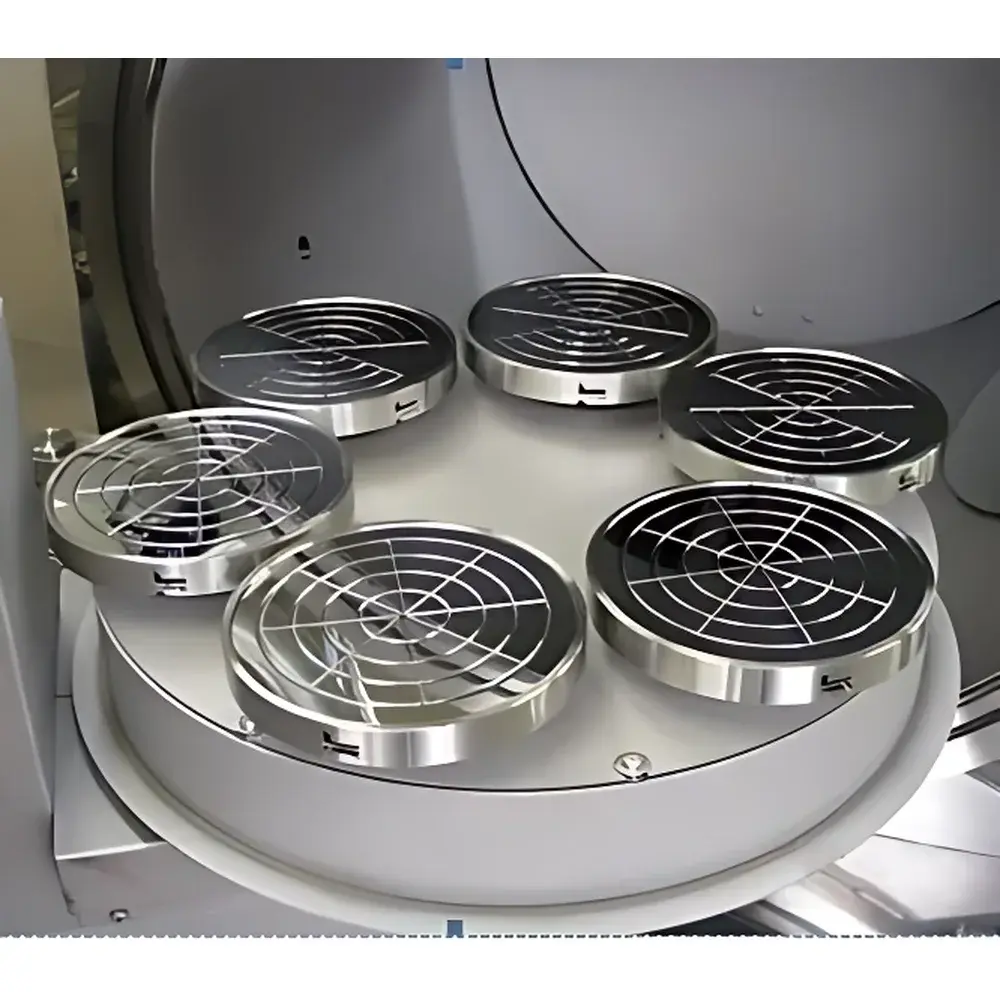
NS 20-M/NS-8 Ion Beam Etching System
| Brand | NS (Japan) |
|---|---|
| Origin | Japan |
| Model | 20-M/NS-8 |
| Minimum Feature Size | 1 µm |
| Ion Beam Diameter | 1 µm |
| Acceleration Voltage Range | 1–5 kV (typical for Kaufman-type sources) |
| Substrate Capacity | 8 × Ø76 mm or 6 × Ø100 mm |
| Ion Source | 20 cm Kaufman-type Broad-Beam Ion Source (KRI, USA) |
| Cooling | Direct substrate cooling via integrated chiller interface |
| Motion Control | Planetary rotation (rotation + revolution) for uniform etch rate distribution |
| Power Supply | WELL-5000 (compatible with domestic replacements) |
| Compliance | CE-marked architecture |
Overview
The NS 20-M/NS-8 Ion Beam Etching System is a high-precision, broad-beam physical sputtering tool engineered for research and medium-volume production environments in advanced microfabrication. Unlike reactive ion etching (RIE) or plasma-based processes, this system operates on the principle of kinetic energy transfer: inert gas ions (typically Ar⁺), accelerated through a 1–5 kV potential, bombard the sample surface to physically displace atoms—enabling material removal without chemical selectivity constraints. This makes it uniquely suited for etching non-volatile, chemically inert, or electrically conductive materials—including magnetic alloys (e.g., NiFe, CoFeB), noble metals (Au, Pt), superconductors (Nb, YBCO), and hard ceramics—where conventional plasma etchants fail or introduce contamination. The system integrates a 20 cm diameter Kaufman-type ion source manufactured by KRI (USA), delivering stable, low-divergence ion beams with high current density uniformity across the target area. Its mechanical design prioritizes thermal stability and process reproducibility: substrates mount directly onto a water-cooled platen, enabling operation at temperatures as low as −40 °C to suppress radiation damage and enhance anisotropy in temperature-sensitive films.
Key Features
- Broad-beam ion source (20 cm KRI Kaufman type) with adjustable beam extraction voltage (1–5 kV) and independent filament current control for optimized ion flux stability
- Direct-contact substrate cooling system compatible with external chillers (−40 °C to +80 °C operating range), critical for maintaining stoichiometry in multilayer stacks during extended etch cycles
- Planetary motion stage: simultaneous rotation and revolution of wafers ensures ±2.5% etch rate uniformity across Ø76 mm or Ø100 mm substrates
- Modular vacuum chamber (stainless steel, all-metal seals) rated for ultimate pressure ≤5×10⁻⁷ Torr, equipped with dual-stage pumping: turbomolecular pump (≥1200 L/s) backed by dry scroll pump
- Integrated residual gas analyzer (RGA) port and optional mass spectrometer interface for real-time endpoint detection via sputtered species monitoring
- Full PLC-based automation with recipe-driven operation, digital I/O for SECS/GEM protocol compatibility, and audit-trail logging compliant with GLP/GMP documentation requirements
Sample Compatibility & Compliance
The NS 20-M/NS-8 supports rigid and brittle substrates up to 100 mm in diameter, including Si, SiO₂, sapphire, quartz, MgO, and metallic foils. It accommodates both conductive and insulating samples without charge compensation—eliminating the need for conductive coatings that compromise metrology accuracy. The system meets electromagnetic compatibility (EMC) Directive 2014/30/EU and Low Voltage Directive 2014/35/EU. Vacuum components conform to ASTM F2789 (standard guide for vacuum system cleanliness) and ISO 14644-1 Class 5 cleanroom installation specifications. All electrical interfaces comply with IEC 61000-6-2/6-4 immunity and emission standards. For regulated industries, the control software supports 21 CFR Part 11-compliant user authentication, electronic signatures, and immutable audit trails when paired with validated IT infrastructure.
Software & Data Management
Operation is managed via NS’s proprietary EtchControl™ v4.2 software suite, running on Windows 10 IoT Enterprise LTSB. The GUI provides real-time visualization of beam current, acceleration voltage, chamber pressure, substrate temperature, and motion parameters. Process recipes store up to 999 steps with conditional logic (e.g., “if RGA signal intensity > threshold X, reduce voltage by Y %”). Data export supports CSV, HDF5, and XML formats for integration with MES platforms (e.g., Siemens Opcenter, Rockwell FactoryTalk). Historical logs are encrypted and time-stamped per NIST SP 800-53 Rev. 4 requirements. Optional add-ons include remote diagnostics via TLS 1.3-secured VNC and OPC UA server for Industry 4.0 interoperability.
Applications
- Spintronics device fabrication: patterning of CoFeB/MgO tunnel junctions, Ta/CoFeB multilayers, and skyrmion-hosting chiral magnets without interfacial oxidation
- Thin-film magnetic head R&D: precision trimming of NiFe pole tips and Al₂O₃ gap layers with sub-10 nm edge roughness (measured by AFM)
- RF MEMS resonators: isotropic-free release etching of AlN, ZnO, and LiNbO₃ piezoelectric membranes
- Superconducting quantum interference devices (SQUIDs): low-damage etching of Nb/AlOx/Nb trilayers preserving Josephson junction integrity
- Optical metasurfaces: high-aspect-ratio etching of TiO₂ and SiNx nanostructures with vertical sidewalls (aspect ratio >15:1)
- Calibration standards: fabrication of certified reference structures for SEM/TEM dimensional metrology (traceable to NIST SRM 2059)
FAQ
What materials can be etched using the NS 20-M/NS-8?
It physically sputters virtually any solid material—including magnetic alloys (NiFe, CoPt), refractory metals (W, Mo), oxides (Al₂O₃, SiO₂), nitrides (Si₃N₄), and superconductors (Nb, YBCO)—without requiring reactive gases or masking chemistry.
Is endpoint detection supported?
Yes, via optional RGA integration or optical emission spectroscopy (OES) port; endpoint algorithms detect characteristic secondary ion peaks (e.g., Fe⁺ from NiFe, Al⁺ from Al₂O₃) with <10 s response latency.
Can the system be integrated into an existing cleanroom fab?
Yes—it meets SEMI S2/S8 safety standards, supports 485 serial and Ethernet/IP communication, and fits standard 19-inch rack-mount footprint (1200 mm H × 800 mm W × 900 mm D).
What maintenance intervals are recommended for the ion source?
KRI 20 cm Kaufman source requires filament replacement every 1,500–2,000 operational hours; neutralizer cathode service is recommended every 3,000 hours. Full preventive maintenance is scheduled annually per ISO 9001:2015 clause 8.5.1.
Does the system support automated cassette-to-cassette handling?
Not natively—but the load-lock chamber includes SMIF-compatible flange ports and SECS/GEM-ready I/O for third-party robotic integration (e.g., Brooks AutoLoader, MKS Sigma).