
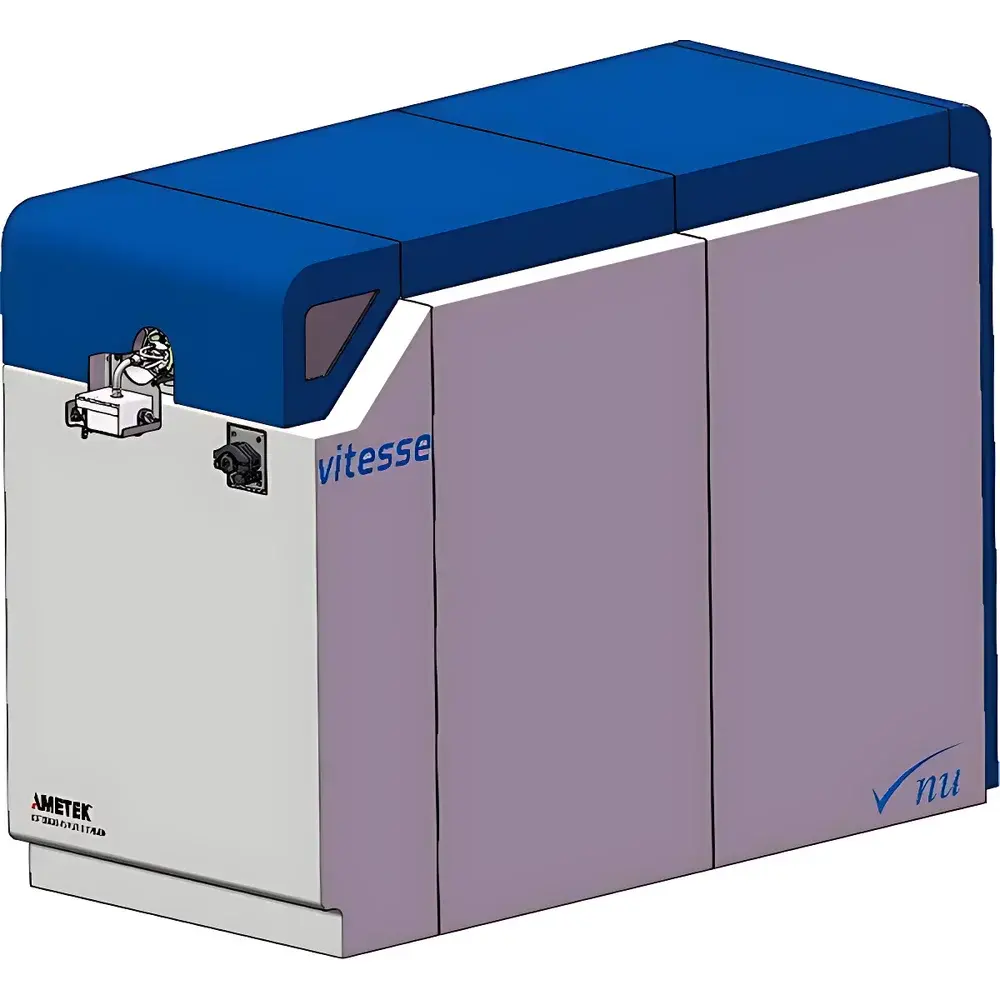
Nu Vitesse Time-of-Flight Plasma Mass Spectrometer
| Brand | NU |
|---|---|
| Origin | United Kingdom |
| Manufacturer Type | Authorized Distributor |
| Origin Category | Imported Instrument |
| Model | Vitesse |
| Pricing | Available Upon Request |
Overview
The Nu Vitesse Time-of-Flight Plasma Mass Spectrometer (TOF-ICP-MS) is a high-performance inorganic mass spectrometry platform engineered for ultra-trace elemental analysis, isotopic ratio measurement, and transient signal characterization. It couples an inductively coupled plasma (ICP) ion source with a high-speed, orthogonal-acceleration time-of-flight mass analyzer to deliver simultaneous multi-element detection across the full mass range (1–280 u) with microsecond-level temporal resolution. Unlike scanning quadrupole or magnetic sector instruments, the Vitesse acquires complete mass spectra in every acquisition cycle—enabling true quantitative fidelity for fast-evolving samples such as laser ablation plumes, single-cell digests, or chromatographic eluents. Its design adheres to core principles of ICP-MS metrology: minimal memory effects, high ion transmission efficiency, and robust interference management under variable plasma conditions.
Key Features
- Optimized ion optics: Mature extraction and focusing system delivering >30% ion transmission efficiency from plasma to TOF region, ensuring high sensitivity for low-abundance isotopes (e.g., <100 fg g⁻¹ detection limits for U in silicate matrices).
- Segmented reaction cell: Multi-zone gas control enables selective use of He, H₂, NH₃, or O₂ to suppress polyatomic interferences (e.g., ⁴⁰Ar¹⁶O⁺ on ⁵⁶Fe⁺, ⁴⁰Ar⁺ on ⁴⁰Ca⁺) while preserving instrumental mass resolution.
- Patented physical ion beam attenuator: Mechanically adjustable aperture array placed pre-analyzer to extend linear dynamic range beyond 10⁸ without detector saturation or gain drift.
- Variable-frequency ion sampling: Synchronized pulsed extraction allows duty-cycle tuning per application—maximizing sensitivity for static solution analysis or temporal fidelity for LA-ICP-MS depth profiling.
- Bradbury-Nielson ion gate: Electrostatic deflection gate upstream of the TOF reflectron enables mass-selective gating, supporting targeted isotope monitoring or background subtraction protocols.
- MagneTOF detector: Magnetic-sector-coupled microchannel plate (MCP) assembly with fast recovery circuitry; maintains linearity over 7 orders of magnitude and recovers full signal response within <5 µs after overload events.
- High-throughput electronics: FPGA-based digital signal processing supports continuous 100 kHz spectral acquisition with zero dead time, enabling real-time peak deconvolution and integrated intensity calculation per transient event.
- Optional full-mass-range quadrupole: Integrated upstream quadrupole with patented bypass ion optics permits mass-filtered introduction into TOF—retaining unit-mass resolution across 1–280 u without mass bias or transmission loss typical of conventional Q-TOF hybrids.
Sample Compatibility & Compliance
The Vitesse interfaces seamlessly with standard ICP-MS sample introduction systems—including glass concentric nebulizers, desolvating PFA microflow systems, and laser ablation cells (e.g., CETAC LSX-213, UP-213). It supports both aqueous standards and complex digests (HF/HNO₃-treated geological, biological, or nuclear materials) with demonstrated compliance to ISO/IEC 17025 method validation requirements. Data integrity architecture conforms to FDA 21 CFR Part 11 for electronic records and signatures, including audit-trail logging, user access controls, and instrument parameter versioning. Routine operation meets ASTM D5673 (trace metal analysis in water) and ISO 13877 (isotopic reference material certification) specifications.
Software & Data Management
Control and data reduction are performed via Nu’s proprietary NuGenesis software suite, built on a modular .NET framework. Acquisition modules support real-time spectral visualization, automatic integration of transient signals (e.g., LA pulses), and on-the-fly interference correction using internal standard ratios. Quantitative workflows include standard addition, isotope dilution (ID-TIMS compatible), and matrix-matched calibration—all exportable in ASTM E1392-compliant .csv or .cdf formats. Raw data files are stored in HDF5 format with embedded metadata (instrument configuration, gas flows, voltage settings), ensuring full traceability for GLP/GMP audits. Remote monitoring and scheduled maintenance alerts are enabled via optional NuConnect cloud gateway.
Applications
- Geochemical provenance studies: High-precision ⁸⁷Sr/⁸⁶Sr, ¹⁴³Nd/¹⁴⁴Nd, and ²⁰⁷Pb/²⁰⁶Pb isotope ratio measurements in zircon, apatite, and carbonate phases.
- Nuclear forensics: Rapid identification of actinide isotopic vectors (²³⁹Pu/²⁴⁰Pu, ²⁴¹Am/²⁴³Am) in swipe samples with sub-femtogram detection capability.
- Single-cell metallomics: Sub-picoliter droplet analysis of intracellular metal distributions (Fe, Zn, Cu) using nano-ESI or droplet-based ICP-MS coupling.
- Environmental speciation: Coupling with HPLC-ICP-MS for As, Se, and Cr species quantification at environmentally relevant concentrations (ng L⁻¹ level).
- Materials science: Depth-resolved impurity mapping in semiconductor wafers and thin-film photovoltaic layers via fs-LA-TOF-ICP-MS.
FAQ
What is the mass resolving power (M/ΔM) of the Vitesse under standard operating conditions?
Typical resolving power exceeds 4,000 (FWHM) at m/z 208, optimized via reflectron voltage tuning and pulse width calibration.
Can the Vitesse perform isotope ratio measurements compliant with IUPAC guidelines?
Yes—when operated with the optional quadrupole mass filter and calibrated using NIST SRM 3100-series standards, it achieves long-term external precision ≤0.05% RSD for ²⁰⁸Pb/²⁰⁶Pb ratios.
Is the segmented reaction cell compatible with collision-only mode for oxide suppression?
Yes—He-only mode reduces MO⁺/M⁺ ratios by >10⁴ for rare earth elements, verified per ASTM D7573 protocols.
How does the MagneTOF detector differ from conventional MCP detectors in dynamic range handling?
Its magnetic focusing element decouples ion impact density from gain saturation, enabling linear response up to 10⁷ cps per channel without analog-to-digital conversion artifacts.
Does NuGenesis support automated QA/QC flagging during batch analysis?
Yes—user-defined acceptance criteria (e.g., ⁸⁹Y recovery ±15%, ²³⁸U/²³⁵U ratio deviation <0.5%) trigger real-time alerts and auto-exclusion of out-of-spec runs.






