NYX HG/T 2871 Standard Rubber Compression Block Set for Footwear Flexing Testers
| Brand | NYX |
|---|---|
| Model | HG/T 2871 Compression Block |
| Material | Silicone Rubber (Shore A Hardness >75) |
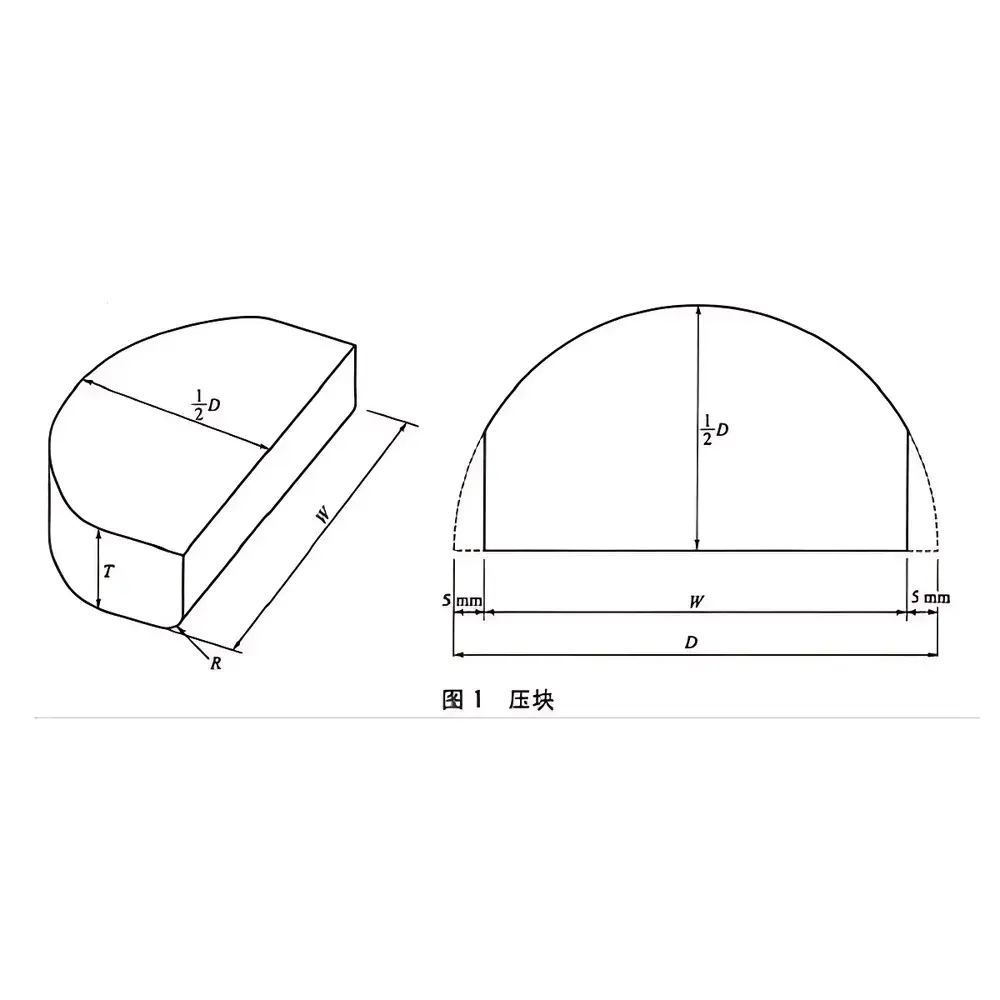
| Dimensions | Three Sizes — Ø80 mm (for shoe length >240 mm), Ø70 mm (200–240 mm), Ø60 mm ( <200 mm) |
| Compliance | Conforms to HG/T 2871–2022 Clause 5.3.4 and Figure 1 / Table 1 |
| Manufacturing | Molded-in-one-piece, odorless, domestically produced in Tianjin, China |
| Package | 12 pieces per set (4 of each size) |
Overview
The NYX HG/T 2871 Standard Rubber Compression Block Set is a precision-engineered mechanical fixture designed exclusively for use with footwear flexing testers operating under the Chinese industrial standard HG/T 2871–2022, specifically Method B for whole-shoe flex resistance testing. These blocks serve a critical functional role: they apply consistent, localized compressive force to the forefoot region of test specimens during cyclic bending, ensuring standardized contact geometry and load distribution across repeated flex cycles. Unlike generic elastomeric pads, these blocks are dimensionally and materially specified to meet the metrological requirements outlined in Clause 5.3.4 of HG/T 2871–2022—including geometric tolerance, Shore A hardness (≥75), material purity (odorless silicone rubber), and monolithic molding integrity. Their design eliminates variability introduced by compression set, surface deformation, or dimensional drift—key contributors to inter-laboratory reproducibility loss in shoe durability assessment.
Key Features
- Three calibrated diameters (Ø60 mm, Ø70 mm, Ø80 mm) precisely matched to shoe length ranges defined in HG/T 2871–2022 Table 1, enabling traceable specimen alignment and load application.
- Monolithic silicone rubber construction with Shore A hardness ≥75—verified per ISO 7619-1—ensures minimal creep and high elastic recovery over thousands of flex cycles.
- Odorless formulation compliant with GB/T 2912.1 (formaldehyde release) and GB/T 17592 (azo dye restrictions), supporting safe handling in QC laboratories and alignment with textile chemical compliance frameworks.
- Tight-tolerance mold tooling guarantees repeatable curvature and edge profile per HG/T 2871–2022 Figure 1, eliminating manual trimming or post-processing that could compromise surface uniformity.
- Supplied as a complete validation set: 4 identical units per size (12 total), facilitating instrument qualification, routine calibration checks, and replacement scheduling without batch-to-batch performance variance.
Sample Compatibility & Compliance
These compression blocks are validated solely for use with HG/T 2871–2022-compliant footwear flexing testers—particularly those implementing the B-method forefoot clamping configuration. They are compatible with leather, synthetic, knitted, and woven upper materials, provided specimen thickness falls within the 3–12 mm range specified for Method B. The blocks do not require recalibration when used with certified testers meeting JJG (Textile) 027 verification criteria. All units conform to national standard HG/T 2871–2022 and support GLP-aligned test documentation; hardness verification certificates and dimensional inspection reports (per ISO 1101 geometrical tolerancing) are available upon request for audit readiness.
Software & Data Management
While the blocks themselves are passive mechanical components, their use directly impacts data integrity in automated flex testers equipped with cycle counters, angle sensors, and crack-detection cameras. When integrated into systems compliant with GB/T 27025–2019 (equivalent to ISO/IEC 17025), the blocks contribute to measurement uncertainty budgets by minimizing interface-related variables. For laboratories maintaining electronic records under FDA 21 CFR Part 11 or CNAS-CL01 requirements, traceability is supported via unique lot numbering and accompanying CoA (Certificate of Conformance) documenting hardness verification, visual inspection, and dimensional sampling results.
Applications
- Forefoot fixation in whole-shoe flex resistance evaluation per HG/T 2871–2022 Method B.
- Inter-laboratory round-robin studies requiring cross-site comparability of flex life data (crack initiation count, delamination onset).
- Internal QA benchmarking for footwear manufacturers validating upper material bonding strength and lasting durability.
- Calibration verification of clamping force distribution in new or refurbished flex testers prior to ISO 17025 accreditation audits.
- Reference artifacts for training technicians on proper specimen mounting geometry and pressure point alignment.
FAQ
Are these blocks compatible with non-HG/T 2871 testers, such as SATRA TM144 or ISO 5423?
No. Their geometry, hardness, and functional role are defined exclusively for HG/T 2871–2022 Method B. Use in other standards may invalidate test results and breach method compliance.
Can individual blocks be purchased separately, or only in full sets of 12?
Only full sets (12 pieces: 4 × each diameter) are supplied to ensure consistency across calibration, qualification, and operational use—partial sets are not offered.
Is Shore A hardness tested per unit or per production lot?
Hardness is verified on three randomly selected units per lot using a calibrated durometer per ISO 7619-1; full test reports are archived for 5 years.
Do these blocks require periodic re-certification or replacement after a certain number of cycles?
Replacement is recommended after 5,000 flex cycles or upon visible surface deformation, cracking, or hardness deviation exceeding ±3 Shore A units from initial certification.
Does NYX provide installation guidance or mounting torque specifications for the blocks?
Mounting torque is governed by the host tester’s mechanical interface—not the block itself. NYX supplies a mounting alignment guide referencing HG/T 2871–2022 Figure 2 and fastener compatibility notes for common tester models.