
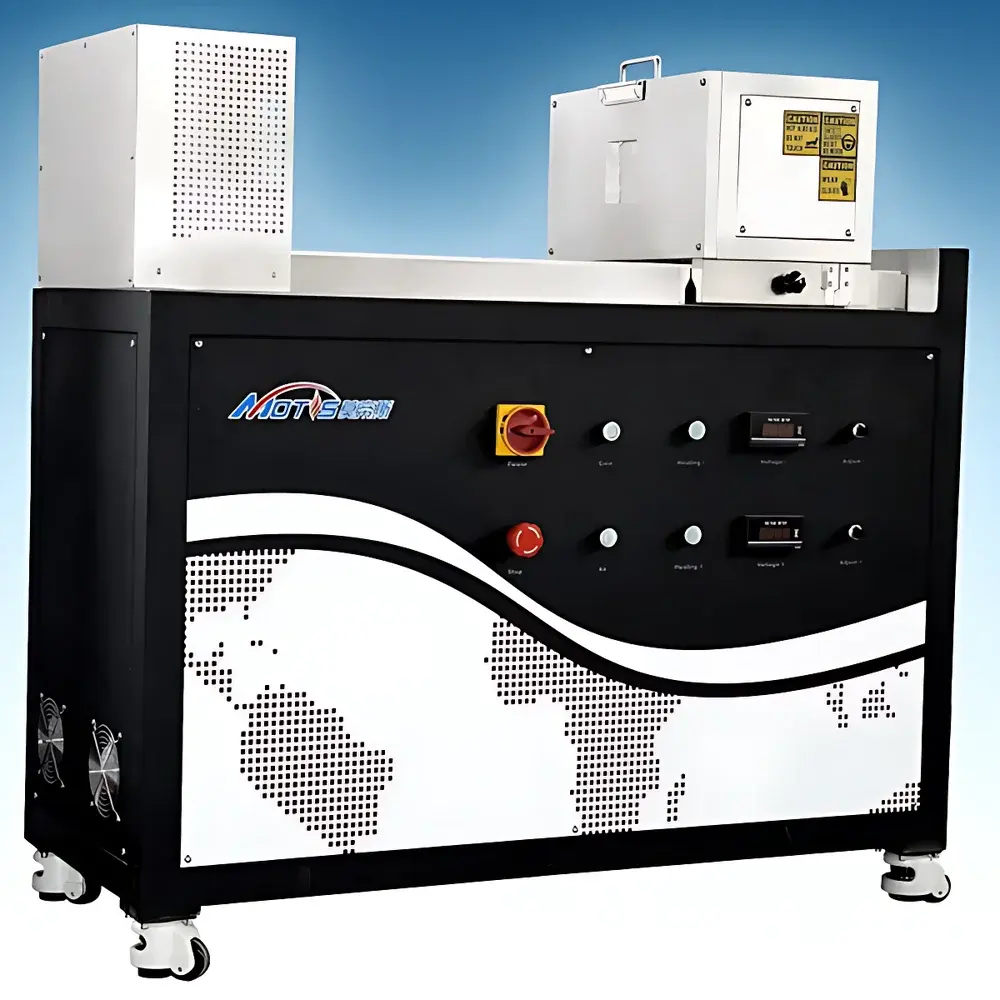
NYX RHP Radiant Heat Protection Tester for Textiles
| Brand | NYX |
|---|---|
| Model | RHP |
| Origin | Tianjin, China |
| Manufacturer | NYX Instrument Co., Ltd. |
| Radiation Source | 6 SiC heating rods (total length 356 ± 2 mm |
| Temperature Control | PID-regulated, accuracy ±1 °C |
| Max Radiation Source Temp | 1200 °C ± 5% |
| Radiant Heat Flux Range | 10–80 kW/m² |
| Heat Flux Sensor | Commercial quartz-window sensor with water cooling, range up to 100 kW/m² |
| Calorimeter | Oxygen-free high-conductivity copper disk calorimeter for backside temperature rise measurement |
| Sample Holders | Dual-configurable fixtures per ISO 6942 Test A and Test B |
| Sample Translation Stage | Motorized XY positioning platform |
| Data Acquisition | 20 Hz sampling rate |
| Software Platform | Windows XP-based control & analysis suite with bilingual (EN/CN) UI, automated test initiation, real-time thermal response logging, and calculation of time-to-12°C/24°C rise, incident heat flux (Q), and heat transfer coefficient (HF) |
Overview
The NYX RHP Radiant Heat Protection Tester is an engineered solution for quantitative evaluation of thermal radiation resistance in personal protective equipment (PPE) textiles—including heat-resistant gloves, flame-retardant coveralls, and protective footwear. It operates on the principle of controlled radiant heat exposure using a calibrated silicon carbide (SiC) heating array, simulating high-intensity infrared radiation environments encountered in industrial fire, foundry, or emergency response scenarios. The system conforms to internationally recognized test methodologies defined in ISO 6942 (Test A and Test B), EN 366, EN 407, ISO 11611, ISO 11612, GA 634:2020 Section 6.1.8, GA 6:2019 Sections 5.11 & 6.11, and GB 38453–2019 Annex B. Optional hardware and calibration protocols support alignment with ASTM F1939 (radiant panel test for flame-resistant fabrics) and ASTM F2702 (radiant heat resistance of firefighter turnout gear components), upon configuration request.
Key Features
- Precision-engineered six-element SiC radiant source with total active length of 356 mm ± 2 mm and independently verified uniformity across the irradiation field;
- PID-controlled thermal regulation ensuring stable source temperature at setpoints up to 1200 °C ± 5%, with real-time feedback loop maintaining ±1 °C accuracy;
- Adjustable radiant heat flux output spanning 10–80 kW/m²—covering the full operational range required for EN 407 Level 1–4 and ISO 11612 Code 1–4 classifications;
- High-fidelity data acquisition system sampling at 20 Hz, enabling resolution of transient thermal events during rapid backside temperature rise;
- Traceable commercial heat flux sensor featuring fused quartz optical window and integrated water-cooling circuit, rated to 100 kW/m² for primary irradiance validation;
- Oxygen-free, high-purity copper disk calorimeter (OFHC Cu) mounted behind specimen plane to measure rear-surface temperature kinetics with minimal thermal inertia;
- Dual-standard sample fixture set compliant with both ISO 6942 Method A (vertical orientation, fixed distance) and Method B (inclined angle, variable gap), facilitating cross-standard comparability;
- Motorized XY translation stage allowing repeatable, operator-independent specimen positioning and multi-point irradiation mapping;
- Integrated Windows XP-based software environment supporting bilingual (English/Chinese) interface, parameter scripting, automatic test sequencing, and post-acquisition derivation of critical metrics: time-to-12°C rise (t12), time-to-24°C rise (t24), incident heat flux (Q), and heat transfer coefficient (HF).
Sample Compatibility & Compliance
The RHP accommodates flat textile specimens up to 150 mm × 150 mm in dimension and thicknesses ranging from 0.5 mm to 25 mm—encompassing multilayer composite garments, laminated insulation systems, and coated technical fabrics. Fixture geometry and mounting force are standardized per ISO 6942 Annex C to minimize edge effects and ensure reproducible contact conditions. All measurement subsystems—including thermocouple placement, sensor calibration intervals, and data logging timestamps—are traceable to national metrological standards. The system architecture supports audit-ready documentation for GLP-compliant laboratories and satisfies instrument qualification requirements under ISO/IEC 17025:2017 Clause 6.4.3 (Equipment Verification). Optional firmware upgrades and accessory kits enable formal verification against ASTM F1939 and ASTM F2702 when deployed in certified testing facilities subject to NIST-traceable calibration schedules.
Software & Data Management
The embedded control software provides full lifecycle test management—from method selection and parameter definition (e.g., target flux, exposure duration, pass/fail thresholds) to real-time graphical monitoring of front-side irradiance and rear-side temperature profiles. Raw time-series data (heat flux, calorimeter temperature, ambient reference) are stored in CSV and binary formats with embedded metadata (operator ID, calibration certificate IDs, environmental conditions). Audit trail functionality logs all user actions—including parameter modifications, manual overrides, and report generation—with timestamped entries compliant with FDA 21 CFR Part 11 principles (when deployed on validated Windows XP SP3 systems with domain-level authentication). Export modules support direct integration with LIMS platforms via ODBC drivers and generate PDF reports containing annotated curves, statistical summaries (mean ± SD of t12/t24 across replicates), and conformance statements per selected standard clauses.
Applications
- Classification of heat-resistant gloves per EN 407 Annex A (Radiant Heat Resistance) and ISO 11612 Code 4 (Radiant Heat);
- Performance validation of structural firefighting turnout gear outer shells and thermal barriers per NFPA 1971 and ISO 11612;
- Comparative evaluation of ceramic fiber, aerogel, and phase-change material (PCM) composites under standardized radiant loading;
- R&D screening of novel intumescent coatings and reflective metallized laminates for aerospace and military PPE;
- Quality assurance testing in ISO 9001-certified textile manufacturing facilities producing arc-flash or flash-fire resistant apparel;
- Third-party certification testing accredited to ISO/IEC 17025 for CE marking submissions under EU PPE Regulation (EU) 2016/425.
FAQ
Does the RHP comply with ISO 6942 Test A and Test B simultaneously?
Yes—the dual-fixture design allows immediate mechanical reconfiguration between vertical (Test A) and inclined (Test B) specimen orientations without recalibration.
Can the system be used for ASTM F1939 testing?
With optional radiant panel alignment jig, calibrated aperture collimator, and revised software protocol, the RHP meets ASTM F1939 geometric and irradiance uniformity requirements; formal validation documentation is provided upon order.
What is the recommended calibration frequency for the heat flux sensor?
Annual recalibration against a NIST-traceable blackbody source is advised; field verification using reference calorimeters is performed before each test series per ISO/IEC 17025 Clause 6.6.
Is Windows XP still supported for regulatory compliance?
Yes—Windows XP Embedded SP3 remains widely accepted in regulated PPE testing labs due to deterministic real-time behavior and long-term validation stability; extended security support is available via air-gapped deployment and application-layer hardening.
How is specimen thickness variation accounted for in thermal resistance calculations?
The software applies standardized correction factors derived from EN 366 Annex D and ISO 11612 Annex E, adjusting HF values based on measured bulk density and nominal thickness input during test setup.



