
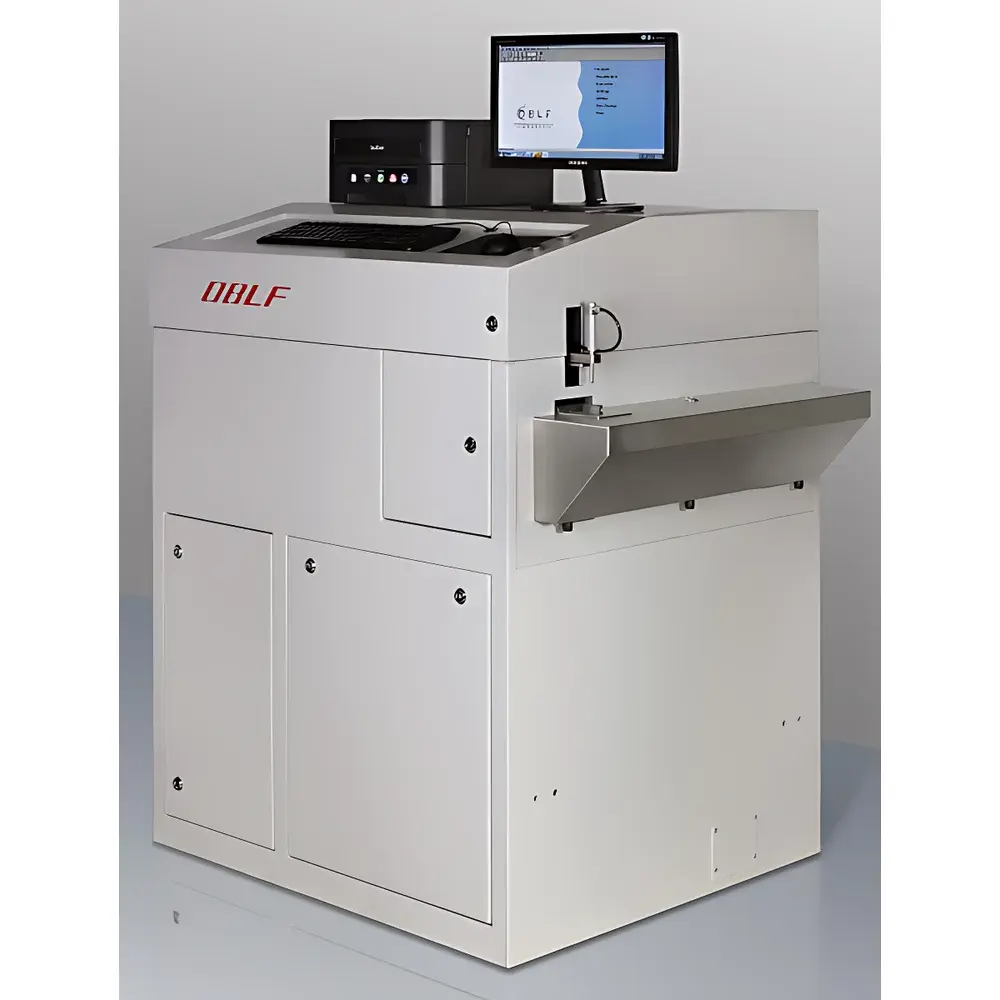
OBLF QSG750-II Vacuum Direct-Reading Optical Emission Spectrometer
| Brand | OBLF |
|---|---|
| Origin | Germany |
| Instrument Type | Floor-Standing |
| Excitation Method | Spark |
| Detector Type | Photomultiplier Tube (PMT) |
| Focal Length | 750 mm |
| Grating Groove Density | 2400 lines/mm |
| Wavelength Range | 120–800 nm |
| Number of Channels | 64 |
Overview
The OBLF QSG750-II is a high-performance floor-standing vacuum direct-reading optical emission spectrometer (OES) engineered for precise, reproducible elemental analysis of metallic alloys in demanding production and quality control environments. Operating on the principle of spark-induced atomic emission spectroscopy, the instrument vaporizes and excites sample surfaces using controlled high-voltage spark discharges; emitted radiation is dispersed by a high-resolution 750 mm focal length Czerny-Turner monochromator equipped with a 2400 lines/mm holographic grating. The resulting spectral lines—spanning the deep UV to near-IR range (120–800 nm)—are simultaneously detected by an array of 64 sealed, low-noise photomultiplier tubes (PMTs). Crucially, the entire optical path—including diffraction grating, mirrors, and PMT detectors—is housed within a continuously evacuated chamber, eliminating atmospheric absorption (especially critical below 190 nm for elements such as C, P, S, and N) and ensuring long-term signal stability.
Key Features
- Vacuum optical system maintained at ≤10⁻³ mbar, enabling reliable quantification of light elements (C, P, S, N, B, As) without spectral interference from O₂ or H₂O vapor.
- Single Spark Pulse Integration (GISS) technology: delivers optimized signal-to-noise ratio by integrating only the most stable portion of each spark discharge, minimizing matrix-dependent drift and enhancing precision for trace and major elements alike.
- Fully automated optical alignment: real-time spectral scanning and peak centering routines verify and correct detector positioning prior to each analysis, ensuring channel-specific wavelength fidelity across instrument lifetime.
- Thermally stabilized vacuum chamber: localized temperature control (±0.1 °C) minimizes thermal expansion effects on optical path length and grating alignment, contributing to exceptional day-to-day and run-to-run reproducibility (RSD < 0.5% for certified reference materials).
- Self-cleaning spark stand with dynamic argon flow: eliminates stagnant gas pockets and reduces argon consumption by up to 40% compared to conventional static purge designs, lowering operational cost without compromising excitation stability or crater homogeneity.
Sample Compatibility & Compliance
The QSG750-II accommodates solid conductive metal samples (e.g., ferrous and non-ferrous alloys, superalloys, aluminum, copper, titanium, and nickel-based grades) with standard diameters of 10–40 mm and thicknesses ≥4 mm. Sample preparation follows ISO 11573 and ASTM E407 guidelines for surface grinding and cleaning. The system supports full compliance with GLP and GMP documentation requirements through audit-trail-enabled software, including electronic signatures per FDA 21 CFR Part 11. All calibration and verification procedures are traceable to NIST SRMs and certified reference materials (CRMs) from BAM, IARM, or JSS standards.
Software & Data Management
Controlled via OBLF’s proprietary WinOIS software suite, the QSG750-II provides intuitive method setup, multi-matrix calibration management, and real-time spectral diagnostics. Software features include automatic inter-element correction (IEC), drift correction using internal reference lines, and statistical process control (SPC) integration for in-line QA/QC reporting. Raw intensity data, background-subtracted net intensities, and calibrated concentration results are stored in secure, timestamped databases with configurable retention policies. Export formats include CSV, XML, and LIMS-compatible ASTM E1382-compliant files.
Applications
- Final product certification of stainless steels, tool steels, and cast irons per ASTM A751, EN 10084, and ISO 4949.
- High-precision analysis of low-alloy and microalloyed steels for carbon equivalency (CEV) and hardenability prediction.
- Quality assurance in aerospace-grade Ti-6Al-4V and Inconel 718 forgings requiring tight tolerances on O, N, and H content.
- Scrap sorting and recycling operations where rapid discrimination between similar alloy families (e.g., 304 vs. 316 stainless) is critical.
- R&D laboratories performing method development for new alloy compositions and validating alternative CRMs.
FAQ
Does the QSG750-II require liquid nitrogen or external chillers for detector cooling?
No. PMTs operate at ambient temperature under vacuum; no active cooling is required.
Can the instrument be upgraded to add additional analytical channels post-purchase?
Yes—hardware channel expansion is supported via optional PMT modules and corresponding optical path modifications, subject to physical slot availability and software licensing.
How frequently must the vacuum pump oil be changed?
With continuous operation, oil change intervals exceed 6,000 hours when using recommended synthetic diffusion pump oil and cold trap maintenance per OBLF Service Bulletin SB-QSG-07.
Is remote diagnostics and software update support available?
Yes—OBLF offers secure, encrypted remote access via dedicated service portal for firmware updates, spectral diagnostics, and preventive maintenance alerts.
What safety certifications does the instrument meet?
Complies with IEC 61010-1 (Safety Requirements for Electrical Equipment), CE marking, and meets electromagnetic compatibility (EMC) requirements per EN 61326-1.




