
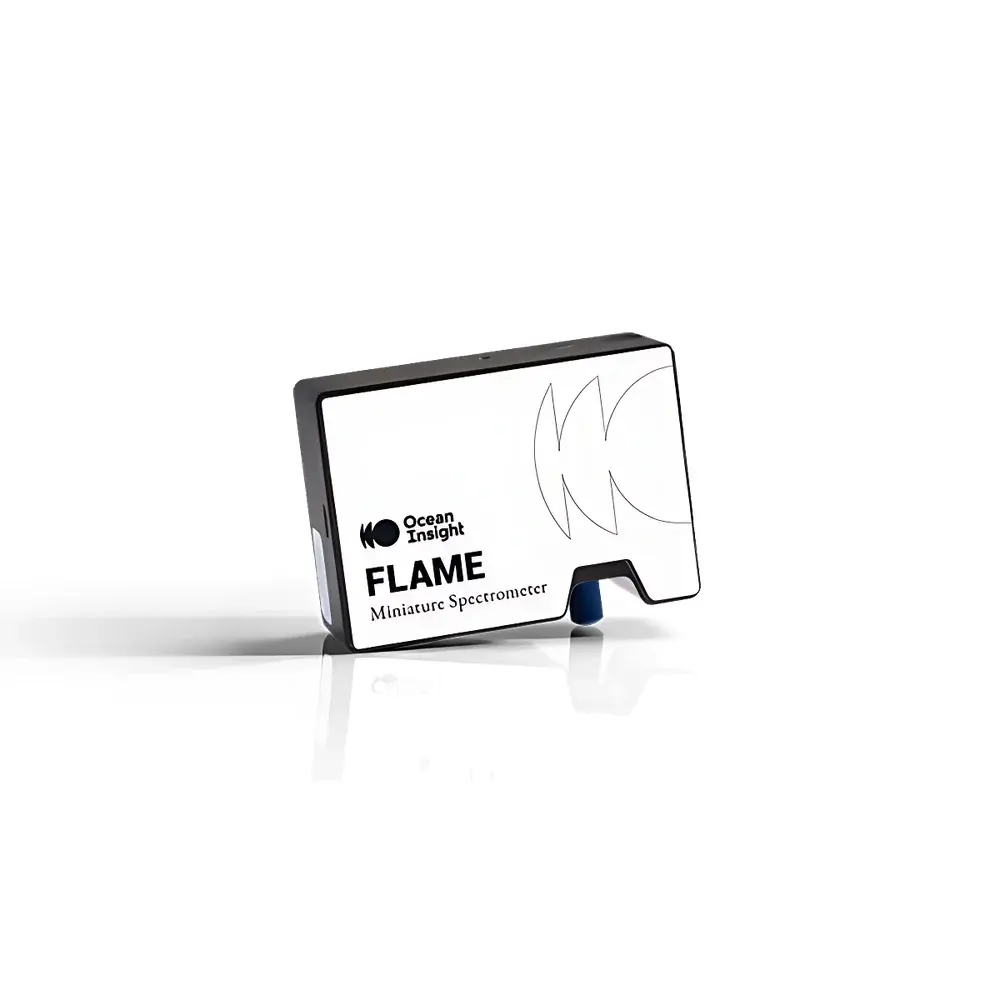
Ocean Insight FLAME-S / FLAME-T Fiber Optic Spectrometer
| Brand | Ocean Insight |
|---|---|
| Origin | USA |
| Model | FLAME-S / FLAME-T |
| Spectral Range | 190–1100 nm |
| Detector Type | CMOS (back-thinned or standard, model-dependent) |
| Optical Resolution (FWHM) | Configurable via slit width and grating selection |
| Sensitivity | Configuration-dependent (e.g., UV-enhanced or NIR-optimized) |
| Signal-to-Noise Ratio | 250:1 (full signal, 10 ms integration) |
| 300 | 1 (with on-chip binning) |
| Dynamic Range | 8.5 × 10⁷ (system, with 16-bit ADC and multi-integration) |
| Stray Light | <0.05% at 600 nm |
| Dimensions | 89.1 × 63.3 × 34.4 mm |
| Weight | 265 g |
| Interface | USB 2.0 (micro-B), no external power required |
| Operating Temperature | 0–40 °C |
| Thermal Drift | <0.03 nm/°C (typical, with onboard thermal stabilization) |
Overview
The Ocean Insight FLAME-S and FLAME-T fiber optic spectrometers represent a generation of compact, high-fidelity analytical instruments engineered for robust spectral acquisition in demanding laboratory, industrial, and field-deployable environments. Built upon a thermally stabilized optical bench and leveraging precision-aligned, automated assembly processes, the FLAME platform minimizes wavelength drift and maximizes inter-unit reproducibility—critical attributes for method transfer, multi-instrument validation, and long-term monitoring applications. These spectrometers operate on the principle of Czerny-Turner optical design, where incoming light is collimated, dispersed by a ruled or holographic grating, and focused onto a linear CMOS detector array. The resulting digital spectrum enables quantitative and qualitative analysis across ultraviolet, visible, and near-infrared regions (190–1100 nm), depending on grating, detector, and order-sorting filter configuration. Unlike legacy OEM modules, FLAME units integrate real-time thermal compensation circuitry and factory-calibrated radiometric and photometric response functions—ensuring traceable, repeatable measurements without post-acquisition correction under typical ambient conditions.
Key Features
- Thermally optimized optical architecture: Onboard temperature sensing and active compensation reduce spectral shift to <0.03 nm/°C, enabling stable operation across uncontrolled lab or portable settings.
- Interchangeable slit module system: Users can replace slits (10–200 µm) in minutes without recalibration, allowing dynamic optimization between resolution (down to ~0.25 nm FWHM) and throughput for diverse sample types.
- Plug-and-play USB 2.0 interface: Powered directly from the host computer via micro-USB; no external power supply or driver installation required on Windows, macOS, or Linux systems.
- Integrated status LEDs: Dual-color indicators provide immediate visual feedback for power state and active data transmission—enhancing troubleshooting efficiency during setup or remote operation.
- Compact and rugged mechanical design: Aluminum housing (89.1 × 63.3 × 34.4 mm, 265 g) meets IEC 60529 IP20 specifications and withstands vibration per MIL-STD-810G (method 514.6, category 2).
- Factory spectral calibration: Each unit ships with NIST-traceable wavelength and intensity calibration coefficients stored in non-volatile memory, supporting compliance with ISO/IEC 17025 and ASTM E275 for spectrophotometric validation.
Sample Compatibility & Compliance
FLAME spectrometers interface seamlessly with Ocean Insight’s ecosystem of fiber-coupled light sources (e.g., PX-2 pulsed xenon, HL-2000 halogen-tungsten), sampling accessories (reflection probes, cuvette holders, integrating spheres), and optical filters. They support liquid, solid, gas-phase, and surface-based measurements—including absorbance, reflectance, fluorescence, and Raman-shifted detection when paired with appropriate excitation sources and edge filters. The platform complies with electromagnetic compatibility standards EN 61326-1:2013 and safety standard UL 61010-1:2012. For regulated environments, FLAME data acquisition workflows—when used with OceanView software v2.3+—support audit trail logging, electronic signatures, and user access control, aligning with FDA 21 CFR Part 11 requirements for GxP laboratories.
Software & Data Management
OceanView desktop software (Windows/macOS/Linux) provides full instrument control, real-time spectral visualization, mathematical processing (baseline correction, peak integration, multivariate regression), and export to CSV, TXT, or HDF5 formats. Application programming interfaces (APIs) are available for Python (via seabreeze), MATLAB, LabVIEW, and C/C++, enabling integration into custom QC protocols or automated manufacturing lines. All spectral data include embedded metadata: timestamp, integration time, detector temperature, calibration ID, and firmware version—facilitating GLP/GMP-compliant record retention and retrospective analysis.
Applications
- UV-Vis-NIR absorbance quantification in pharmaceutical dissolution testing (USP <711>)
- In-line color measurement for paint, textile, and polymer production
- Plasma emission monitoring in semiconductor process chambers
- Fluorescence lifetime screening in bioassay development
- LED and OLED spectral power distribution (SPD) characterization per IES LM-79
- Environmental water quality assessment (nitrate, chlorophyll-a, dissolved organic carbon)
FAQ
What spectral resolution can be achieved with the FLAME series?
Resolution is determined by slit width, grating groove density, and focal length. Typical configurations yield FWHM values between 0.25 nm (10 µm slit + 2400 l/mm grating) and 1.5 nm (200 µm slit + 300 l/mm grating), as verified by Hg-Ne line spectra per ISO 14785.
Is radiometric calibration included with each unit?
Yes—each FLAME spectrometer ships with factory-applied, NIST-traceable irradiance and responsivity calibration, valid for two years under normal use. Optional annual recalibration services are available through Ocean Insight’s ISO/IEC 17025-accredited lab.
Can FLAME spectrometers operate in continuous acquisition mode for kinetic studies?
Yes—acquisition rates up to 1,000 spectra/sec are supported (depending on integration time and USB bandwidth), with hardware triggering and buffer streaming to enable reaction monitoring, pump-probe experiments, and real-time process analytics.
Are firmware updates provided free of charge?
Yes—Ocean Insight releases firmware and software updates publicly via its support portal, including performance enhancements, bug fixes, and new feature rollouts, with full backward compatibility maintained across FLAME-S and FLAME-T models.
Does the FLAME platform support synchronization with external devices?
Yes—TTL-compatible trigger input/output ports allow precise temporal alignment with lasers, shutters, or motion stages, satisfying timing-critical applications such as time-resolved spectroscopy or synchronized multi-sensor arrays.




