
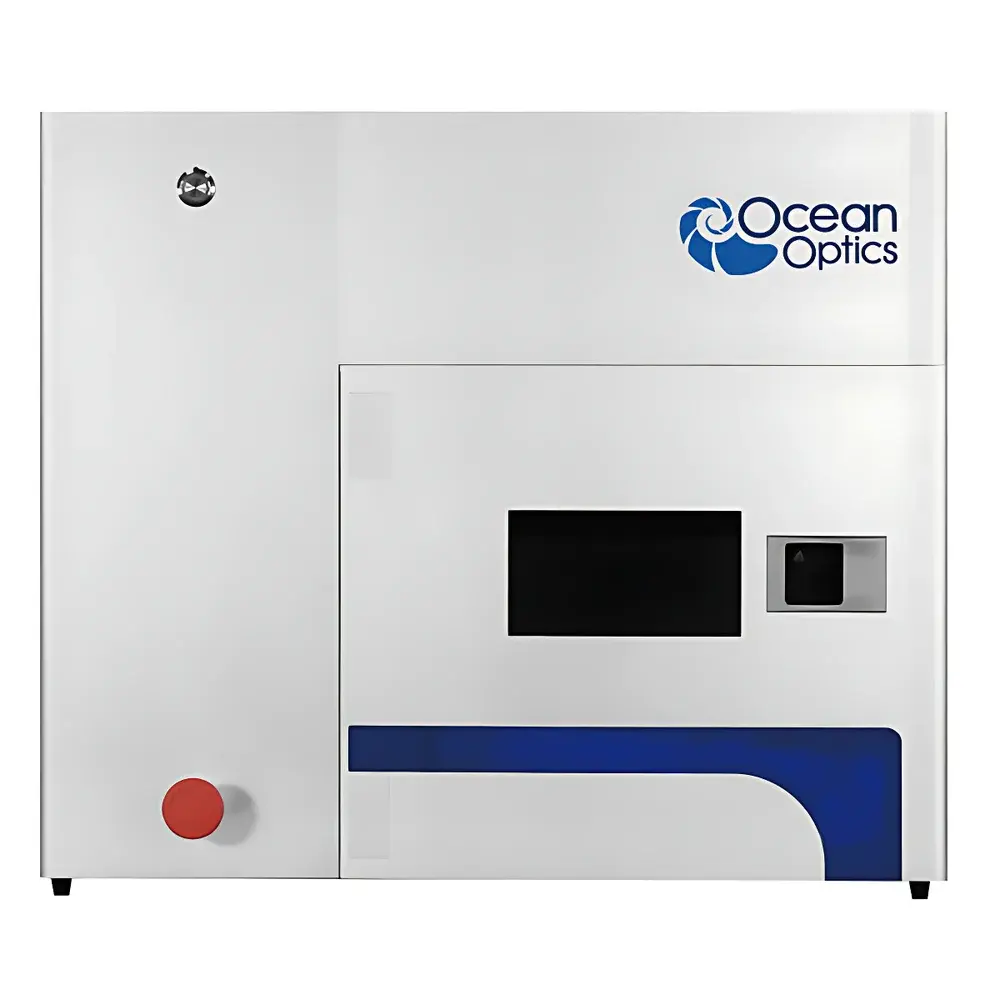
Ocean Optics ACCULIBS 2500 Benchtop Laser-Induced Breakdown Spectroscopy (LIBS) System
| Brand | Ocean Optics |
|---|---|
| Origin | USA |
| Model | ACCULIBS 2500 |
| Instrument Type | Benchtop |
| Integration | Fully Integrated |
| Laser Wavelength | 1064 nm |
| Translation Stage Range | 50 × 50 × 20 mm |
| Positioning Accuracy | ≥1 μm |
| Wavelength Coverage | 180–1037 nm (configurable) |
| Optical Resolution | 0.1 nm (FWHM) |
| Minimum Integration Time | 1 ms |
| Trigger Jitter | ±10 ns |
| Trigger Delay Range | ±450 μs |
| Spectral Channels | 1–8 |
| Gas Control | Solenoid-Valve Actuated Enclosure |
| Imaging | Optional 2× or 5× magnification, fixed-focus optical path |
Overview
The Ocean Optics ACCULIBS 2500 is a fully integrated, benchtop Laser-Induced Breakdown Spectroscopy (LIBS) system engineered for quantitative and semi-quantitative multi-element analysis of solid samples in laboratory and field-deployable environments. Operating on the fundamental principle of laser ablation—where a high-energy pulsed Nd:YAG laser (1064 nm) generates a transient microplasma on the sample surface—the system captures the resulting atomic and ionic emission spectra across an extended spectral range (180–1037 nm). This enables simultaneous detection of elements from hydrogen (Z = 1) through heavy metals, including light elements (Z ≤ 12) that are often challenging for XRF or conventional EDX. The ACCULIBS 2500 is not a modular assembly but a purpose-built platform incorporating synchronized laser triggering, high-fidelity spectral acquisition, motorized 3-axis positioning, real-time imaging, and controlled atmosphere management—all governed by deterministic timing with <±10 ns trigger jitter and sub-microsecond stage positioning repeatability.
Key Features
- ODSS (Ocean Dynamoelectric Sampling Stage): Proprietary integrated motion and environmental control subsystem comprising a precision 3-axis translation stage (standard 50 × 50 × 20 mm travel; customizable up to 100 mm), solenoid-valve gas enclosure, and fixed-focus imaging module.
- Stable dual-path optical architecture: Separated laser delivery and spectral collection paths minimize alignment drift; no manual collimation or refocusing required during operation.
- Configurable spectral detection: Supports 1–8 parallel spectrometer channels with selectable grating and detector options; standard resolution of 0.1 nm (FWHM) across the full UV-VIS-NIR range.
- Real-time visual guidance: Integrated high-resolution camera with 2× or 5× optical magnification provides direct sample visualization—enabling precise plasma targeting without iterative focusing procedures.
- Tight temporal synchronization: Hardware-level triggering supports programmable delay (±450 μs) and minimal jitter (±10 ns), ensuring reproducible plasma sampling relative to laser pulse onset.
- Robust environmental control: Gas enclosure supports inert atmosphere (e.g., Ar, He) or vacuum conditions, enhancing signal-to-background ratio for low-Z elements and suppressing oxide formation during ablation.
Sample Compatibility & Compliance
The ACCULIBS 2500 accommodates heterogeneous solid matrices—including metals, alloys, geological specimens, polymers, ceramics, pigments, and biological tissues—without requiring conductive coating or vacuum chamber loading. Its ability to perform depth profiling (via sequential layer ablation) and lateral mapping (via automated raster scanning) supports ASTM E2926-23 (Standard Test Method for Determination of Elements in Solid Samples by LIBS) and aligns with ISO/IEC 17025 requirements for method validation in accredited testing laboratories. While not pre-certified for FDA 21 CFR Part 11, the software architecture supports audit-trail logging, user-access controls, and electronic signature implementation—facilitating GLP/GMP-compliant deployment in regulated QC/QA workflows.
Software & Data Management
ACCULIBS Control Suite is a native Windows application providing unified control of hardware subsystems and spectral data processing. Core modules include: (1) Stage Navigator for coordinate-based sample positioning and auto-focus-assisted targeting; (2) Spectral Acquisition Engine supporting gated integration, multi-channel synchronization, and metadata-tagged raw spectrum storage (HDF5 format); (3) Elemental Analysis Module with embedded NIST-based emission line database (wavelengths, intensities, transition probabilities), enabling both single-line quantification and multivariate calibration (PLS, PCA). All spectral acquisitions are timestamped, georeferenced to stage coordinates, and exportable in CSV, TXT, or vendor-neutral JCAMP-DX formats—ensuring interoperability with third-party chemometric tools such as MATLAB, Python (scikit-learn), or Unscrambler.
Applications
- Environmental monitoring: Rapid screening of soil heavy metals (Pb, Cd, As, Cr), industrial slag composition, and airborne particulate matter collected on filters.
- Materials science: Inclusion analysis in steel, alloy grade verification, coal ash composition, polymer filler identification, and thin-film layer characterization.
- Cultural heritage science: Non-invasive pigment stratigraphy in paintings, provenance determination of ceramics and gemstones, and corrosion product mapping on archaeological metal artifacts.
- Geosciences: Field-portable mineral identification, rare earth element (REE) distribution mapping in rock sections, and volcanic glass compositional profiling.
- Quality assurance: Incoming raw material verification, weld seam homogeneity assessment, and coating thickness estimation via depth-resolved LIBS.
FAQ
Does the ACCULIBS 2500 require external vacuum pumps or chiller units?
No. The gas enclosure operates via solenoid valves and compressed gas cylinders; optional vacuum mode uses a compact diaphragm pump (not included). No active cooling is needed—the laser and spectrometers are air-cooled and thermally stabilized.
Can I perform calibration-free qualitative analysis?
Yes. The built-in NIST line database supports rapid elemental identification using peak matching algorithms; no standards are required for presence/absence screening.
Is depth profiling supported out-of-the-box?
Yes. The software includes a “Layer Stack” acquisition mode that automates sequential ablation at defined Z-intervals, with automatic spectral registration and depth-correlated data export.
What spectral resolution options are available beyond the standard 0.1 nm?
Higher resolution configurations (e.g., 0.05 nm FWHM) are available via custom grating selection; trade-offs between resolution, throughput, and spectral coverage are evaluated during system configuration.
How is data integrity ensured during long-duration mapping runs?
Each spectrum is embedded with hardware timestamps, stage coordinates, laser energy logs, and environmental status flags; checksummed HDF5 containers prevent corruption during multi-hour acquisitions.






