
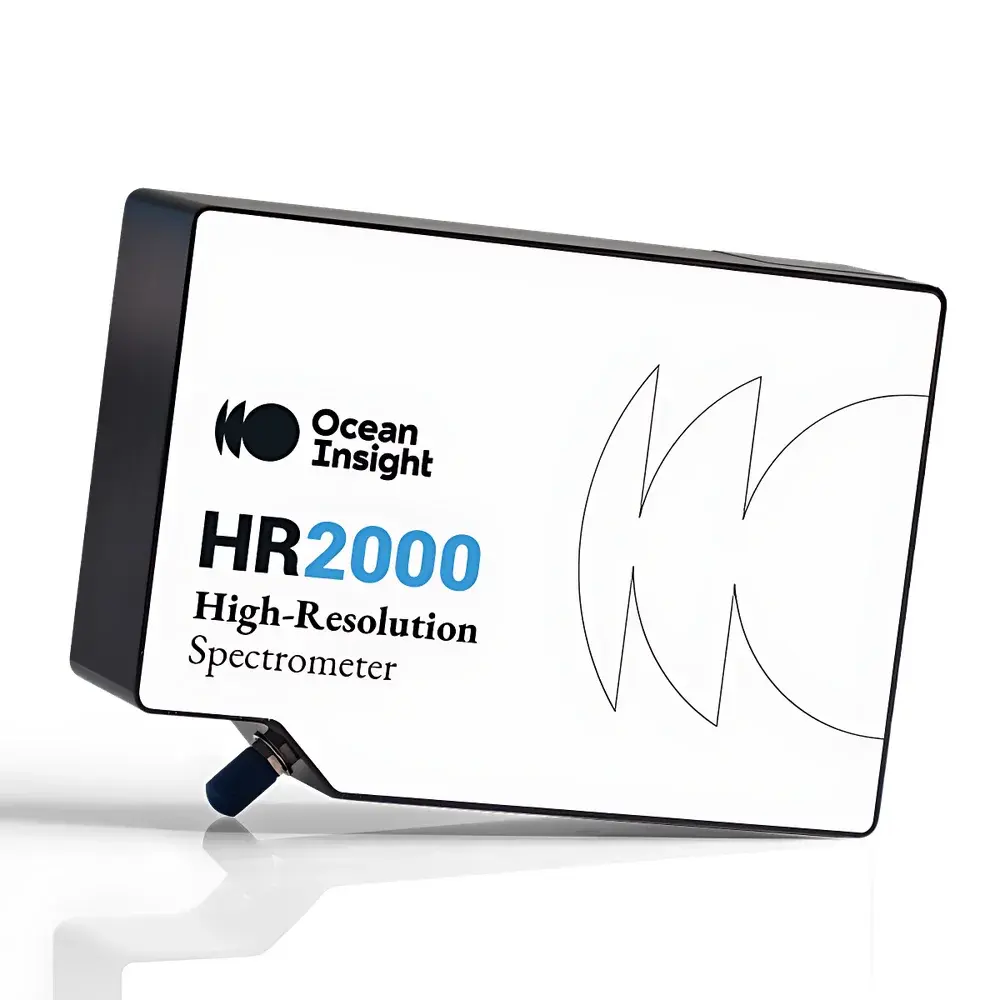
Ocean Optics HR2000+ High-Resolution Fiber Optic Spectrometer
| Brand | Ocean Optics |
|---|---|
| Origin | Shanghai, China |
| Model | HR2000+ |
| Spectral Range | 200–1100 nm |
| Detector | Sony ILX511B linear CCD array (2048 pixels) |
| Optical Resolution (FWHM) | 0.035–6.8 nm |
| Sensitivity | 75 photons/count @ 400 nm |
| Signal-to-Noise Ratio | 250:1 (full signal) |
| Dynamic Range | 2 × 10⁸ (system) |
| 1300 | 1 (single acquisition) |
| Stray Light | <0.05% @ 600 nm |
| A/D Resolution | 14-bit |
| Integration Time | 1 ms – 65 s |
| Slit Options | 5, 10, 25, 50, 100, or 200 µm |
| Grating Options | 14 UV–NIR gratings including HC-1 for enhanced UV throughput |
| Optical Design | f/4 symmetrical crossed Czerny-Turner (101.6 mm focal length) |
| Interface | USB 2.0 (480 Mbps), RS-232 (115.2 kbaud), or Ethernet via Remora adapter |
| Trigger Modes | 4 hardware/software-selectable modes |
| Digital I/O | 10 programmable GPIO pins |
| Analog I/O | 1 × 13-bit input, 1 × 9-bit output |
| Dimensions | 148.6 × 104.8 × 45.1 mm |
| Weight | 570 g |
Overview
The Ocean Optics HR2000+ is a compact, high-resolution fiber optic spectrometer engineered for precision spectral analysis in research, industrial process monitoring, and quality control environments. Based on a symmetrical crossed Czerny-Turner optical architecture with a 101.6 mm focal length and f/4 beam geometry, the HR2000+ delivers exceptional wavelength fidelity and optical throughput across the 200–1100 nm range. Its core detector — the Sony ILX511B linear CCD array (2048 pixels, 14 µm × 200 µm pixel size) — provides high quantum efficiency and low dark noise (12 RMS counts), enabling reliable detection of weak signals in demanding applications such as laser characterization, atomic emission spectroscopy, and rapid kinetic studies. The instrument achieves configurable optical resolution from 0.035 nm to 6.8 nm (FWHM), determined by user-selected slit width, grating, and optical path optimization — making it suitable for both narrow-line source analysis (e.g., He-Ne lasers, mercury lamp lines) and broader spectral profiling.
Key Features
- High-speed spectral acquisition: Up to 1,000 full-spectrum scans per second at 1 ms integration time, enabled by an onboard 2 MHz A/D converter and optimized USB 2.0 data pipeline (1 ms transfer latency).
- Programmable microcontroller: Integrated 30-pin interface supports real-time synchronization with external devices, including TTL-triggered light sources, shutters, or data acquisition systems.
- Flexible I/O architecture: 10 digital GPIOs, one 13-bit analog input, one 9-bit analog output, and a built-in signal generator for precise external triggering and feedback control.
- Modular optical platform: Fully customizable configuration via interchangeable slits (5–200 µm), 14 grating options (including UV-enhanced HC-1), OFLV broadband filters (200–1100 nm), and optional UV2 quartz windows.
- Network-ready operation: Compatible with the Remora Network Adapter for Ethernet/Wi-Fi connectivity, supporting remote spectral acquisition, multi-user access, and browser-based monitoring via standard HTTP interfaces — compliant with lab network security policies.
- Robust software integration: Native support for Ocean Insight’s SpectraSuite software (Windows, macOS, Linux), offering real-time visualization, calibration management, batch processing, and export to CSV, XML, or HDF5 formats.
Sample Compatibility & Compliance
The HR2000+ accommodates diverse sample types through standardized SMA905 fiber coupling (0.22 NA), enabling seamless integration with reflection probes, immersion probes, flow cells, gas cells, and LIBS sampling chambers. When configured with appropriate accessories — such as the LIBS-SC chamber, LIBS-IM-USB imaging module, and LIBS2500plus controller — the HR2000+ can be upgraded to a single-channel Laser-Induced Breakdown Spectroscopy (LIBS) system (LIBS2500-1PLUS), meeting ASTM E2725 and ISO 17294-2 requirements for elemental analysis in solid, liquid, and aerosol matrices. Its optical design and calibration traceability align with NIST-traceable standards, and SpectraSuite supports audit trails, electronic signatures, and data integrity features compliant with FDA 21 CFR Part 11 and GLP/GMP workflows when deployed in regulated laboratories.
Software & Data Management
SpectraSuite provides comprehensive control, calibration, and analysis capabilities — including wavelength calibration using Hg/Ar or Ne lamps, intensity correction via radiometric calibration kits, and advanced peak-fitting algorithms (Gaussian, Lorentzian, Voigt). All spectral data are stored with embedded metadata (timestamp, integration time, slit width, grating ID, calibration coefficients), ensuring full experimental reproducibility. For automated deployment, the HR2000+ supports scripting via COM/ActiveX (Windows), Python SDK (oceanoptics.github.io), and LabVIEW drivers. Data export formats comply with FAIR principles (Findable, Accessible, Interoperable, Reusable), facilitating integration into LIMS, ELN, or MATLAB-based modeling pipelines. Firmware updates and configuration backups are managed directly through SpectraSuite, with version-controlled firmware archives maintained per instrument serial number.
Applications
- Laser and LED spectral characterization (center wavelength, FWHM, side-mode suppression ratio)
- Gas-phase absorption and emission monitoring (O₂, NO, NH₃, CH₄) using tunable diode laser absorption spectroscopy (TDLAS) setups
- Atomic line identification and quantification in flame or plasma emission spectroscopy
- Rapid kinetic measurements in protein folding, enzyme kinetics, and photochemical reactions
- Colorimetry and reflectance measurement in pigment, coating, and display manufacturing
- UV-Vis-NIR absorbance and transmittance analysis in pharmaceutical dissolution testing and chemical reaction monitoring
- Field-deployable LIBS for elemental mapping in geology, metallurgy, and environmental forensics
FAQ
What spectral resolution can be achieved with the HR2000+?
Optical resolution is application-dependent and ranges from ~0.035 nm to 6.8 nm FWHM, determined by selected slit width, grating groove density, and focal plane geometry. Typical configurations include 0.09 nm (25 µm slit + 2400 l/mm grating) or 1.2 nm (100 µm slit + 600 l/mm grating).
Is the HR2000+ compatible with regulatory-compliant data handling?
Yes — when used with SpectraSuite in audit mode and paired with validated calibration procedures, the system supports 21 CFR Part 11 compliance through electronic signatures, secure user authentication, and immutable audit logs.
Can the HR2000+ operate without a PC connection?
No — the HR2000+ requires host control for initialization, spectrum readout, and configuration. However, its programmable microcontroller enables autonomous triggering and synchronization with external hardware during acquisition.
How is stray light performance verified?
Stray light is measured per ISO 17123-7 using a monochromator-based reference method, reporting values of <0.05% at 600 nm and <0.10% at 435 nm — critical for accurate quantitation in overlapping spectral regions.
What is the maximum usable integration time before saturation?
While the datasheet specifies up to 65 seconds, practical upper limits depend on illumination intensity and slit/grating selection. In most high-sensitivity configurations, 20 seconds represents the typical maximum before pixel well depth (~62,500 e⁻) is approached.





